Some traditions in golf are more malleable than others. Certain fundamentals within the sport have recently been tested, particularly during the post-COVID boom and the wave of newcomers to the game.
Some were rightfully challenged and resulted in progress, such as non-gender-specific tees, flag-in putting and the rise of golf simulators. Others less so, like the scourge of poorly raked bunkers and anywhere still enforcing rigid dress codes or allowing 54-handicappers to win club competitions.
RELATED: Staffing crisis hits Australian golf courses harder than any other turf sector, new survey reveals
One of the tenets where the slightest crack is beginning to appear is the concept of golf being 18 holes.
It’s always been an arbitrary number anyway. Golf at St Andrews began as 22 holes before 1764 when the Old Course was condensed to the 18 holes that endure to this day. (Imagine how the game would be different – think championship results, the duration of rounds – had that 22 figure stuck.)
We’ve become far too wedded to the notion of 18 holes constituting a round of golf, yet there’s been a reluctance among golf-course architects to break from the norm. Or, perhaps more accurately, for their clients to consider anything less than 18.
Talk to any course architect and they are often quick to declare that they prefer not to aim for a set par figure when designing a course and instead leave that up to ‘what the land gives them’. Whether that results in a par-70, 71 or 72 layout (or higher) is incidental.
Why, then, shouldn’t the case be the same for the number of holes on a course? And why design a mediocre 18 when there’s a chance for greater quality across fewer holes?
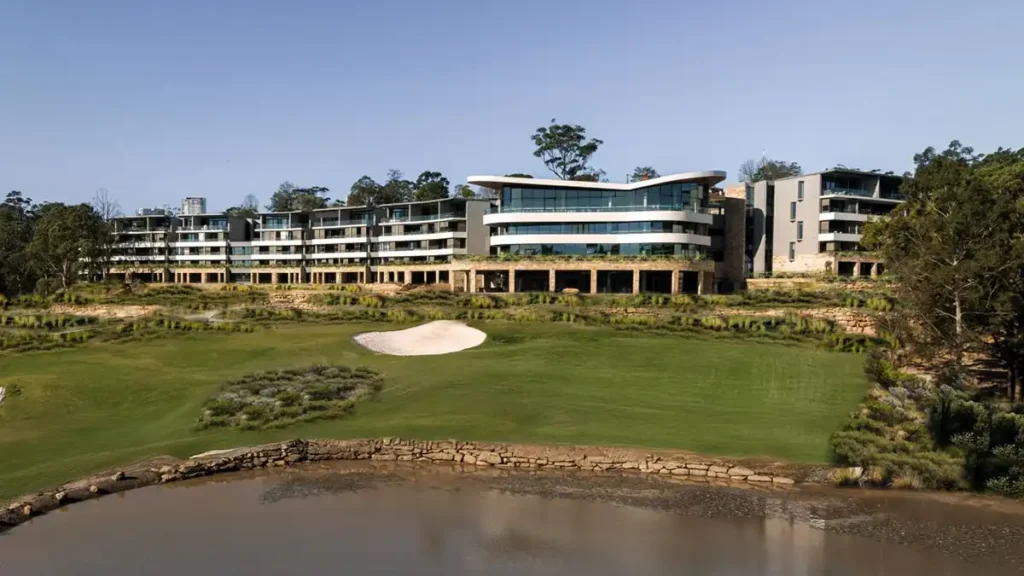
Sydney’s Chatswood Golf Club [pictured] is the first Australian course to break from the norm. Formerly an 18-holer where par 3s dominated and fairways were hemmed into tight playing corridors, the club opted to take a different path.
As part of a broader redevelopment that saw the club partner with property developer Pariter and Watermark Living to add a residential component to the site and build a multi-storey clubhouse precinct, the entity now branded as Newgreens Chatswood also enlisted course architect Neil Crafter to redesign its golf course into a 12-holer. Crafter turned the lacklustre former par-65 layout of 4,372 metres into a fresh 12-hole, par-44 course that measures 2,871 metres.
RELATED: What rising renovation costs mean for your golf course
The course re-opened in May, and your correspondent played the 12 holes in late August on a perfect winter afternoon. Playing in a two-ball, the round took a comfortable two hours and 50 minutes despite a larger, slower group ahead failing to call us through.
It was an eye-opening experience in several ways. Yes, the speed of a round was one immediate takeaway, although slightly less than three hours is to be expected via the maths alone. Perhaps more nuanced was the way touring 12 holes 1) didn’t consume so much of the day, and 2) didn’t leave us feeling nearly as tired afterwards.
Playing 12 holes might not feel that much different from a nine-hole game, but there remain subtle discoveries that are individual to each golfer.
“I discovered that I really enjoyed helping people adopt change. And I think going down this project was a reflection of that,” Chatswood Golf Club president Alan Hall-Watson told Rohan Clarke in Australian Golf Digest’s September issue. “Once our members heard that it was a 12-hole golf course, they said, ‘Forget it. We’re out of here. Golf’s 18 holes.’ But we’ve got so many people now supporting it.”
A few areas need tidying up should playing fewer than 18 holes become more prevalent. Foremost is handicapping competition rounds. As things stand, that’s not as straightforward at Chatswood as simply applying two-thirds of a golfer’s handicap. More mathematical input will be required there.
Second is managing the desires of those players who still wish to play 18 holes. At a 12-holer like Chatswood, it’s not as simple as continuing over to the first tee as you’ll run into groups starting out. So the club simply books a second tee-time, although unless such groups want to play 24 holes, it does place them in the furthest reaches of the course if they cut their second lap after six holes.
These are problems with easy remedies. The big picture here is that the traditional mould has been broken.
RELATED: Moore Park Golf Course to be cut to 12 holes from July
Where might 12-hole golf (or eight holes, six holes – pick your figure) fare best? Suburban clubs where space is cramped. (There’s also a school of thought that says the revamped Sandy Links course in Melbourne would have been better with fewer than the 18 holes it contains today.) Rural clubs where space is ample but maintenance costs for 18 are challenging and/or demand is lower. Clubs in financial difficulty with attractive peripheral land available to be sold.
“On the basis of what was achieved at Chatswood on a pretty limited site, 12 holes has been a perfect design solution,” Crafter says after his experience redesigning the layout.
Crucially, what is helping legitimise the concept is that Clublinks, which manages Newgreens Chatswood, views 12 holes as an entire round. Crafter says golf clubs and courses are “numerically too hung up” when it comes to total course par and the number of holes, so the outcome at Chatswood is encouraging for the future.
“It’s a case-by-case thing, but the Chatswood experience shows what is possible,” he says. “It’s not the panacea to all ills, but it’s a valid option in certain cases.”
Mike Clayton is another architect who says sub-18 holes should be more common, especially where the land doesn’t genuinely allow the full complement.
“Building 18 holes in a space where only 12 fit properly doesn’t make much sense,” says Clayton, who is part of the design team reducing Moore Park to 12 holes. “And Sydney is full of courses that have more holes than really fit.”
For so long, 12-hole golf was a concept alone. Much like nervous swimmers looking up and down the starting blocks, no one was prepared to be the first to dive into uncertain waters. Now that Chatswood has, it remains to be seen who takes the leap next.