The job of architecture editor for Golf Digest takes me to golf courses around the world, and I’ve become convinced the most fundamental difference between high-end private and affordable public golf is not expensive clubhouses, service or amenities but turf conditions. Not deep-green colour and lush grass but rather uniformly tight and dry playing surfaces that promote ideal club-ball-turf contact and greens that roll true regard-less of speed. It’s a standard not usually possible at affordable public courses, but the good news is that advances in agronomy and science, coupled with certain design innovations, can help.
More fairway, fewer trees
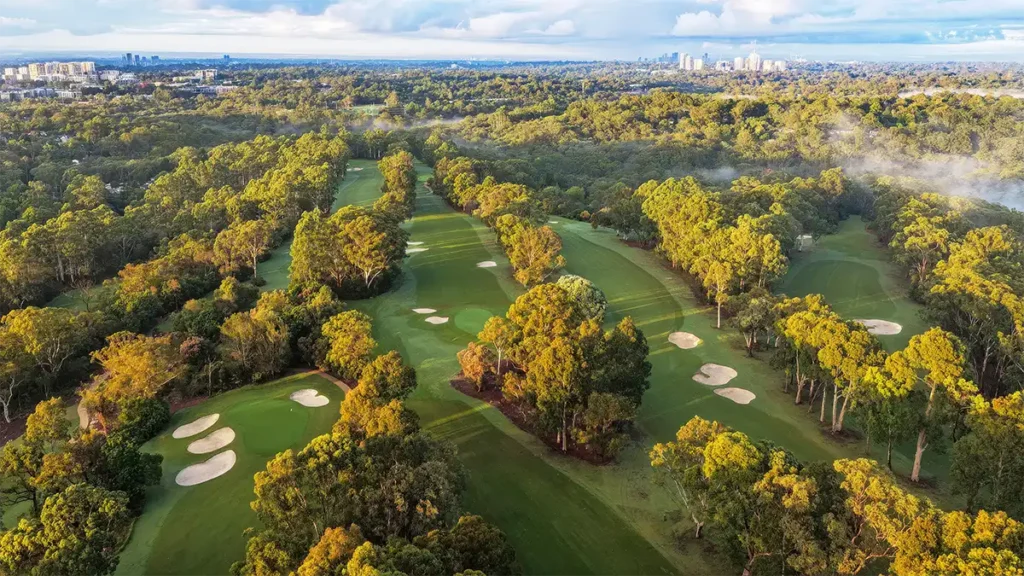
For the past 25 years, almost every high-end private club has improved agronomic conditions through tree clearing. This doesn’t mean total clear-cutting the way Oakmont famously did, but the first and easiest step public courses can take towards better turf is to remove trees that block needed sunlight and sap water and nutrients. This has the benefit of allowing fairways and green surrounds to expand, meaning more playing space and therefore more strategic options, plus a greater dispersion of traffic that’s essential to reducing stress on the grass.
Turf 2.0
Course conditions are dependent on climate, grass and soil type, moisture, seasons and treatments – there’s no one-size prescription for great turf. But a version of firm-and-fast turf, found across the Melbourne Sandbelt, at Barnbougle Dunes and many other Top 100 Courses, is increasingly achievable for public courses as more durable turfs are developed.
“There’s so much time and effort being put into genetically engineering new varie-ties of grass,” says Bob Wolverton, director of agronomy at The Fall Line, US Golf Digest’s winner for the Best New Private Course in America for 2025. “You can have a new strain out in five years where before you had to wait 20.” New strains bred for tighter turf or heat and drought tolerance will help public courses approximate the dry, tight playing surfaces that define the best private clubs.
Fewer bunkers can help
Rain washouts, soil contamination, weeds and labour-intensive edging make bunkers the most expensive line item on construction and superintendent budgets. Future public designs might experiment with more maintainable berms, depressions, ditches, native plants and undulating ground contour to provide alternative strategic defence and recov-eries. An intriguing model is Sheep Ranch at Bandon Dunes, where Bill Coore and Ben Crenshaw carved out bunker cavities planted with fescues. Lies in these types of hazards are random yet more playable than sand, a boon for pace of play, and the saved costs can be reallocated into improving turf in other areas.
A.I. (Artificial Installations)
Tees on public courses are often more dirt than grass. Installing synthetic turf tees would permanently remediate this. Connor Daugherty, an associate for Jackson Kahn Design who recently oversaw construction of an all-synthetic-turf, 19-hole, par-3 course in Oregon, sees the benefit of converting tees: “Turf tees are a viable long-term solution. The maintenance is significantly less than grass tees, the ball-striking playability is great, and if nobody is taking divots, your footprint doesn’t have to be as big.”
Walk it off
There’s no getting around that motorised golf carts do damage to turf, wearing out grass at choke points and necessitating the installation and upkeep of intrusive cartpaths. The lightest footprint is that of a walker, and it’s no coincidence that clubs with the most ideal playing surfaces also have strong if not exclusive walking cultures. Public courses that promote walking, including the renting of push buggies, have the best chance of simulating those conditions.
Photos by Gary Lisbon