
Golf clubs across Australia are facing a squeeze that is becoming impossible to ignore. Rising labour costs, tightening budgets and now global instability pushing fuel prices higher have combined to create a perfect storm for course operators.
The latest pressure point is energy. With conflict in Iran sending petrol prices climbing, the cost of running diesel powered mowing fleets has become one of the most volatile and significant line items in a club’s maintenance budget. For an industry already balancing high expectations with limited resources, something has to give.
Or perhaps, something has to change.
Enter a new generation of turf care that is quietly, and increasingly, reshaping how golf courses operate.
Husqvarna’s commercial fleet of autonomous robotic mowers is not just a technological curiosity. It is emerging as a serious solution to one of the game’s biggest modern challenges: how to maintain elite playing conditions while dramatically reducing costs.
According to Husqvarna’s latest industry white paper, the opportunity is significant. “The transition from conventional commercial mowers to robotic mowers has been shown to reduce turf maintenance costs by up to 50 percent,” the report states*. In an environment where every dollar counts, that is not a marginal gain. It is transformative.
The savings come from multiple fronts. Fuel is the most obvious. Traditional mowing fleets are heavily reliant on diesel and petrol, leaving clubs exposed to global price shocks. Robotic mowers, by contrast, are battery powered and eliminate fuel costs during operation entirely.
Maintenance is another major factor. Without engines, belts, and complex mechanical systems to service, the ongoing upkeep is significantly reduced. Add in labour efficiencies and the numbers begin to stack up quickly.
And labour, increasingly, is the crux of the issue.
“Turf management is facing a range of challenges: labour shortages, low wages, climate pressures, and reduced education funding,” says Sporteng senior turf agronomist John Neylan in the report. “These challenges make it increasingly difficult to maintain high quality playing surfaces.”
It is a sentiment echoed across the industry. With fewer skilled workers available and increasing competition from other sectors, many clubs are struggling to maintain full teams. The result is pressure on existing staff and, in some cases, a compromise in course conditioning. This is where automation is not about replacement, but relief.
“Robotic mowers have the potential to ease labour shortages by allowing staff to focus on higher value maintenance tasks,” Neylan adds.
Instead of spending hours on repetitive mowing, greenkeeping teams can redirect their time towards detail work, presentation, and course improvement.
At Oatlands Golf Club in Sydney, the move to robotic mowing has delivered tangible results. As previously reported by Australian Golf Digest, the club embraced the technology not just as a cost-saving measure, but as a way to future-proof its operations. Saving about 60 litres of fuel per week with zero direct emissions, the shift is already making a measurable difference to the bottom line. The machines work quietly in the background, often overnight, delivering fresh fairways each morning without disrupting play. The near silent operation is a stark contrast to the noise and interruption of traditional mowing fleets, while also freeing up valuable man hours for detailed work such as trimming around trees.
“As a course superintendent, we need to embrace technology because it’s there to help us with our jobs,” says Oatlands superintendent Dominic Yates. “The CEORA mowers have definitely benefited Oatlands Golf Club. [They provide] better time management and cost savings with reduced fuels, which is a positive step in the direction of sustainability and reducing our carbon footprint.”
But the real benefit lies in consistency. Robotic mowers cut grass more frequently, maintaining a uniform height that is difficult to achieve with traditional methods. The result is denser, healthier turf and a more reliable playing surface, with minimal maintenance required beyond quick, 20-minute blade changes every two to three weeks.
There are agronomic advantages, too. Lighter machines mean significantly reduced soil compaction, while finely mulched clippings are redistributed back into the turf, acting as a natural fertiliser. “Recycling grass clippings is a natural way to return nutrients to the soil, reducing fertiliser needs and improving turf health,” Neylan explains.
Then there is the environmental equation, which is becoming increasingly important for clubs and members alike. Battery powered mowers produce no direct emissions during use and operate with far lower overall carbon impact.
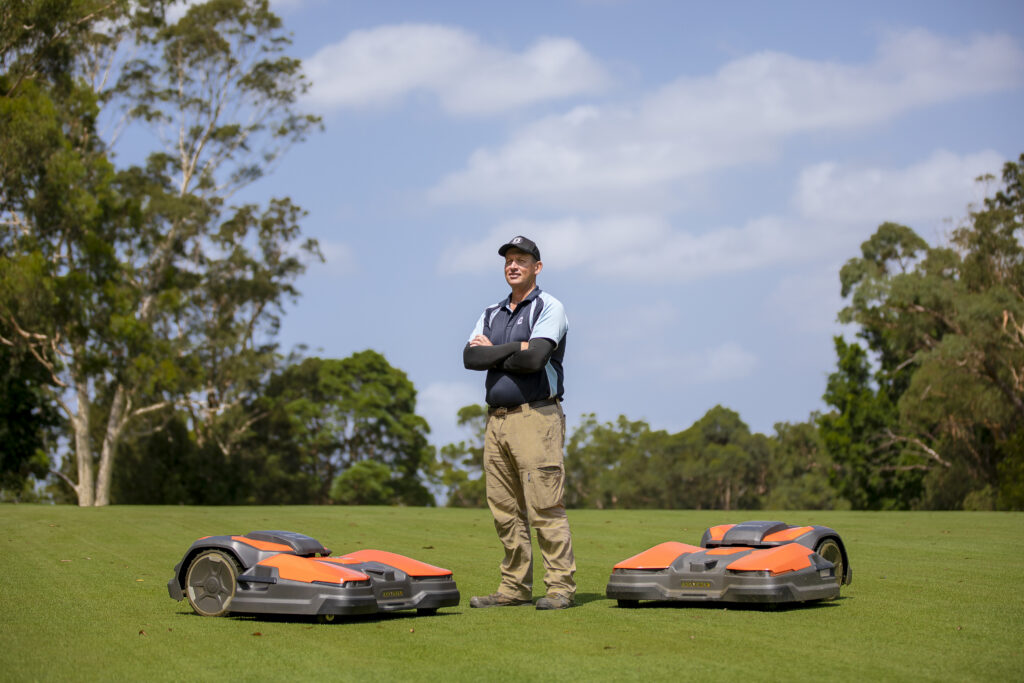
In Husqvarna’s lifecycle analysis, one of its large-scale robotic models delivered an 83 percent reduction in emissions compared to a conventional diesel mower**. For clubs looking to align with sustainability targets, that is a compelling shift.
But perhaps the most persuasive argument remains the simplest one: control. In a world where fuel prices can spike overnight and labour markets remain unpredictable, robotic mowing offers a level of cost certainty that traditional operations simply cannot match. Schedules can be managed remotely via smartphone, mowing can continue in varying conditions, and the reliance on external variables is reduced. For an industry under pressure, that stability is invaluable.
The reality is golf is not getting cheaper to run. Expectations from members remain high, while the cost of delivering those conditions continues to rise. The old model, reliant on fuel heavy machinery and large labour forces, is becoming harder to sustain.
What Husqvarna is offering is not just a new piece of equipment, but a new way of thinking. A quieter way. A smarter way. And in the current climate, a far more economical one. As more clubs like Oatlands make the transition, the question is no longer whether robotic mowing works. It is how long clubs can afford to operate without it.
CEORA IS CALLING!
Husqvarna’s commercial range is purpose-built for large scale environments like golf courses, using satellite-guided virtual boundaries and systematic cutting to deliver consistently high-quality turf across areas of up to 50,000 square metres. Quiet, battery powered and fully autonomous, it allows clubs to maintain pristine fairways while dramatically reducing labour, fuel use and day to day operating costs. Check out the full range at Husqvarna.com
*Based on estimations made by Husqvarna in June 2023 of total cost of ownership of CEORA™ compared with a conventional ride-on-mower, on average over a five-year period. Costs savings will vary depending on many factors such as electricity costs, frequency of use, maintenance, labour costs / reductions and other contributing factors.
**Lifecycle assessment performed by accredited analyst firm Ramboll and reviewed by third party reviewer Research Institute of Sweden (RISE), accessible at husqvarna.com/ceora-lca. CO2 emissions are still generated during other stages of the product’s lifecycle, such as production, charging and end-of-life disposal.