
There is a story about Patrick Reed that has received very little attention, yet which the 2018 Masters champion feels sums him up as a golfer and a person.
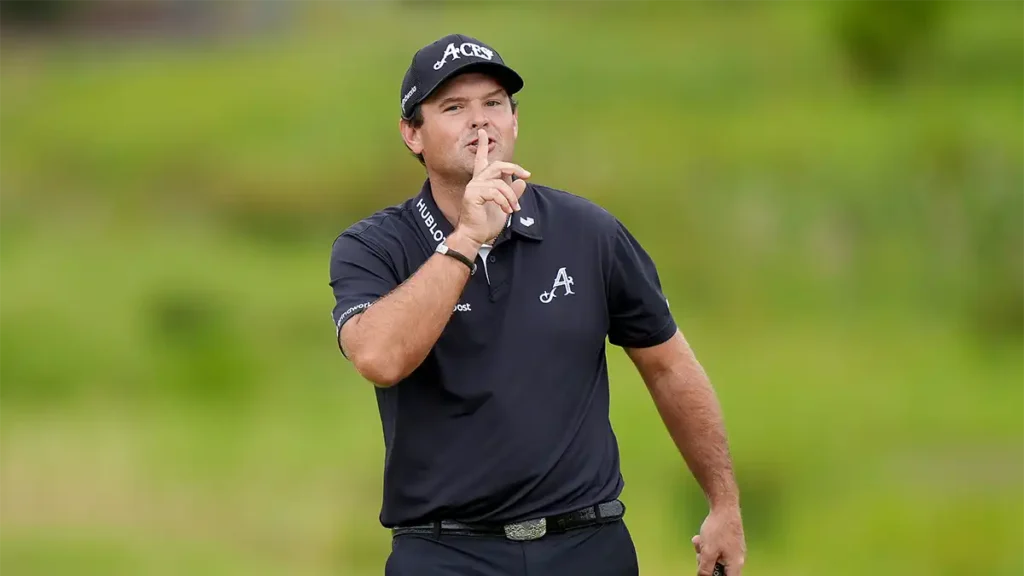
It originated from the 2014 Ryder Cup. You know, the edition in Scotland where Reed ignited the European home crowds at Gleneagles with his first iconic “shoosh” gesture during his singles win over Henrik Stenson. Reed earned the nickname “Captain America” that week due to his US team-high tally of 3.5 points – and his patriotic, passionate play during an otherwise lacklustre week for the Americans as Europe smashed the visitors 16.5 to 11.5.
“I’ll never forget my first Ryder Cup,” Reed tells Australian Golf Digest over the phone from Houston. “Captain [Tom] Watson had a Wounded Warrior [US veteran] come into the team locker room and he gave every one of us a travelling American flag. It was folded. It has lived in every golf bag I have ever used since that moment. Whether I’m playing a golf tournament or practising at home. I will not play a round of golf without it in my golf bag. The amount of heat and rainstorms it has lived through… I can’t imagine what’s inside that thing.”

Reed, a proud Texan, feels that flag represents the real “Captain America”. Something more meaningful than just playing golf on US teams in three Ryder Cups and as many Presidents Cups. It’s a symbol of his appreciation for the military, and how golf is a way of repaying that gratitude.
“My brother-in-law is a veteran; he’s in the military,” adds Reed. “It means so much to me whenever I get that opportunity to go out and play for the USA. Ryder Cups are huge for me, but anytime I can represent my country – Presidents Cup, Olympics – it means so much.”
But the nine-time PGA Tour winner who at times has had a complicated relationship with both the media and golf fans, is disappointed that folded flag story had rarely been reported. A quick Google search indicates that, yes, the only coverage it received was on a local Houston news site and the PGA Tour’s own media channels. Both articles were in 2019. He’s not wrong; it hasn’t been given a lot of airtime.
“I [feel like I’ve told that story] 50,000 times, and I don’t think I’ve ever seen it in an article,” the former world No.6 says.
Why? The answer to that has layers. Make no mistake, despite his occasional controversies, Reed is a likeable guy, one of pro golf’s most prolific global travellers and rather well-spoken. He is among the last members of a generation of old-school shot-shapers and short-game gurus. He plays interesting golf. He plays real golf, if you want to call it that. He doesn’t play bomb and gouge with 310-metre drives. He’s creative. And that’s why he has found a happy hunting ground in Augusta National. More on that in a moment.
The answer, in truth, is that Reed’s narrative got off to a rocky start when, in March 2014, he said in an interview that he was “a top-five player in the world” after his victory at the World Golf Championships event at Miami’s famed Doral course. He was unfairly mocked. No, the comment wasn’t accurate, strictly speaking. And he hadn’t even played in a major before that. But he had won three times on the PGA Tour in seven months. His victory at the brutal Doral course ensured he was the youngest winner of
a WGC event. He was playing like a top five golfer.
“Anytime I’ve done something positive, [the media] always try to bring up the negative stuff to keep me as that villain,” Reed says. “Now, have I helped myself in other situations after that? Probably not, no. But there has been a lot of good and things that kind of show who I really am.”
The US flag being one of them.
Another aspect of the true Reed is the grinder within. At the age of 35, with the comfort of the financial success from being a Masters champion, nine-time PGA Tour winner, DP World Tour honorary life member and now LIV golfer, Reed hasn’t lost his love for the grind. Outside LIV’s 14 events, Reed made 18 starts in tournaments with Official World Golf Rankings points throughout 2025.
On LIV Golf, Reed was consistent with spikes of success, including a win at LIV Golf Dallas. There were also top-10 finishes in Hong Kong, Andalucía and the UK, plus a top-five result in Korea.
Away from LIV, Reed’s third-place finish at the Masters represented his best major result since slipping on the green jacket in 2018. He was, for large stretches on Sunday at Augusta National, a genuine chance to win before a three-putt on the par-5 13th hole. A top-25 result at the US Open contrasted with missed cuts at the PGA Championship and The Open.
On the DP World Tour, Reed remained competitive without threatening dominance. A tie for third at the BMW PGA Championship stood out, complemented by solid mid-pack finishes across Europe, the Middle East and Asia, including Hong Kong, Macau and the Philippines.
“I would say both [LIV and outside LIV] were completely different [seasons], considering the majors,” Reed says. “Augusta was a solid week, finishing third, but the other majors weren’t up to [standard]. My game was not where I really wanted it to be [at the majors], but overall the year on LIV was good. I got off to slower start, scoring-wise, but actual technique-wise and what I was working on in my game, I felt like was really sharp.

“That’s a funny thing about golf. I mean, sometimes you go out there and everything feels really good and technically looks sound and everything. You just don’t quite get the numbers you want. And just after a little bit of a mindset and grind work that I was doing in the beginning of the year, it seemed to pay off and throughout the season.”
Perhaps his form in the majors is reaching another purple patch. Certainly, he seems to be trending at Augusta National. Before the T-3 last year, Reed was T-12 in 2024, T-4 in 2023, and enjoyed two other top 10s at the Masters since winning the green jacket. He seems poised to become a multiple Masters champion – a feat only 18 players have achieved.
“Obviously I want it really bad,” Reed says of the Masters. “The game feels really close. It feels like it’s really there. When I could see what [eventual winner] Rory [McIlroy] and Bryson [DeChambeau] did on 13, I thought, We still have actual shot at winning this golf tournament. Unfortunately it wasn’t meant to be.
“Augusta is one of those special places where you can’t play golf swing, or be a robot. You have to see golf shots, hit golf shots and be creative.”
Reed’s shot-making is a throwback. He is an admirer of old-school golf, of shaping shots both ways, of manipulating trajectories rather than overpowering courses. In an era tilted increasingly towards distance and data, Reed remains among a handful of outliers.
“I think there’s different ways we can do it, but I think we need to have golf back to where we’re being artists playing golf rather than sitting there and just every shot is hitting it as far as we can and – as long as the face is somewhat square – it’s going to still be in play, if not in the fairway. At Augusta, and playing links golf, you still have to play golf even with the technology we have these days.”
That reverence for the game’s past is not theoretical. It lives in his garage.
“My brother-in-law, ‘Kess’ (Kessler Karain), he actually bought me a full set of old hickories and the golf balls from that time period,” Reed says. “I’ve yet to play with them, but I’ve been itching to. The problem is I would have no idea how far any of them go. And I don’t know how I chip. I looked at their so-called sand wedge. There are zero grooves. [The clubface] is flat and it’s half an inch thick. How would I hit a bunker shot? Even if I open this face up, it’s impossible.”
Reed has plenty of likeable traits, yet controversy has followed his career. That peaked in 2019, starting with the Hero World Challenge in the Bahamas. In the third round, Reed was penalised two strokes for sweeping sand from behind his ball in a waste area. Despite footage going viral and heavy criticism, Reed still shot 66 on the final day and finished third. The next week, after he had travelled with Tiger Woods’ US team to Australia for the Presidents Cup at Royal Melbourne, he was heckled relentlessly by Australian crowds. Reed lost his first three matches before delivering an emphatic singles victory on the final day.
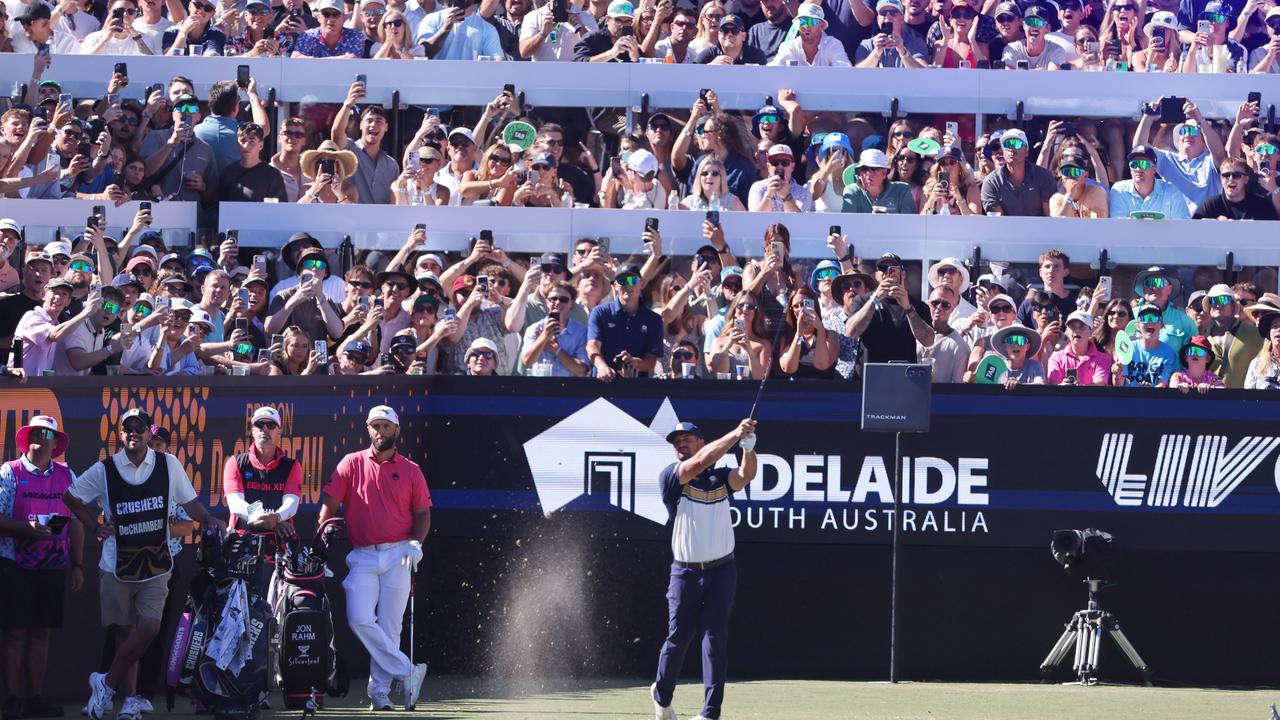
In the years since, golf fans’ attitude towards Reed has slowly shifted. Through his repeated appearances at LIV Golf Adelaide, he has started to gain more admiration from Australian fans. He finished third at the inaugural event in 2023. In 2025, he made global highlight reels by acing the par-3 12th – the tournament’s raucous party hole – as fans’ beer cups rained down in celebration.
“The first LIV event in Australia that was not very good,” Reed says of the treatment by fans. “They weren’t the greatest at all. I didn’t know what to expect. I finished on the podium that week in spite of the fans’ [treatment].
As I was about to walk off the stage that week, I decided to do a ‘shoey’ for them. And then next thing you know, the following year I was like one of the buddies. Then, in 2025, I make a hole-in-one and now it seemed like the people absolutely love me.
“So we’ll see when I show back up in Australia [this month]. I will say one thing about Australian fans, though. You have to absolutely love the passion they have for sport in general. When the Aussies go get behind that entire Ripper GC team, [you can see how much] they love sports. I have nothing but respect for that.”
Reed says it’s not just Australians. In fact, only weeks after the 2019 Presidents Cup, he was heckled back in the US while trying to win the 2020 Tournament of Champions in Hawaii on the PGA Tour. He lost in a playoff to Justin Thomas.
Reed feels the advent of social media has created a beast. As US golf writer James Colgan described in a separate, brilliant piece about the ugly scenes at Bethpage during last September’s Ryder Cup, the proximity to players at tournaments leaves golf uniquely exposed to “a small group of bad actors stoked by the uniquely anti-social instincts of achieving viral fame”.
“As a whole, I feel like the society we live in these days is getting too ‘Gotcha!’ or trying to tear everyone down rather than pick everyone up,” Reed says.
He is unapologetic in his belief that tours should take responsibility for fan behaviour rather than leaving the heavy lifting to players and caddies.
“If I’m walking down a fairway and Kess and someone yells something at me, and even if there is a security guy walking in our group and I say, ‘Hey, that guy needs to go.’ Or Kess says, ‘Hey, that guy needs to go,’ now a player or caddie has had to step in and all the people see that. So that person gets thrown out because of me. Well, now all of a sudden, they lay on that player or that caddie… rather than the organisation.
“The [organisation] that does the best is Augusta [National Golf Club]. They have set a precedent, and everyone knows right off the bat, ‘We can’t cross this line, [or] we’re never going to be able to come back [to the Masters].”
At the same time, Reed insists he has no issue with banter, provided it stays above the belt. Fun sledging about golf shots or clever, soccer-style chants are enjoyable to play through.
“If it’s fun and playful banter, where it’s not hitting below the belt, I have no problem bantering back and forth and having some fun out there,” he says. “Europeans do it really well with all their funny chants. I’ll sit there and give it right back to them. I mean, I shooshed them in my first Ryder Cup! I mean, I gave Rory a freaking finger wag [in Minnesota during the 2016 Ryder Cup]. I’m always doing something and having playful banter back and forth that seems to elevate and get people more engaged. It’s important because, to be honest, golf can be boring if guys just keep their head down and don’t really have any reaction.”
What Reed resents most is anyone reducing his career, personality or body of work into a single narrative.
“It’s a hard one because I hate talking about myself; it’s just so weird,” he says when asked what the real Patrick Reed is like behind the scenes in his hometown of Houston. When pressed, he answers: “The biggest thing is, let’s be honest, everyone’s made mistakes in their life. I’ve probably handled some things not the best way in my career and in my life. But at the end of the day, I love to help grow the game. The passion I have for my family and just how I like to be out there and have a good time, have fun and showcase not only my talents, but try to engage with people [are examples of the real Patrick Reed].
“All I can do is continue being me and hopefully at some point it changes and turns around. I’m not the guy who will promote everything I do, or the amount of stuff I do for people around [Houston], around the country, or what we do for our foundation and charity work. I’m not going to post it on social media to try to get credit. No, I do it because it’s the right thing to do.”
The folded US flag in his golf bag, Reed feels, is also the right thing to do – to have a reminder that there is a higher national purpose like the military. “But I’ve never ever seen it in an article,” Reed says again during this hour-long interview.
Until now. Perhaps the game could start fresh with Reed, beginning with Australian fans this month at LIV Golf Adelaide. Because, whether you consider him polarising or not, he’s a character. He’s interesting. He’s an old-school shot-maker. And pro golf could use a lot more of all those traits.
Main photograph by Getty Images/Asanka Ratnayake