There are a host of products on the market designed to help you apply heat to soft-tissue such as muscles, fascia, etc. The problem with most, however, is that they can’t penetrate deep enough into the body to be beneficial.Think about products such as Ben Gay, a topical analgesic cream you rub onto a sore back. Or ThermaCare heat wraps. They both have similar functions but can really only reach muscle tissue that is close to the skin’s surface. Even a hot shower might not get the job done.For years trainers have used heat therapy to aid athletes, but the treatments mostly provide comfort versus actually speeding recovery. In recent years, however, the fitness and rehabilitation communities have turned to a technology that was first developed by NASA in the 1960s to keep astronauts from getting stiff during space flights.It’s called Far Infrared (FIR) energy, and when NASA’s patents on it expired in the 1990s, private companies began developing products that utilize its ability to provide real heat to parts of the body that would otherwise be very tough to reach.Forgive the geek explanation, but FIR energy is the longest-wavelength portion of the invisible infrared spectrum, and it provides radiant heat that is easily absorbed by the body—mostly because our bodies are about 80 percent water. The technology has been widely endorsed as effective therapy after several clinical trials were published that confirmed its usefulness. The National Institutes of Health (NIH) has published several including a comprehensive scientific review from the Wellman Center for Photomedicine at Massachusetts General Hospital and Harvard Medical School. The review noted among other things that FIR stimulate release of nitric oxide in the body, which helps widen blood vesels to speed recovery by transporting anti-inflammatory agents. It also aids with arthritic pain and helps remove metabolic waste.
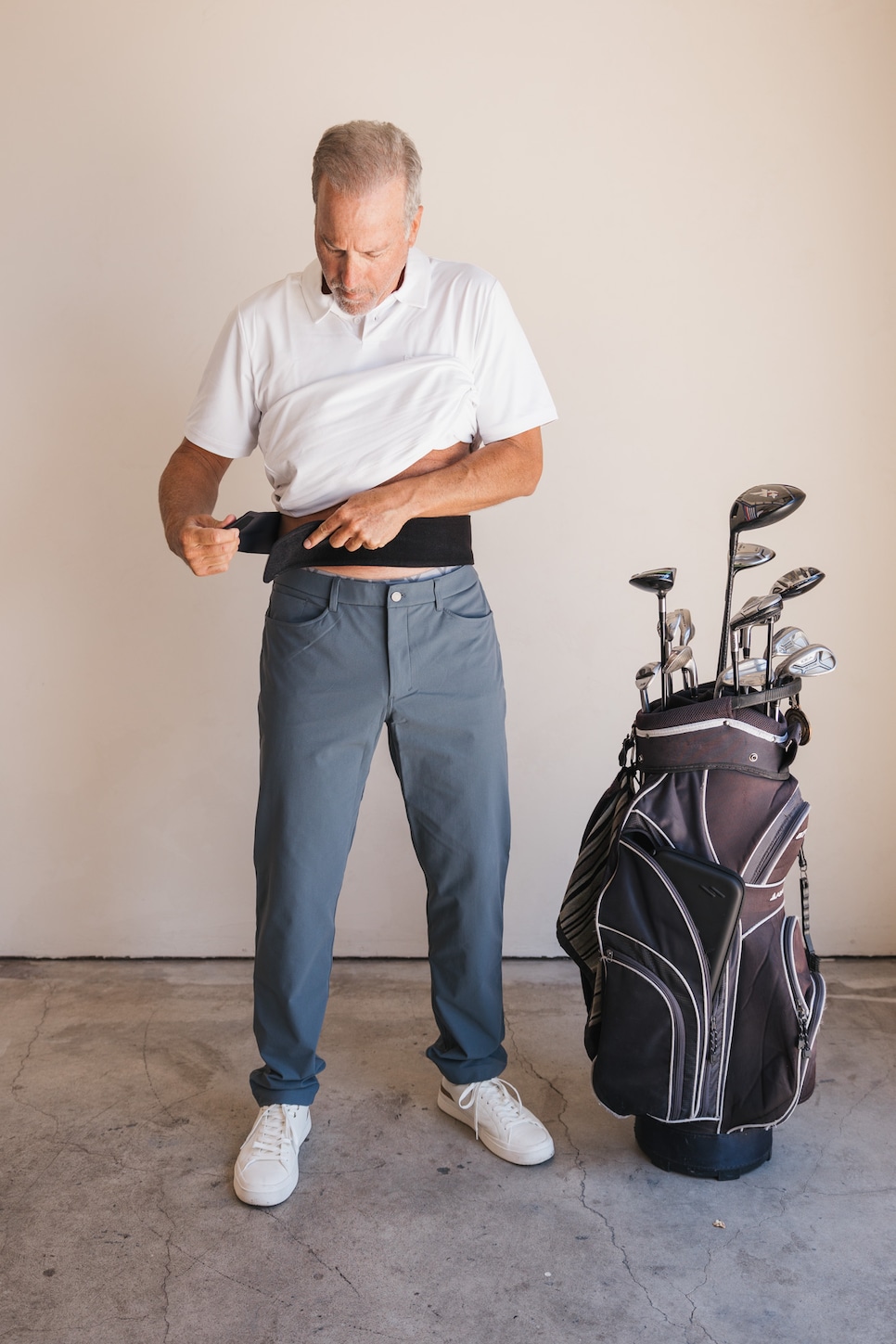
If you’re sold on the idea of applying heat to sore and stiff areas of the body, there are many products on the market that purport to use FIR or near-infrared energy, but one that might appeal to golfers more than most is a belt that can actually be worn while you play.
Infraway makes a lower-back heat pad ($200, infraway.com) that can be worn under your golf clothes during a round. It’s controlled by an app on your phone and you can set the duration of heat (up to 30 minutes) and the temperature (up to 140 degrees) based on your personal preferences.
Samantha Josette Photography
“There’s no single ‘ideal’ [setting] and that’s intentional,” says Infraway CEO Max Betkowski. “The customization is one of [its] strongest features. Users adjust it based on their intended activity, heat preference and available time.”According to Betkowski, users wear it to loosen up before a round, to recover after a round and/or as part of a daily routine to keep their low backs happy.“I always recommend people start at 120 degrees for 20 minutes and expand from there. Rule of thumb we share with users: Pick a temp that’s comfortable enough to wear for an extended period. More time on equals more accumulated FIR exposure. Time on skin is what compounds.”One other benefit to golfers pre round is that it can increase range of motion, allowing players to make a more free-flowing swing. That could be especially helpful on a multi-day, multi-round golf trip or during peak season when you might be tempted to play more than 18 holes in one day.”The key to these products is the frequencies of infrared they produce,” says Ben Shear, Golf Digest’s Chief Fitness Advisor. “If the wavelength is high enough, they do work.”
This article was originally published on golfdigest.com