Here’s the catch: to keep them healthy, focus on other joints.
A widely held belief in fitness, popularised by Gray Cook and Mike Boyle, is that the body has a series of joints that alternate in roles. If joints that are supposed to have good mobility – such as the ankles or hips – are too limited, then the body recruits a stable joint with less range of motion – such as the knees – to help perform the movement. When stable joints are pushed to their mobility limits, that’s when pain and injuries occur.
Taking this into consideration, if you want to protect your knees while you play golf, doing full-body exercises where the joints have to work in harmony is a smart way to train, says Ryon Bosscher, a Golf Digest Certified Fitness Trainer.
Here are his recommendations for performance-boosting exercises that keep the knees healthy while utilising all three planes of motion in the golf swing: side to side, up and down and rotational. Depending on your swing characteristics, exercises in one plane might give your more benefit than the others.
LATERAL EXERCISES
Controlling side-to-side movement is key to maintaining balance, generating power and staying stable throughout the golf swing.
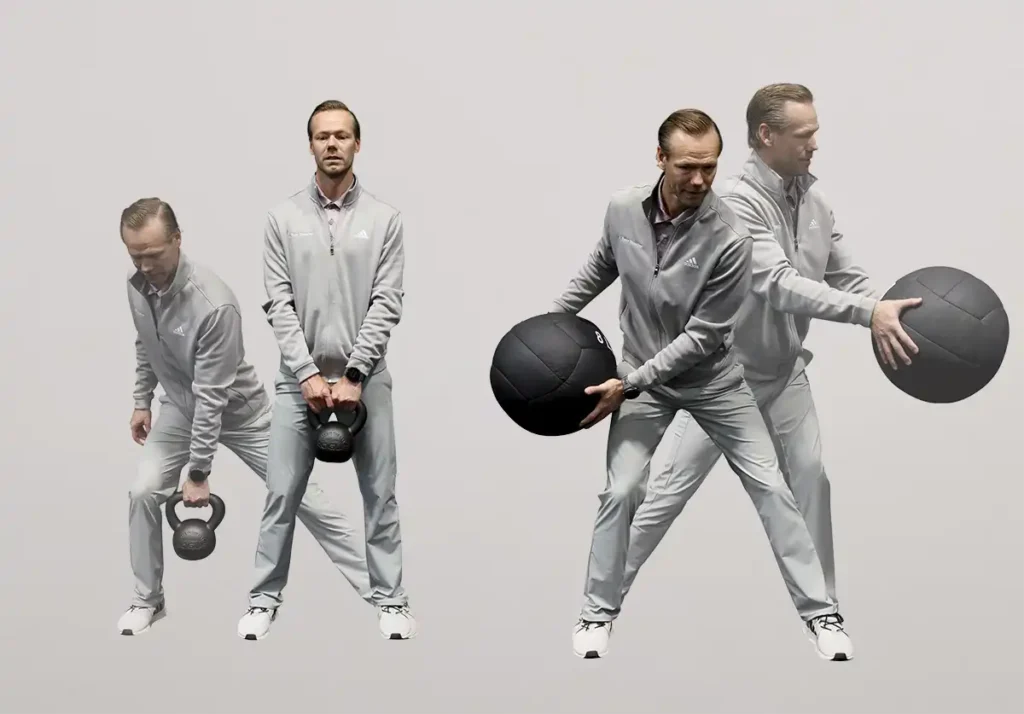
A. Lateral lunges [above left]: Strengthen the muscles around the knee/hip and improve side-to-side stability, helping golfers control knee alignment during swings and reduce injury risk. They also mimic the weight shift in a golf swing, enhancing performance and joint protection.
B.Medicine-ball tosses (wall) [above right]: There is some rotary movement, but this lateral exercise is great at training the weight shift from the trail leg to the lead leg. This helps build explosive strength (through the hips) and protects the knees from unwanted torque or collapse in the swing.
ROTATIONAL
Rotational training builds power through the hips and core, taking pressure off the knees and preventing harmful twisting.
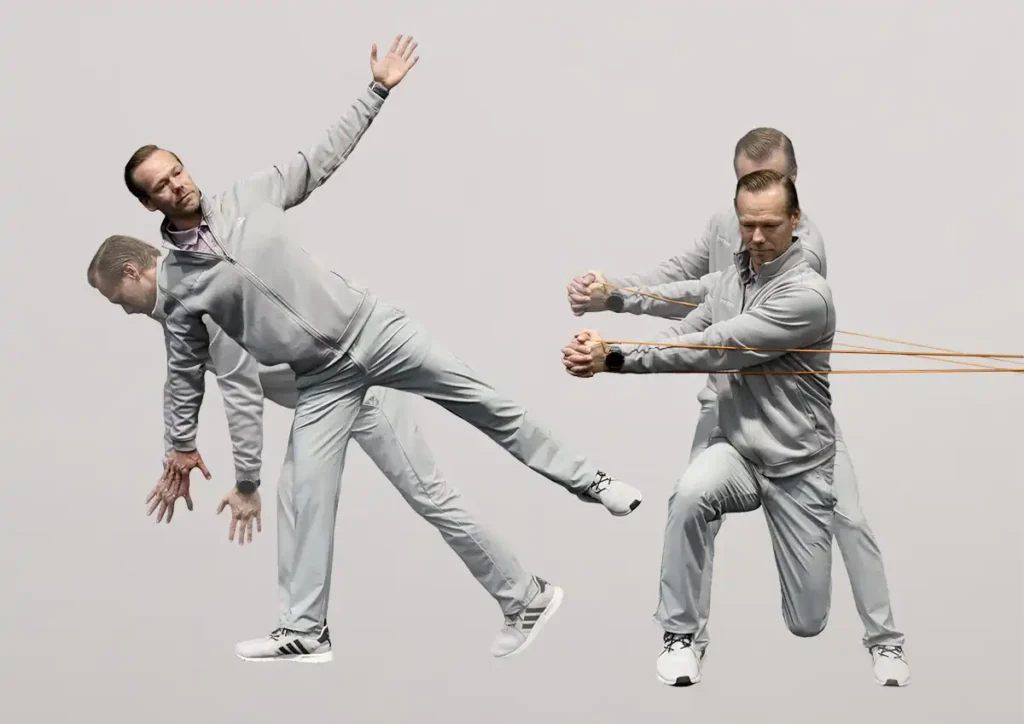
A. Hip airplanes [above left]:As the name describes, this is a hip-dominant movement. It’s a very good exercise targeting both hip mobility and stability, which is necessary to offload excessive stress to the knees. You can do it against a wall to prevent excessive hip shifting. You can also make it easier by performing this kneeling on one knee.
B. Banded chops [above right]:The resistance of the band through this movement requires great core and hip activation to remain stable. Get creative with it: use resistance to mimic the backswing or the downswing. You can do this standing or kneeling and can have the band attached at various heights (high-to-low, low-to-high, etc.).
VERTICAL
Ground-reaction vertical force creates an upward energy that transfers through the legs, hips and into the club. When vertical force is used efficiently, it reduces the need to over-rely on twisting or lateral movements, which can strain the knee joint.
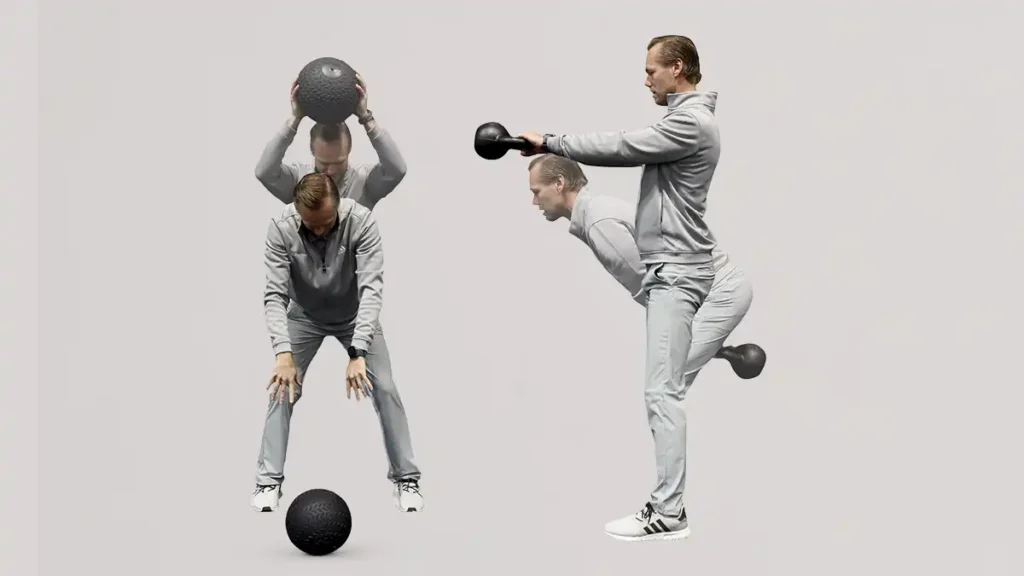
A. Ball slams (ground) [above left]: An exercise very similar to a squat, but it adds a slam or med-ball throw into the ground for greater core activation. Start at an appropriate height and throw hard into the ground.
B.Kettlebell swings [above right]: This is a simple hip-hinge move while maintaining an erect spine. The hips are the primary driver here, and the kettlebell is along for the ride. Drive your hips backward first, as the torso drops. Then stand tall as the hips thrust forward.