When does ‘golf influencer’ become a full-time job? We profile some of those who are attracting eyeballs Down Under.
There’s a moment during a round, the kind that would’ve once belonged entirely to the rhythm of the game, when a golfer pauses mid-swing, steps back and adjusts their tripod. The metallic thwack still echoes across the fairway, but now it shares space with something else: the hope that this shot might capture the perfect moment.
Watching this play out, it’s tempting to think social media is an accessory to golf. But anyone paying attention can see how it’s quietly reshaping the game and waking up whole generations who never thought golf was theirs to play. For a growing group, golf exists on two planes at once, the physical and the digital. Both demand focus and patience, but neither looks as effortless as it appears on your grid.
“I didn’t start with some big strategy,” says golfer and content creator Amy Grimmond. “I just became obsessed with golf and started posting my progress.” She noticed something missing: content that reflected the experience of a girl picking up a club for the first time. Her feed became less a tutorial and more an invitation, quietly pulling thousands of followers across TikTok, Instagram and YouTube into the journey.
That cultural change is real and it’s tangible. Take Grace Hallinan, for example: a golfer who’s been playing since she was 5. During the past year-and-a-half, she’s landed three holes-in-one, all captured on video and shared online to her thousands of followers, one clip even racking up more than 170,000 views. It’s a perfect illustration of how these ‘moments’ travel beyond the course and into a community hungry for inclusion and inspiration. And it really makes you pause and think, Why golf? And why now?
THE SHIFT
Golf has long been framed as precise, traditional and exclusive. There was a right way to dress, behave and play. But spend time hanging out on the profiles of the current generation of creators and the tone is noticeably different. More fashionable? Less conservative? Cooler? Yes, let’s go with cooler.
Changhyun Nam, a.k.a. GolfSlump, mixes swing tutorials, lifestyle snippets and gear reviews for hundreds of thousands of followers. “Golf is becoming a lot more expressive,” he says. “It used to feel quite rigid… now there’s room for personality, humour and individuality.”
That personality shows up both on and off the course. Dress codes loosen. Group games feel more social than competitive. Online, it takes a slightly different shape: outfit checks between holes, “What’s in my bag” tutorials and swing tips all edited to the cadence of a TikTok scroll. Behind it all is a simple principle: golf doesn’t have to fit one structure. Inclusivity, Nam adds, starts with representation. “People need to see someone they connect with and think,
I could do that too.”
For women in particular, that visual language has become a kind of quiet disruption. “It’s not just about scorecards anymore,” Grimmond says. “It’s outfits, friends, travel and good vibes.” What was once a sport begins to read more like a lifestyle. Something you can step into, not just qualify for.
WOMEN ARE (REALLY) DIALLING IN
Female participation in Australia has surged, with programs like Get Into Golf bringing thousands of new women to courses nationwide. In January alone, women made up 90 percent of participants according to Golf Australia’s participation data – marking a record-breaking month for the sport.
“I’ve noticed a lot more girls, especially younger ones, getting into it because they see people like them playing,” Grimmond says. “It doesn’t feel as exclusive or intimidating anymore.” That sentiment is echoed across feeds and fairways alike, a subtle but meaningful shift from aspiration to accessibility.
For Jana Rothacker, the journey started more technically. Filming her swing simply to understand it, she realised, “I felt like I had a very shallow swing, but the video showed something completely different.” Progress tracking turned into posting, posting turned into consistency and, somewhere along the way, a community formed.
COACHING AND CONTENT COMBINED
Kerrod Gray, PGA professional and founder of Coach Creator, tells a similar story. “I was young and just getting started in the coaching industry,” he says. “I wanted to set myself apart and build my in-person business. I noticed there wasn’t anyone in Australia putting out consistent short-form content on Instagram, so I just started. It wasn’t a grand plan, it was a gap I could see and felt like I could fill.” Today, his content reaches hundreds of thousands of golfers across social media, with a huge audience on Instagram and YouTube tuning in for his simple, effective drills.
Gray’s approach evolved from surface-level instruction to something far more strategic. “The real art of coaching is learning how to talk about complicated, technical parts of the golf swing in very simple terms. Everything in the golf swing comes down to cause and effect. Once I built my content around that framework, everything clicked.”
Consistency is key. Gray posts more than 4,000 pieces of content across platforms every year. “Most coaches overestimate how hard content creation has to be. They think they need to create content from scratch,” he says. “The better approach is to document what you’re already doing every day. Coaches have unlimited material sitting in phones and student portals. It’s just about knowing how to package it.”
Gray also sees social media as a critical tool for inclusion. “Traditional golf lessons have barriers. They can be expensive or intimidating and for someone who has never picked up a club, walking into a facility and booking a lesson isn’t always comfortable. Social media removes that. You can learn from a qualified instructor on your own terms, at your own pace, for free. If the content is clear and solves a relatable problem, it can connect with anyone regardless of age, gender or experience.”
IT’S NOT AS EASY AS IT MIGHT LOOK
However, there’s a tension to content creation, described by Rothacker as “the battle between vanity and transparency”. Show the messy reality and risk judgment or revert to what looks better on camera? Improvement doesn’t always film well, but imperfection resonates most.
The work itself is constant. Filming, re-filming, editing, posting. Playing a round can take hours; turning it into content can take significantly longer. It’s a rhythm that requires as much commitment to storytelling as it does to the sport itself. That duality isn’t lost on creators who came to the space from a more traditional golf background.
“I was a shy, young pro that lucked his way into a documentary,” says coach and creator Ollie Neave, otherwise known as ‘Aussie Beef’. “I just loved being behind the camera.”
What began as a way to grow his lesson book has evolved into something much larger: brand partnerships, creative projects and a full-scale content business. Today, his content reaches a substantial audience across Instagram, TikTok, YouTube and other platforms, with thousands of followers tuning in. But at the centre of it is still the same principle: don’t dilute your unique style. “Whatever you do,” he says, “don’t cheat the craft.”
It’s a sentiment that sits in quiet contrast to the pace of social media. Short-form tips promise quick fixes, where algorithms reward immediacy. But golf resists that kind of simplification. “When you’re on the lesson tee all day,” Neave says, “you realise how hard it is to fix someone in 30 seconds.” Behind the best content is still expertise, still hours of practise, still a respect for the craft that doesn’t always translate into a quick clip.”
Still, the overall effect of this content ecosystem is difficult to ignore.
Another creator making enormous waves in Australia’s golf content scene is the irrepressible Ron Chopper. With a persona that started as a COVID-era joke at Western Australia’s Pinjarra Golf Club, he has grown into a household name for golf fans online. “It obviously resonated with everyone, from PGA professionals to members of golf clubs,” he says. His content, which spans YouTube, podcasts, merch and online coaching, has attracted a huge following, with fans sporting the official Ron Chopper uniform and the “Good player out of luck” shirts, even at major tournaments like the Australian Open and LIV Golf Adelaide.
The charm of Ron Chopper isn’t just in his golf, but in his humour and relatability. “The banter between me and Joel (Innes, his cameraman) is the most relatable part. I play some amazing shots but can also hit some shockers. Having a mate there to let you know about the bad shots is a very Australian way of life,” he explains. For Ron, content is a bridge to community, helping make the sport feel accessible and inclusive. “I think it’s awesome to see the women’s game explode over the past few years,” he adds. “There are content creators really trying to grow women’s golf in Australia, creating small communities that meet up and play.”
Ron’s vast following and creative approach highlight a bigger truth: social media isn’t just reshaping golf, it’s helping make it a game for everyone.
As Neave explains, this digital wave has played a huge role in breaking down barriers and creating a cultural shift. “Social media has played a huge part in making the game less daunting. Celebrities, brands and fashion labels are all flocking to the sport, helped largely by the sheer amount of golf content flooding algorithms,” he says. Participation is up. Interest is broadening. And perhaps most importantly, perceptions of golf are changing. “Has the game gotten cooler?” Neave asks. “Or has it always been cool and new people have just discovered it? Somewhere in the middle.”
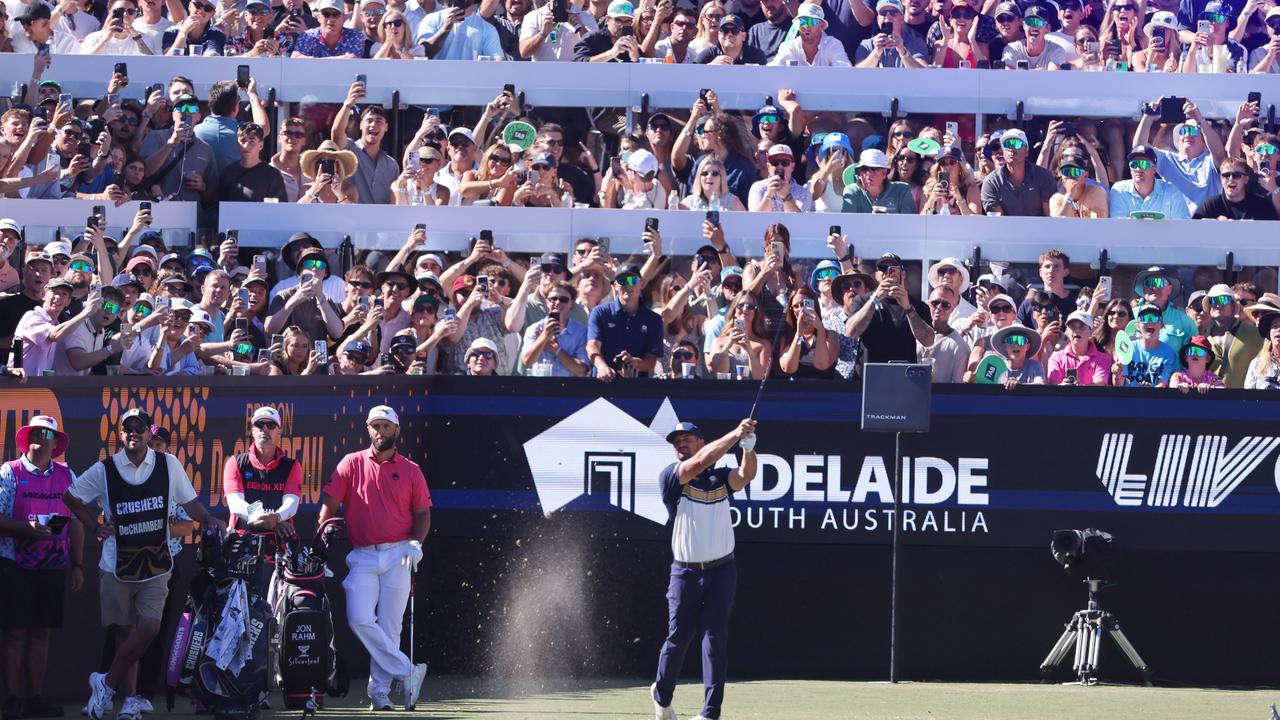
Events like LIV Golf Adelaide are leaning into that energy. Alongside the golf experts and dedicated creators (and we absolutely need them), a new wave of social media personalities – many from outside the sport – are showing up, laughing, filming and soaking it all in, much like a beginner falling for the game in real time. They turn the atmosphere into something instantly shareable, immediate, electric and hard to ignore. “It just makes sense,” Grimmond says. “It brings in new people and makes it more engaging.”
And they’re not just there to party, though yes, there is a lot of that going on (cue Fisher at LIV Adelaide or the reverberating antics of the “Watering Hole”). They’re also shaping how golf looks, feels and lands on screens for a whole new audience. They’re working with brands, giving us rundowns on gear, outfits and the sport’s style side. Suddenly, golf isn’t only about the leaderboard. It’s content, it’s culture, it’s a living, breathing moment that everyone then wants to get in on.
EVERYONE’S GAME
For women, that moment feels especially significant. It nourishes a more accepting attitude towards being feminine while enjoying the game.
“It’s not a boys club anymore. It’s for the girls,” Rothacker says, not as a statement of exclusion, but of expansion – a recognition that the space is opening wider.
There’s something disarming in that framing. It strips away the intimidation and replaces it with something lighter. And yet, beneath it is real commitment. Hours of practice. Early mornings. The quiet persistence of trying to get better at something difficult.
Back on the fairway, the camera is already rolling. Whether it’s perched on a tripod or held by someone just out of frame, the moment is being captured. The swing comes again. Clean. Repeatable. Maybe even useable.
Next time you watch a swing clip, remember: it’s more than content. It’s culture. Community. A quiet revolution, filmed, edited and shared in real time. Peek down that digital golf hole and who knows, the game could be entirely yours, too.