As Golf Digest has been documenting the past several years, new golf course development is booming throughout the South and Southeast, particularly in states like South Carolina and Texas.
RELATED: The best golf courses in every state, ranked
Demographic migration to warmer climates, a robust golf economy, the availability of rural sections of land and a yearning to play in out of the ordinary environments have created a small explosion of prestige clubs and architecture.
Interesting things happen when developers take architects into uncharted territories. Many of the sites being worked are rural, unfettered and mostly sand-based, allowing the designers to turn up the dials on stimulation. Quality is as high as it’s been this century, and each new course seems to outdo the last in terms of concept and ambiance.
In Florida, three new golf courses demonstrate the range of design possibilities being explored. The three occupy distinct spaces on the spectrum of golf course architecture, different milieus of design ranging from low-fi artisanal construction to the highest aspiration of industrial engineering. Taken together, they are a fascinating portrait of how not dissimilar soils and climates can be rendered into very different expressions of architecture.
RELATED: The best courses in Florida, ranked
THE MINIMALIST
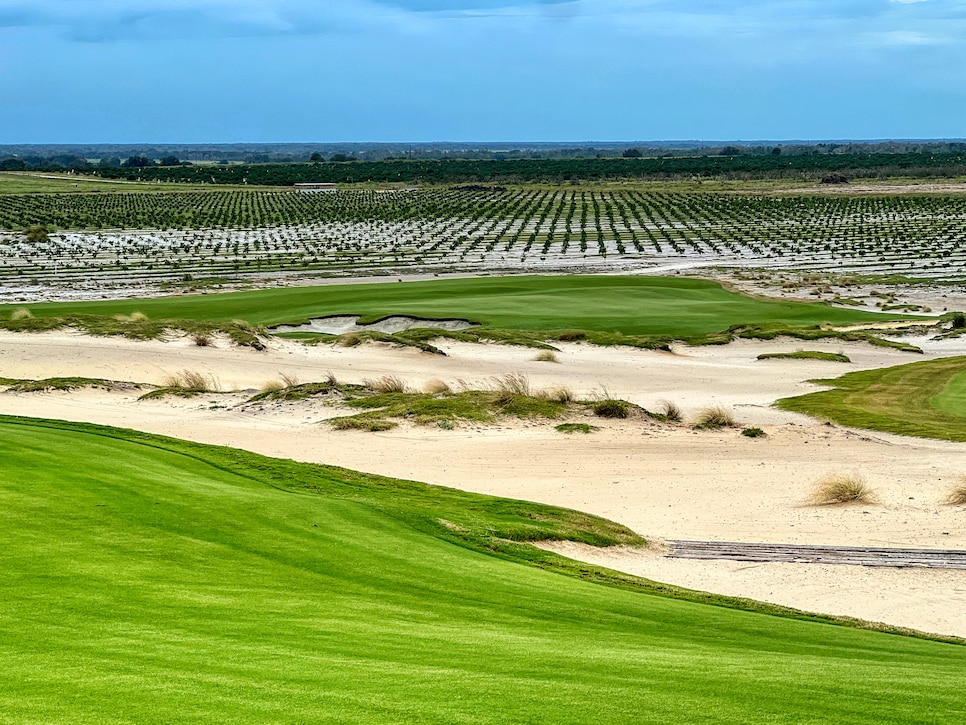
High Grove Golf Club is intensely rural. The course sits on the southern end of Lake Wales Ridge, a vein of sand running 100 miles north-south through the center of Florida that crests up to 300 feet above sea level. The nearest town is Lake Placid, population roughly 2,400, and Lake Okeechobee in the heart of the Everglades is just 25 miles southeast as the crow flies. In other words, Florida Man country. To do anything more than the minimum to build a course here would seem to be in violation.
Architects Gil Hanse and Jim Wagner worked High Grove hand in glove with the land. The holes carpet the site’s sloping grade with little to no added furniture. It works because the sandy soils and topography have enough natural movement to create variation and expectation through a good routing, and the elevations on the ridge, with un-Florida-like vistas into far off horizons, provide extra aesthetic pop. The architecture doesn’t have to show off.
Derek Duncan
RELATED: The 13 most fun golf courses in the U.S., according to our expert
Early on, though, you’d be excused to wonder if Hanse and Wagner treated the ground with too much respect. The opening holes slip away quietly, descending off the high point of the main campus with fairways as broad as freeways vanishing nakedly over crests and terminating into large, lightly bunkered greens with gentle contours but few other points of interest. Their character has all the snoozy energy of the orange groves that surround the property for miles on end. You wish the designers would have knuckled something up here or there.
The story takes a twist when the holes swing back toward the central elevation, highlighted by the uphill, George Thomas-inspired par-5 sixth with a split fairway second shot and wide, spectacle green benched above a bunker nosing into the middle of the putting surface. From here we lean forward: the bunkering intensifies, the shot demands stiffen and the architects begin getting to the point.
RELATED: America’s most challenging courses, ranked
The second nine, cut through the orange groves on the high part of the site, makes it clear that Hanse and Wagner have been plotting the pace. The holes turn and tumble through the orchards, the perimeter grass lines frazzled at the edges where they bleed into the sand of the linear orchards, nothing piled or pushed.

Derek Duncan
The intensity builds with wild slopes, blind drives, long range views and a beautiful up-and-over par-4 16th with a scenic approach shot to a green framed against the endlessly marching groves. The big, animated greens steer balls when they land, and many are draped on ridgelines making attractive targets with only slight perimeter enhancements to support them. This is the only place, other than tees and the carving and building of bunkers, where any construction is evident.
High Grove is the equivalent of architecture that lives off the land, and why developers and owners over the last two decades have exerted so much time, patience and equity searching for properties like this one.
RELATED: The death of the championship course
THE MAXIMALIST
When Tom Fazio and Steve Wynn’s Shadow Creek opened outside of Las Vegas in 1990, it was a supernova event. No construction project to that point in the history of golf courses had made so dramatic an alteration to a property as Shadow Creek, where a pan-flat parcel of desert was transformed into mountain-like foothills covered in pines and cut with streams amid 60- to 80-foot elevation changes created by digging deep into the rocky earth. Conservative estimates at the time put the construction cost at an unheard of $40 million, over $100 million in today’s dollars.
Shadow Creek redefined what was possible in golf course creation, and recalibrated what wealthy owners would have to pay to make a similar statement. Over the following decades, architects and developers continued to pursue similarly ambitious golf largesse, invading previously hostile environments and moving cubic yards by the millions to make silk purses of sow’s ears.
Derek Duncan
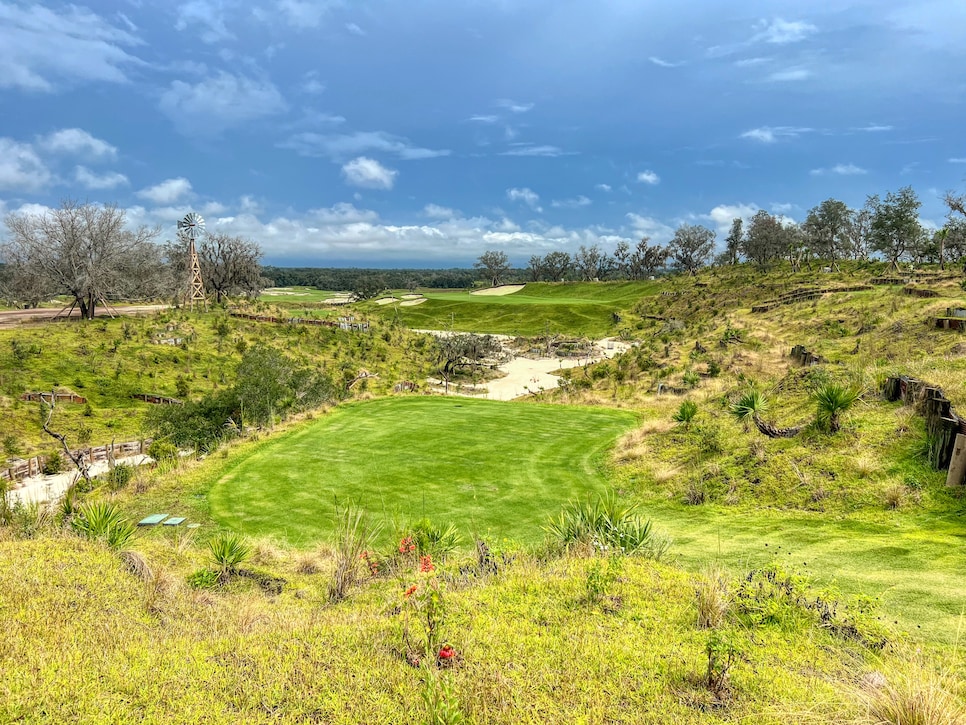
Miakka Golf Club in southwest Florida, 45 minutes east of Sarasota, has taken this concept of maximalist golf design to previously unheard-of levels. It is as far away from High Grove on the architecture spectrum as John D. Rockefeller is from Mahatma Gandhi.
The course sits on roughly 900 acres of a much larger collection of ranches and ag land that owner Steve Herrig purchased along the Miakka River. The property was gentle and bucolic with large live oaks along the river but nothing special in terms of golf potential beyond the sandy sub-base.
Herrig hired architects Dana Fry, who once worked for Tom Fazio, and partner Jason Straka to design the course with consultation from Paul Azinger. Fry had experience in the elevation creation business with big digs at places like Calusa Pines, two hours south in Naples when he worked with former partner Michael Hurdzan. But what Fry and Straka attempted at Miakka was next level epic, with many of the ideas tilting into the “never tried before” category.
Derek Duncan
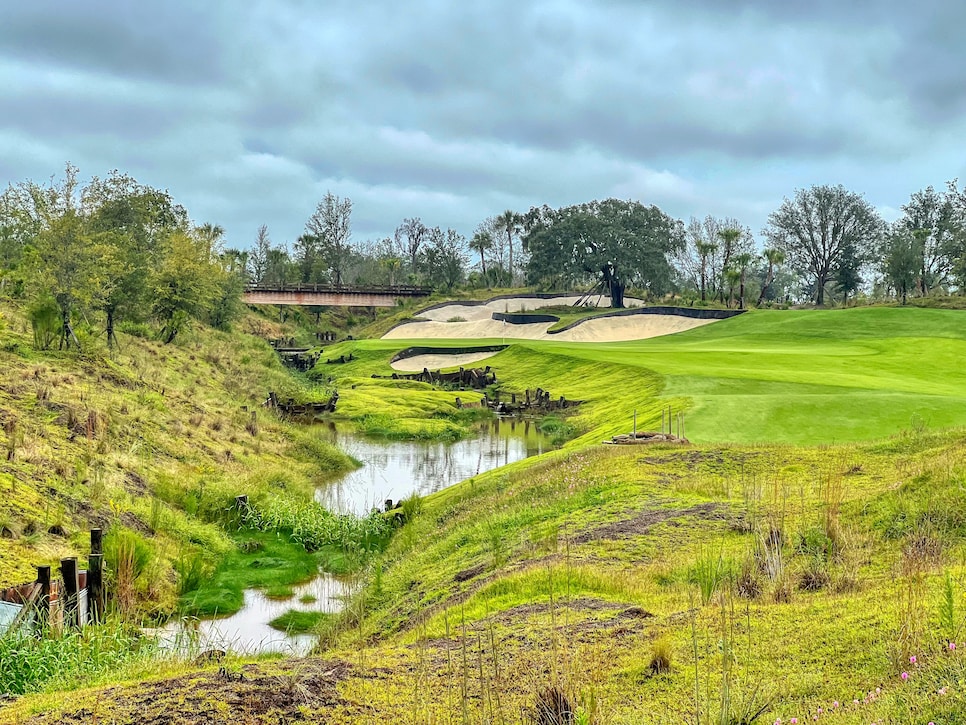
The Germans have a word, Gesamtkunstwerk, that means “total work of art.” Miakka puts the gesampt in Gesamtkunstwerk. Every aspect of the golf property is created, from the 80-foot dune ridge on the eastern edge of the site to each wash, ravine, waterway, mogul and embankment. This is not just total artwork but total earthwork.
Millions of trees, bushes, clusters of ornamental grasses and other flora have been imported and planted. Thousands—yes thousands—of live oaks and other large hardwood specimens were rolled in and arranged to create barriers and sightlines that tie in with distant canopy horizons.
RELATED: When does a hazard become unfair?
On the agronomic side, there’s more. Miakka is wall-to-wall zoysia grass, Stadium zoysia fairways and tees (there is no rough) and Lazer zoysia greens and approaches, grown on a sod farm the club owns across the road.
It’s expensive but not uncommon for courses to sand-cap fairways—that means trucking in sand and building a percolating base beneath the grass to assist in shaping and drainage. Miakka didn’t just do that. They covered the entire course in six inches of the same combination of greens mix profile that are typically found only on the putting surfaces of golf courses, essentially creating a 140-acre USGA green with 89 miles of drain pipe underneath.
Derek Duncan
RELATED: The best courses around $100 among our list of the top public options
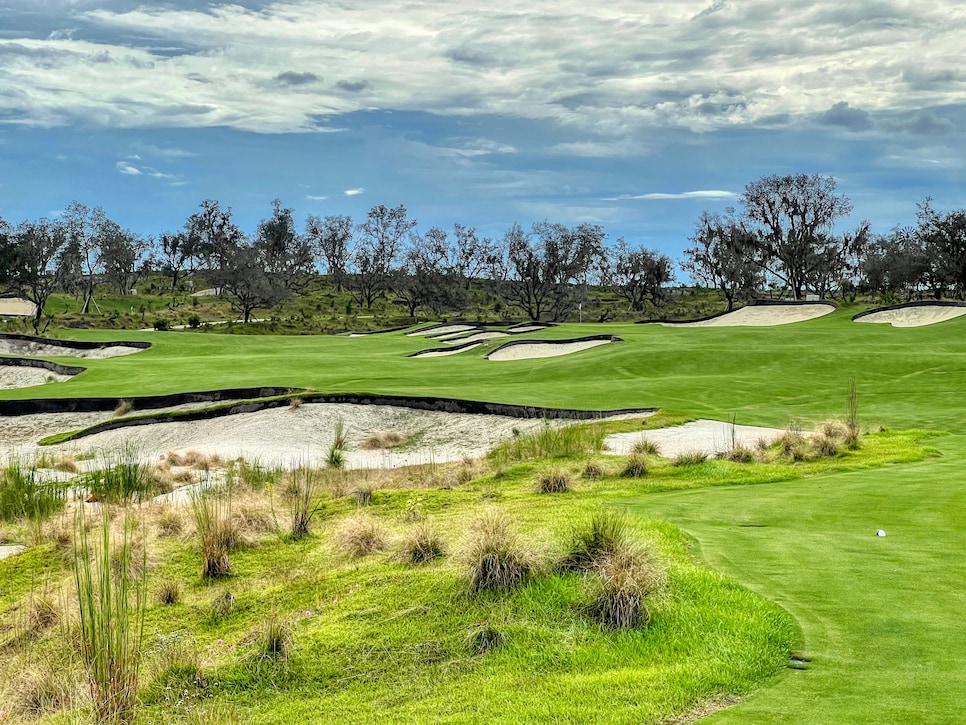
The bunkers are inspired by those cut into unique sands of Australia’s Sand Belt in Melbourne. To mimic the natural compaction of the soil that gives those courses their crisp edges, Miakka harvested tons of the dark dirty sand and silt from the site, processed it, and mixed it with a soil stabilizer called Loksand. They then rolled out miles of the thick liner composite and used it as a stark barrier that props up the fairway and greens grasses above the bunker sand. These vertical black faces are one of a kind and provide not just sturdy soil foundation but a color contrast that makes the bunkers pop against the surrounding white, beige and green.
Of course, none of this matters if the golf is not good. Members and guests will determine that when they begin playing this winter, but all the elements for excitement are present: wide fairways, alternate angles and risk/reward drives, attractive hazards, hints of blindness, a combination of concave, flowing greens and big bowled putting surfaces like one and 11, and four vastly diverse par 3s. The effect is total.
Bone Valley, the newest course at Streamsong from David McLay Kidd now open for limited preview play, lives in the middle of the architectural spectrum between the extremes of High Grove and Miakka.
High Grove looks like it was simply laid over the top of the sand ridge and orange groves. Miakka looks like you’ve stepped inside Willy Wonka’s factory, especially considering how docile the surrounding countryside is. Bone Valley, meanwhile, is totally believable as a product of the old Mosaic mining outputs in the same way the character of the original Red and Blue courses derive from the tall sand dunes they weave around, leftovers from the site’s phosphate extraction process.

Derek Duncan
RELATED: America’s 75 greatest golf resorts, ranked
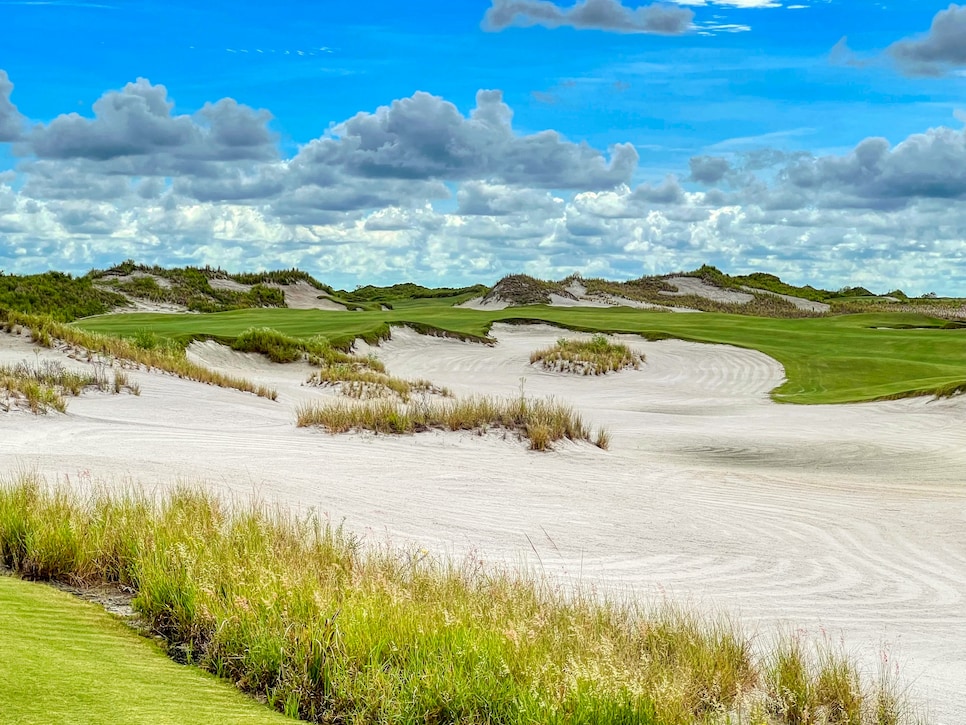
Those leftovers—10- to 40-foot-high piles of sand that were filtered for minerals and discarded, only to revegetate across decades to develop their own dunes-like ecosystems—are what give Streamsong a such vivid tapestry through which to build links-like golf holes.
Kidd’s property, west of the Black Course, south of the Red, had very little in the way of these gifts. There were some old mining spoils where Bone Valley’s third, 17th and 18th play, but the land Kidd chose for the course was relatively calm, open and scarred by a vast sand desert where Gil Hanse excavated material to use for the Black. In other words, more prairie than mining magic.
Derek Duncan
To compensate for the lack of topographical assets, Kidd’s team reimagined the site as if it were once plumbed for phosphate the way other parts of Streamsong were. Using sand harvested by digging out different sections along the edges, as Hanse had before, he created new grassy dunes, conical spoils and long, irregular ridgelines that span across multiple holes. Bone Valley looks like it had been tossed and turned in the same vein as the Red and Blue.
Naturalism describes the architectural manipulation of a site with the intention of making it look entirely authentic or found. This can be done in a maximalist, highly engineered way, like Whistling Straits or Ladera in the Coachella Valley, or the minimalist way on a site that already yields authentic golf hole. Bone Valley is a naturalist vision but works because the manufacturing is done across a believable scale with no tells or jump cuts. It also benefits from its sister courses who have already done the work of establishing the Streamsong vernacular, of which Bone Valley sings fluently.

Derek Duncan
Kidd’s holes are broad, buoyant and playful, full of wide angles and kick slopes that move the ball laterally on the ground. It’s already a gorgeous course to look at, and if the agronomic team does its job and keeps the turf fast and firm, it will likely be the most adventurous and volatile of Streamsong’s outstanding collection of golf.
RELATED: Bone Valley might be your new favorite course at Streamsong—here’s how our experts rank it
• • •
Explore Golf Digest’s new Course Reviews section where you can submit a star rating and evaluation on all the courses you’ve played. We’ve collected tens of thousands of reviews from our course-ranking panelists to deliver a premium experience, which includes course rankings, experts’ opinions, bonus course photography, videos and much more. Check it out here!
This article was originally published on golfdigest.com