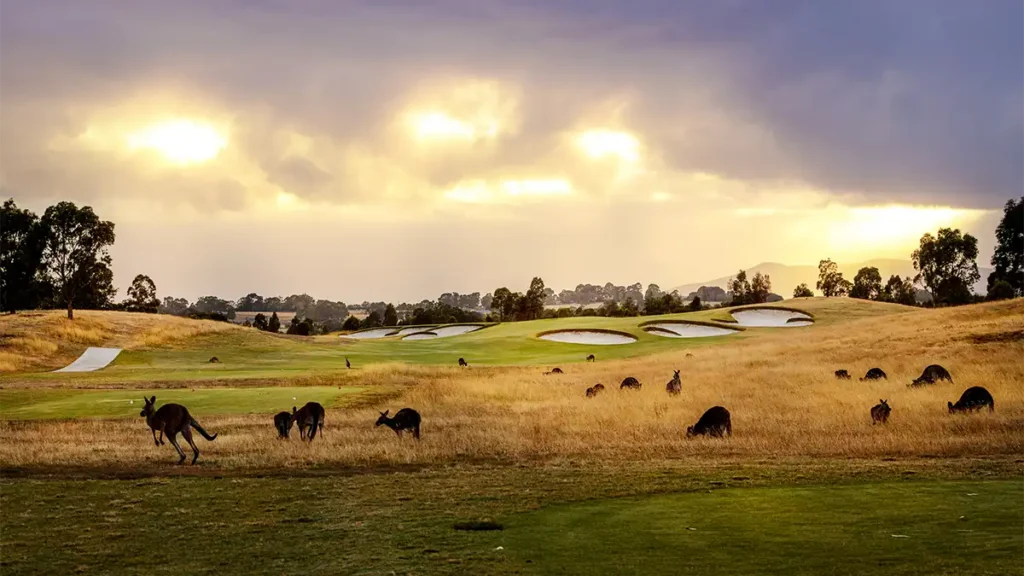
Is Turnberry on the R&A’s radar for The Open at all?
Australian golfers rightfully have a soft spot for Turnberry and the Scottish resort’s tremendous Ailsa course. It was there on Scotland’s west coast that Greg Norman raised the claret jug 40 Julys ago, while nationality and patriotism evaporated as the world cheered on Tom Watson in his spirited bid to win the 2009 Open Championship there just weeks before turning 60 (even if our own Mathew Goggin was right in the mix).
There’s something special about Turnberry that makes it different to other courses on the Open rota. Having been fortunate to play there a dozen years ago, I remember walking off the 18th green on a midsummer’s evening utterly enraptured by what I’d just experienced. And the layout is even better these days after the much-admired renovation by Tom Mackenzie and Martin Ebert – who recently performed an applauded re-do of New South Wales Golf Club, perhaps our equivalent of the Ailsa course.
The 2009 Open was Turnberry’s fourth and, sadly, most recent Open as a return visit feels more distant today than ever. That’s almost certainly because of the name missing in its title so far in this column. Ever since it was bought by a notable American in 2014, the resort’s official name became Trump Turnberry. Those five letters – and everything that comes with them – are one roadblock between golf’s oldest championship and a return to the Ailsa course.
The R&A has had three different chief executives since Donald Trump’s purchase and neither Peter Dawson, Martin Slumbers nor current CEO Mark Darbon have found a path back to Turnberry for The Open. They cite congestion issues and other associated aspects of staging the championship that have escalated since 2009.
“We need a venue that is appropriate from both a logistical and commercial perspective,” Darbon said last year. “That’s critical for us, because through The Open, we generate most of our revenue and we use that to invest in the rest of the game all around the world. So the reality is that a modern-day Open requires a venue that can support us logistically and commercially.
“So we do have some questions that we need to work through on the logistical and commercial front. When we were there in 2009, we had [123,0000 spectators] for the week. We are operating at comfortably more than double that at most of our venues today. So it’s not quite as simple as just saying, ‘Would we go back?’ There’s a chunk of work that’s required to investigate.”
It’s understandable, but it’s still a loss for golf. The re-emergence of – and fast return to – Royal Portrush as an Open venue has salved the wound a little, especially as it gave Northern Ireland a much-deserved slice of Open action. However, no Turnberry in the foreseeable future continues to hurt.
Darbon’s predecessor was more direct a few months earlier when quizzed about it, and you can almost hear the T-word in his voice: “We will not be taking events there until we’re comfortable that the whole dialogue will be about golf,” Slumbers told The Telegraph in late 2024.
“About golf.” I like those words, loaded as they may be in this instance. They hark back to Bill Clinton’s presidential campaign in America in 1992 when he repeatedly referred to the simple phrase, “It’s the economy, stupid” – a line coined by campaign strategist James Carville – whenever Clinton’s quest deviated.
As large, financially lucrative and globally significant as the Open Championship has become, it remains “about golf” more than anything else. It’s a phrase the R&A would do well to remember next time someone reminds them that Turnberry is sitting there, waiting.
Top 5 Open Championship venues
5. Royal Birkdale: It stings to omit the wild and wicked Carnoustie from this list, yet Birkdale [see page 98] owns an inescapable quality as a genuine championship test. Plus, Aussies thrive there [see page 66].
4.Royal Portrush: There’s a reason why the R&A waited a mere six years between Opens at this Northern Irish gem.
3.Turnberry: Still officially part of the Open rota, even if lying dormant.
2.Muirfield: The concentric-circles routing, where the front nine forms the outer lap and the inward nine the inner route, and position flush against the Firth of Forth make it a true links challenge.
1.St Andrews: The double greens mean rounds take an eternity and the weather can create lopsided draws, plus the Old Course is perhaps not long enough to combat modern technology. However, there are countless intangible reasons why the championship returns to the Home of Golf every five years.
Photograph by getty images/david cannon