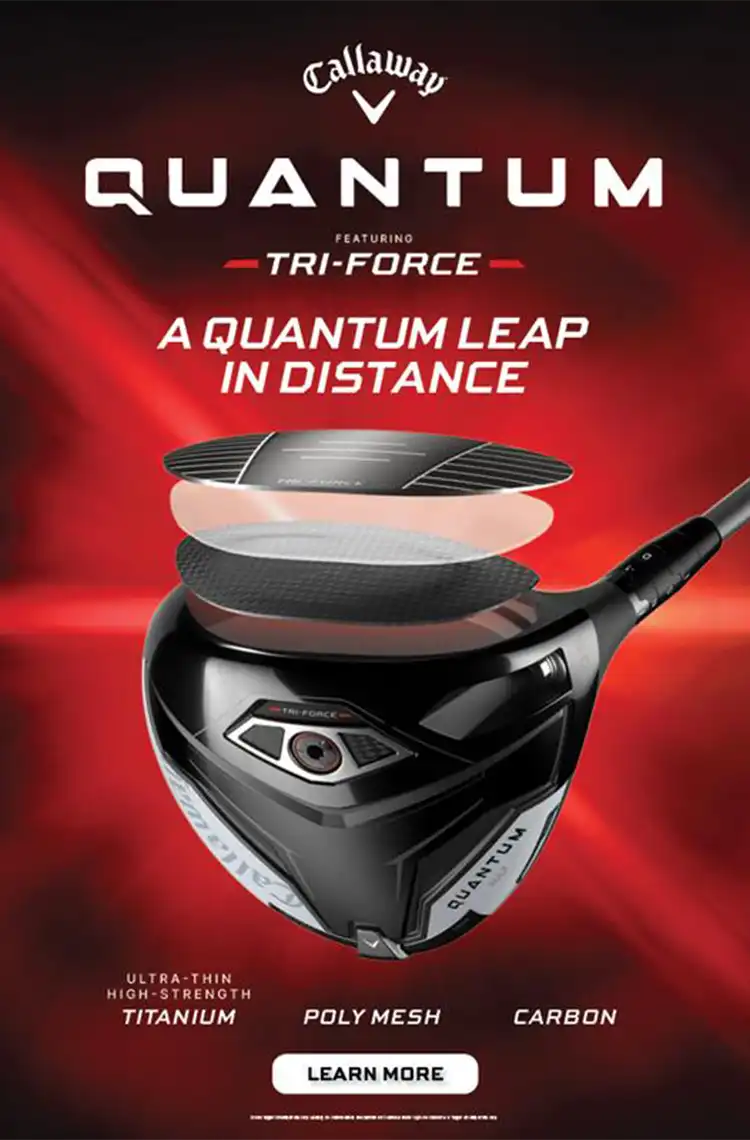
What you need to know: The top of the bag remains a tricky proposition for many golfers. Do you opt for a high-lofted fairway wood, hybrid or utility iron? Callaway’s latest Apex lineup offers a multitude of options to fill the yardage gaps in the form of Apex Ti Super Hybrid, Apex UT and Apex UW.
MORE: Callaway Opus SP wedges: What you need to know
Price/availability: Callaway’s Apex UT retails for $499.99 ($639.99 NZD) and comes in four lofts (18, 20, 22 and 24 degrees); and Apex UW retails for $629.99 ($749.99 NZD) and comes in four lofts (17, 19, 21 and 23 degrees). Both are available for pre-order and hit Aussie retail shelves on November 7. More information on Ti model to come.
3 Cool Things 
1. Iron DNA. Loaded with fairway wood-esque technology, Callaway’s original Super Hybrid, first released in 2019, was designed to push the limits of ball speed in a slightly larger hybrid footprint.
Callaway’s research and design team leaned heavily on titanium and MIM’d (Metal Injection Molded) tungsten weights to achieve the ideal combination of distance and speed. But as Brian Williams, Callaway’s vice president of research and design, noted, the combination used in previous versions of the Super Hybrid came with some limitations.
“In the past, we could construct the whole body out of titanium,” said Williams. “That meant we had to reinvest mass somewhere in the head, and we usually did it with MIM’d weighting. That was okay for ball speed, but not as good for stability and forgiveness.”
MORE: Minjee Lee reveals new change she’ll make to her Callaway ball
Instead of continuing with an all-titanium construction, Callaway took a page from the Ti Fusion irons with the Apex Ti Super Hybrid and brazed a titanium face to a steel body for more robust ball speeds across the entire structure.
“This allows us to put the titanium exactly where we want it for ball speeds,” Williams said, “but support it with a steel body so it’s very strong and stable.

2. More flex. It’s well documented that golfers routinely miss low on the face. Several manufacturers have added a slot in the sole to help improve face flex on the lower third over the years, including Callaway.
The flex core technology found on the multi-material Apex UT utility iron places a flexible core design behind the face for improved speed and spin consistency, particularly on low misses.
“The flex core technology allows us to get deflection not only from the forged hollow body construction – kind of our traditional approach using a face cup – but also having a secondary opportunity for deflection along the sole,” Williams said.
The flex core material is visible in the sole and back cavity, and is secured in place by a steel section with heel and toe weight screws.
3. Cult classic. Messing with successful products can be bad for business. But there’s nothing wrong with making subtle refinements to make a good product even better.
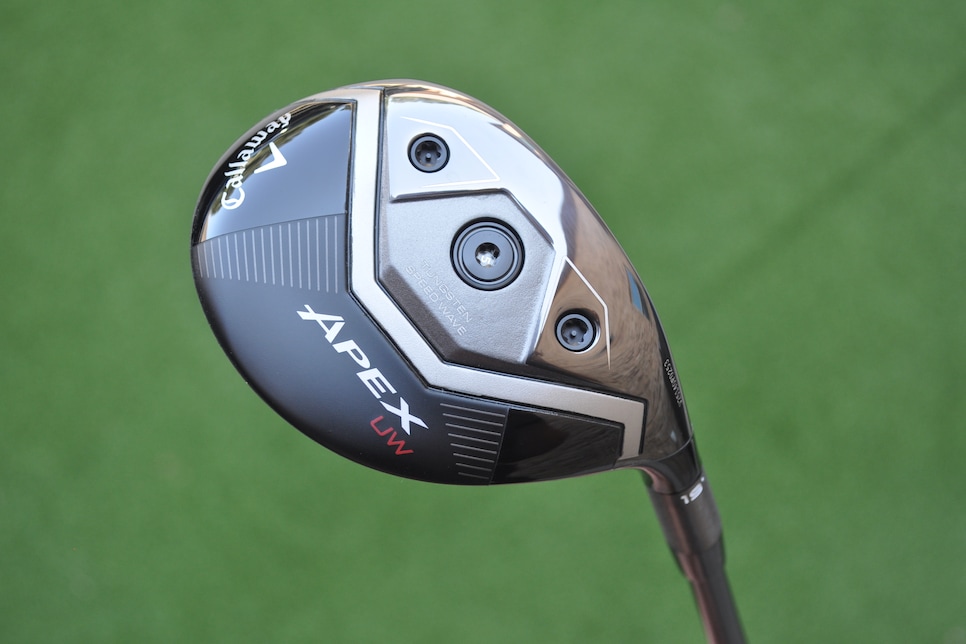
Case in point: Callaway Apex UW.
The overall profile remains the same, but in an effort to enhance impact and speed, two modifications were made to the latest Apex UW. The first is a redesigned sole design that steps down to reduce turf interaction and promote consistent contact, regardless of lie.
The sole design is paired with a wave structure — also found in the sole — that places more than 41 grams of tungsten low and forward for speed purposes. However, instead of simply placing the tungsten directly on the sole like other brands, Callaway chose to go with a more unique internal structure.
“It allows us to put weight low and forward,” Williams said. “But it’s suspended from the sole, which gives us more deflection and flex low on the face.”