
Forged by nature. That is the tagline of the Open Championship. A major that is survived, not simply won. A major where the elements play as much as part in the week as the players themselves.
At least that’s how the story goes.
It seems that mid-July, around the links of the U.K., web traffic to weather apps and websites hits an all-time high as fans, media, gamblers and players scramble to find an edge for the year’s final major. But what impact does the draw, and when a player is teeing off, actually have on the result?
We dove deep into the data to find the answer.
Related: Open championship 2026: 5 ways Royal Birkdale has changed since its last Open
Let’s begin with how the impact of the draw is measured. In the opening rounds of any tournament, players are split into two sides of the draw. They either tee off early-late, meaning a morning tee time on Thursday and an afternoon tee time on Friday, or vice-versa. The difference between those two groups of players represents the impact of the draw.
Dating to 2004, the average impact of the draw in a major is a little more than one shot (1.09).
There are years when the difference is nearly null. Take the 2021 PGA Championship at Kiawah Island. The variance between the two waves of players was a 0.01 shot advantage for those who teed off late on Thursday compared to those who went off early. The group did contain Phil Mickelson, who went on to win by two shots.
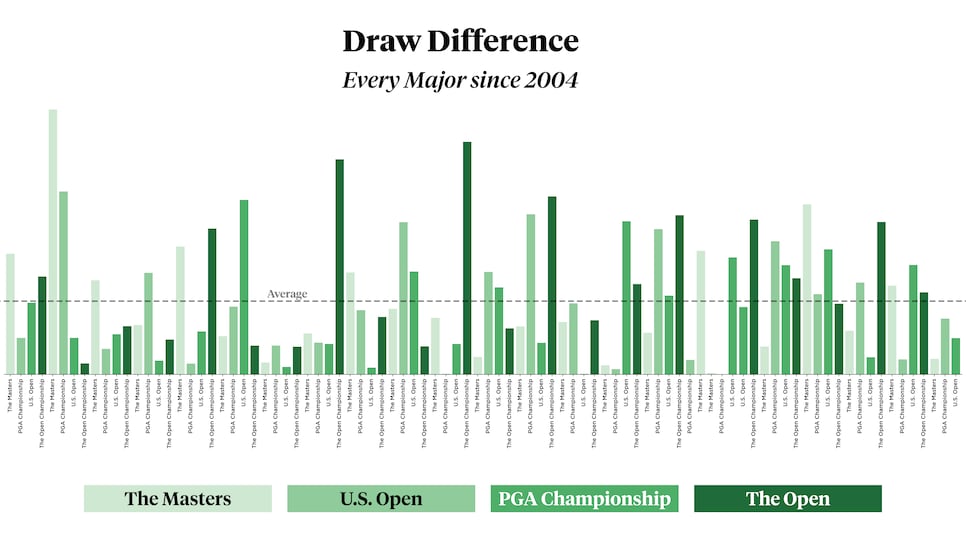
On the other end of the scale, there’s the 2005 Masters. Those on the early-late side of the draw had an advantage of nearly four shots (3.88). However, that week was severely impacted by weather delays that actually saw most players finish their opening rounds on Friday, which skews the numbers in this case.
However, if you take all 93 majors played since 2004, seven of the top 14 tournaments with the largest scoring difference by wave have come at the Open Championship.

Surprisingly, though, considering all the conversation surrounding “draw bias,” of those seven Open Championships, only four of the seven winners were on the “better” side of the draw. Shane Lowry, Collin Morikawa and Padraig Harrington all overcame a supposed draw disadvantage to lift the Claret Jug.
While many will remember Harrington’s heroics on the penultimate hole at Birkdale in 2008, it was arguably his opening round that led to his victory. Teeing off in the early wave Thursday morning, Harrington battled to an opening-round 74. While that doesn’t sound impressive, the average score of that wave was 77.4.
Also playing in the morning wave that day were Mickelson, Ernie Els and Vijay Singh, all top-10 players at the time. In the same conditions as Harrington, they shot 79, 80 and 80, respectively, essentially ending their Open dreams before they’d eaten lunch on the opening day.
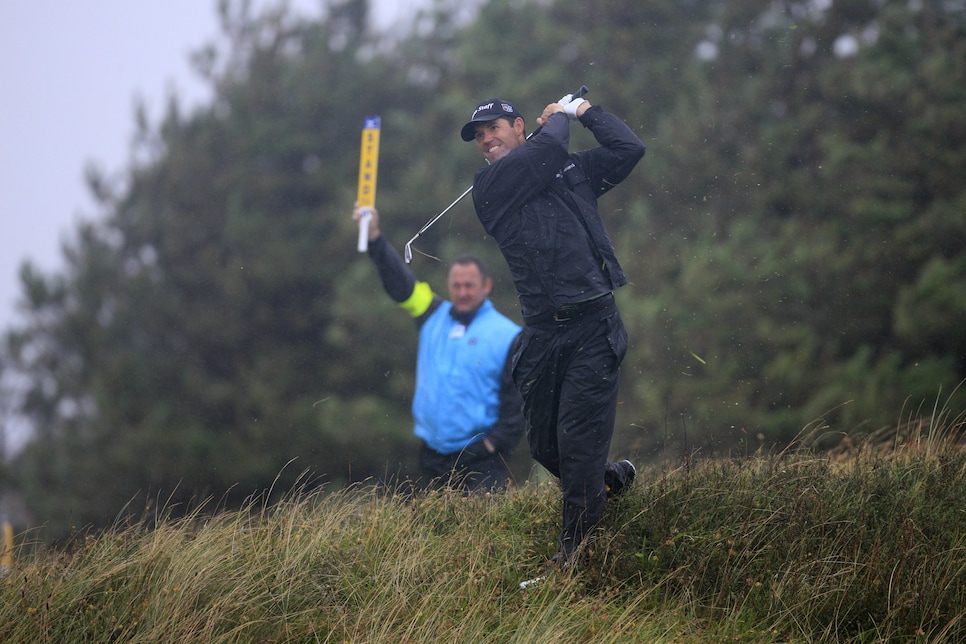
[Photo: Peter Muhly] In 2008 at Birkdale, Harrington got a lousy draw, but shot an opening 74 when his side of the draw’s average was 77.4. He then fought back to win the claret jug for the second straight year.
Els battled back with rounds of 69, 74 and 69 to finish inside the top 10, but wasn’t able to overcome the disadvantage of the draw to mount a charge on Sunday. Harrington, however, shot 68, 72 and 69 and won by four shots.
That shows the differences in the waves generally, but what about playing early-late, meaning a player tees off Thursday morning and then Friday afternoon, versus late-early? Is there a statistical difference over time?
Using the Open as the example, there is no sign that either wave is “generally” advantageous. This century, there have been 25 Open Championships, 13 won by players who teed off early-late and 12 from the late-early wave.
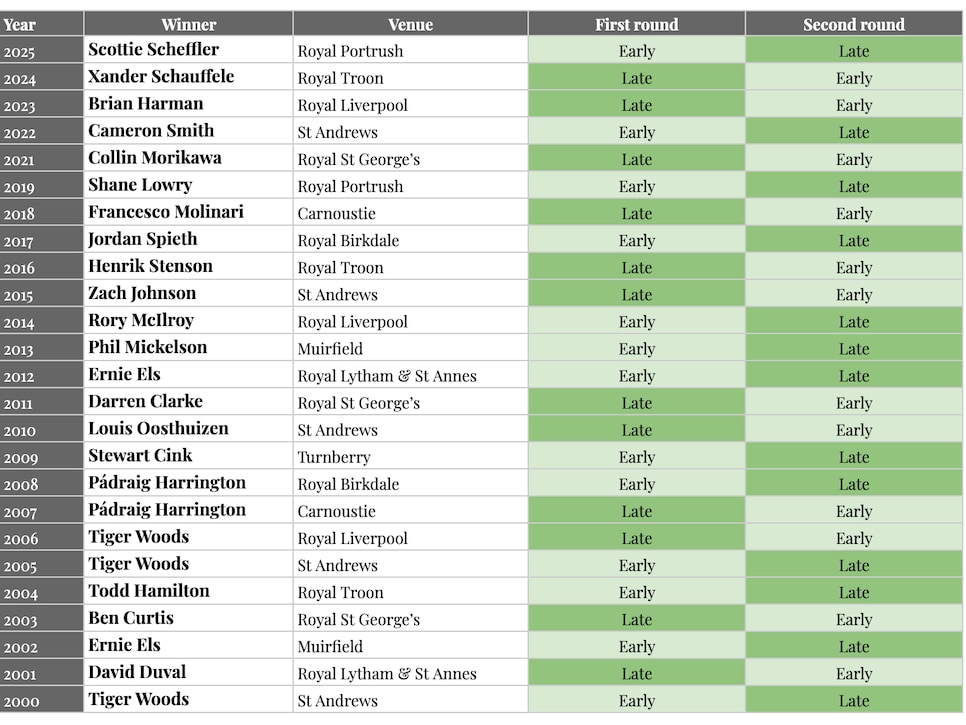
Of course, the weather is the x-factor in all of this. The Open, as the R&A’s branding says, is “forged by nature,” and so are the scores. For example, 2016 at Troon, of the 11 players who finished the week at two under par or better, nine teed off late Thursday and early Friday, with heavy winds and rain blowing through late in the second round. (Mind you, the Open is unique among majors with full 156-player fields in that everybody tees off on the first hole. That means the “extremes” of the early and late side are more drawn out.)
Rory McIlroy was one of those two players who battled the tougher side of the draw that year to finish inside the top 10. “It was a tough week,” he admitted after his final round. “I think Friday for our side of the draw especially and then Saturday was a tough day.”
It’s a common quote during Open weeks.
In conclusion, is there a notable draw bias at the Open Championship?
Of the four majors, it does produce the largest scoring differences between waves, with a difference of 1.2 shots. However, that is only minimally larger than the Masters at 1.1 shots and the U.S. Open at just under a shot (0.97). The PGA Championship is the most even of the four majors, with a wave difference of just 0.56 shots.
Of course, it’s heavily affected by weather. Be prepared to digest multiple predictive forecasts early in the week at Royal Birkdale and then await the quotes of an unlikely draw come the weekend. As with all parts of links golf, there’s an element of luck and fortune involved. Those that embrace it, like Harrington did in 2008, are best suited to the test the Open presents.