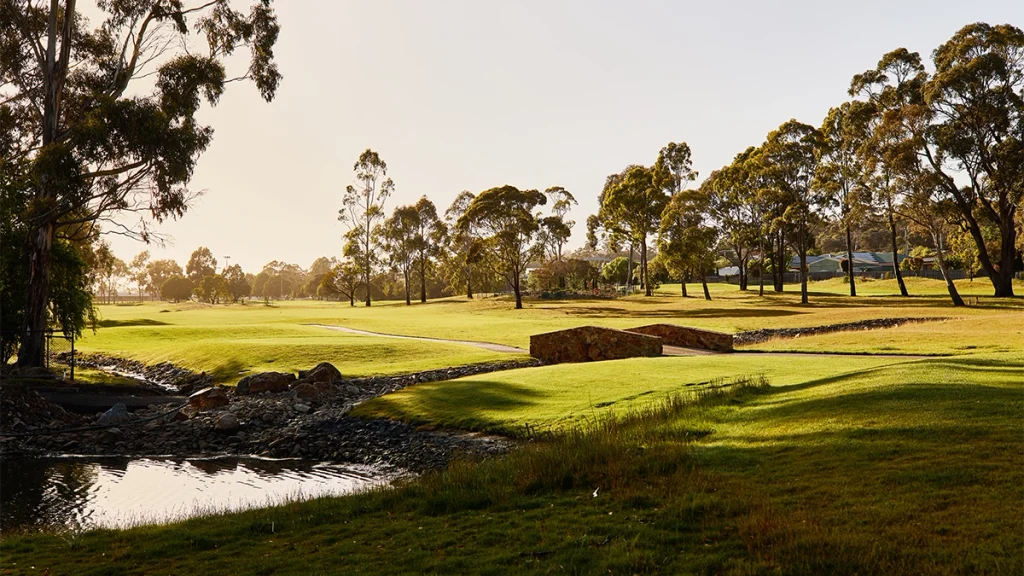
At Royal Birkdale this week we are seeing a firm, fast and baked out Open Championship for the first time since Carnoustie in 2018. While the brown-tinged links of Europe dominate our World’s 100 Greatest list, many American golfers likely believe that green is healthy and brown is dead.
RELATED: This common golf-cart mistake is a ‘superintendent’s worst nightmare’
Your local superintendent likely disagrees with that common misconception. Many golfers are surprised to learn that firm and brown fairways can be healthier, heartier and more fun to play on than many of the lush greenscapes golfers have become accustomed to. The trend toward firmer and browner conditions could be here to stay globally, as the turf industry makes new innovations in drought and heat-tolerant grass varieties in response to economic pressures.
In order to better understand the specifics behind keeping courses firmer and browner we spoke with Michael Dachowski, the Director of Agronomy at Shelter Harbor Golf Club, in Charlestown, R.I.
How do you weigh optimal playing conditions against the common misconception that wall-to-wall greenery is the only indication of a healthy golf course?
Michael Dachowski: I blend a balance of the two, where the course is not overly green, but still looks good and plays as dry as it can without being too brown. I grew up working and playing at a property that only had irrigation on the greens and tees and the grass grew back each year healthy without dying in the summer months.
Are certain grasses more tolerant to drying out than others?
Michael Dachowski: I’ve managed everything except for paspalum, and all of them can play firm and dry. The most tolerant and the easiest to grow back healthy are bentgrass and fescue, especially places like the United Kingdom and Ireland that use fescue on fairways, greens and rough. Conversely, Bermuda and Poa annua grass are more delicate and can die if they dry out too much.

Michael Reaves
Walk us through some of the money and resource-saving that can happen with reduced watering?
Michael Dachowski: To maximize efficiency you can spatial-adjust irrigation heads based on the micro-climates of the course. Some heads don’t run once during the whole year if they’re positioned in an area that dries out slowly. Other places you have the opposite where a head on a wind-swept mound will need constant water to keep the surrounding area alive. Using less water means less usage of fungicides and less disease for the course as a whole. Watering when necessary in this way creates significant savings.
How do firm and dry conditions change on-course strategy and set up nuances?
Michael Dachowski: It brings more things into play that don’t happen when it’s soft. Mounds bounce in different ways, you have to run it up greens and play more bump-and-run shots. It plays more fun, and you can be more creative, using backstops and slopes that you otherwise could not if it wasn’t firm.
MORE ASK A SUPER
You might be throwing broken tees in the wrong spot. A course superintendent explains why
Should I leave bunker rakes inside or outside the sand?
How courses prep for high-level competition, according to top USGA experts
Why are practice greens slower than greens on the course?
Why’s the grass all brown on our course?
Why are you aerating our greens when they’re in perfect shape?
I repaired my ball mark, but it still doesn’t look right. What did I do wrong?
We all want fast greens, why can’t you just cut them shorter?
Why your superintendent is hoping for lots of snow this winter
This article was originally published on golfdigest.com