US Opens aren’t won by doing great things. They’re won by avoiding bad things. Which is exactly the challenge the rest of us face every time we play.
It’s why the US Open is the major we can learn the most from. And the single biggest lesson, the thing you’ll see at Shinnecock all next week, is the art of the bailout. It’s the subject of our latest Game Plan episode (watch it on YouTube or below!).
Bailout strategy #1: Play to what you can see off the tee
On semi-blind tee shots, pros bail out to the part of the fairway they can see clearly. Matt Brilliant from his YouTube Channel “Golf Sidekick” calls it “playing to what you can see.”
Getting your ball into play closer to the hole off the tee, even if it’s in the rough, is why Bomb and Gouge exists, and the stats show it’s a more optimised strategy. But statistics also can’t measure earthing. Matt says playing to what you can see can breed confidence and help you make a committed swing. And a confident, committed swing is always better than a tentative one.
Brooks Koepka put on a clinic of this at Shinnecock in 2018; go count how many irons he hit off the tees that week.
For higher handicaps, coach Will Robins has a version of this idea for 80s and 90s shooters: the 10% rule. Take 10% of your club’s total distance, then add it to both sides of your target as a miss budget.

So, a hybrid that goes 200 yards needs a 20-yard buffer on each side, so 40 yards total.
As soon as you find a club within the hole, that’s your bailout club. If it doesn’t, club down.
Bailout strategy #2: Knowing when to bail out short and long
Old courses like Shinnecock are designed with bailout areas short of the greens and chutes that lead onto the putting surface. Most trouble is pushed aside. That’s because they were designed in the hickory area, when the ground game was more important. Players rolled the ball along the ground more often, so courses were designed to reward that. In the modern era, these blank spaces of grass are often good places to bailout, zones to hit your ball into to avoid a big number and move on.
Of course, sometimes the worst trouble around the green is right in front of it. That’s when it’s time to bail out long.
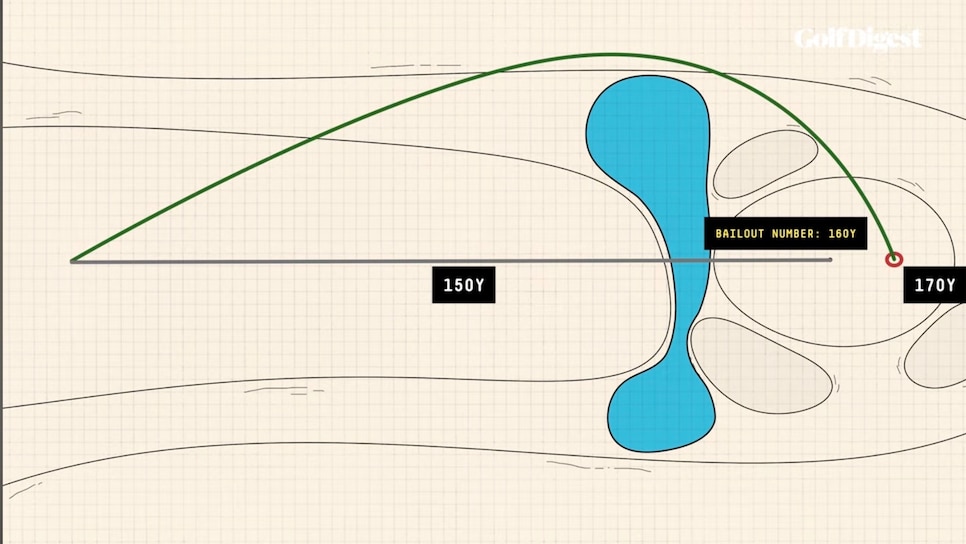
When that’s the situation, a good rule is to take the number between the pin or the middle of the green and the back edge and fly the ball to that number. So, if the pin is 150 yards, and the back edge is 170 yards, your goal is to fly your ball at least 160 yards.
Bailout strategy #3: Putt to the high side
Amateurs from scratch to 15-handicap three-putt about 25% of the time, starting at around 30 feet. A big reason is that we tend to under-read putts. And because gravity pulls the ball down the slope, an under-read putt keeps rolling away from the hole, while an over-read putt keeps rolling toward it.
Renowned putting coach Phil Kenyon has a clever trick for this. Imagine a straight line from your ball to the hole. Then, based on the slope, pick a spot you think the ball should pass through about 2/3 of the way to the hole. Now take that distance and double it. That’s where you should actually aim. Even a little outside of that, to be safe.
On long putts with a big slope, bail to the high side. You’ll be surprised how many fewer three-putts you’ll have.