The Americans could feel the celebration coming before they knew where it would find them, a low roar gathering across Medinah without a fixed address, the only question was where it would finally break.
They were waiting behind the 18th green to welcome Jackson Koivun after he finished off Si Woo Kim, but the United States remained one point short of winning the Presidents Cup. With Xander Schauffele poised to deliver it on the 16th, the team peeled away and headed toward the par-3 hole. Schauffele missed the winning putt, sending everyone scrambling back to 18, where Jacob Bridgeman suddenly had the honour. Min Woo Lee rammed his par attempt past the hole, Bridgeman buried his two-footer and the Americans poured onto the green, an oddly muted punctuation mark on a wild week that somehow ended exactly where everyone expected.
It was a historic Sunday comeback for the Americans, though not enough to erase the doubts and frustrations created over the previous three days. It was a devastating collapse for the Internationals, though not enough to diminish everything they did to reach the brink. The competition gave us everything we claimed to want from it, earning itself a reprieve while delivering a verdict it can no longer escape as the Americans, once again, captured the Presidents Cup.
“I think these guys never lost faith,” US captain Brandt Snedeker said following his team’s 17-13 comeback victory. “I know what that team room is like. I told the guys last night that funny stuff happens here. Medinah has a history of funny things happening. Sure enough, they went out and played their asses off today. I’m so damn proud of those guys.”
RELATED:
Where to start? Perhaps with the first hint of the chaos to come in the uncertainty surrounding President Donald Trump, or more precisely, what he planned to do with a microphone. A report claimed Trump had requested 15 minutes to speak, threatening to turn a communal celebration into a political rally. Instead, PGA Tour CEO Brian Rolapp introduced the president, who took a swipe at the “fake news media,” said he had been asked to speak but would rather watch golf, and surrendered the mic after roughly 30 seconds. That was only slightly less time than it took to realise the Internationals were in trouble.
After falling behind early, Cameron Young became the American pace car, winning five holes in a nine-hole stretch to dispatch Ryo Hisatsune. Justin Thomas went 4 up through four against Corey Conners, who putted as if the greens were changing speeds beneath his feet. Scottie Scheffler was hardly at his best but still handled Nico Echavarria, the sacrificial lamb battling a case of the driver yips. Chris Gotterup remained in control even as Christiaan Bezuidenhout dragged him to the 18th. At one point late in the afternoon, the Internationals led only two of the 12 matches. Through three days, the suspense had stacked like a slow-building thriller, only for the ending to give itself away by happy hour.
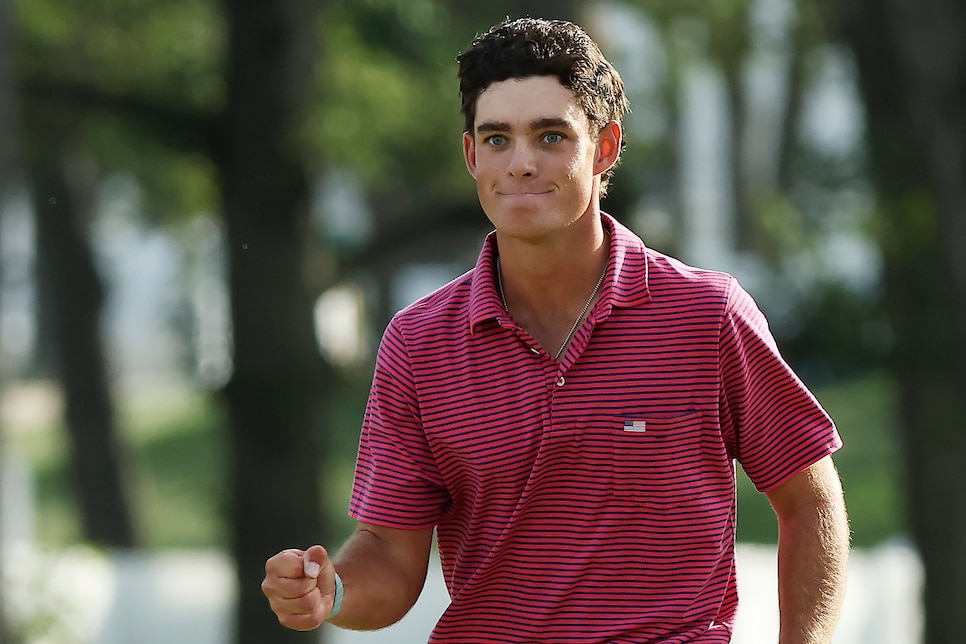
The afternoon had two inflection points. The first belonged to Collin Morikawa, who poured in a 30-footer on the 15th shortly before Hideki Matsuyama missed from four feet, pulling their match square. The second belonged to Koivun. The 21-year-old, only four months removed from competing against amateurs, drew Si Woo Kim, the Internationals’ best player, and stood 2 down through 10. Koivun answered with consecutive birdies to square the match, marking the second with a fist pump on the 12th that summoned one of the loudest roars of the day. When Kim bogeyed the 13th, Koivun owned the lead.
[Photo: Sarah Stier]
What followed gave American golf an indelible image. Much has been made of the supposed lack of chemistry inside the U.S. team room, the belief that its players cannot summon the same affection and fellowship the Europeans bring to the Ryder Cup. The Americans pushed back against that charge all week, and on Sunday they offered something more convincing than words. Young and Thomas, who had shepherded Koivun through his opening session Thursday, were waiting beside the 13th. By the 15th, Scheffler, Sam Burns and Wyndham Clark had joined them, sensing the kid might need a little help getting home. The group even broke away to roar across the lake when Patrick Cantlay buried a 40-footer on the 16th to put away Adam Scott. American teams have always insisted the bonds were there; for once, they were visible. When Koivun won, his teammates swallowed him in an embrace and draped the Chicago Cubs’ “W” flag over his shoulders. He looked less like the rookie they had carried than the little brother they had claimed.
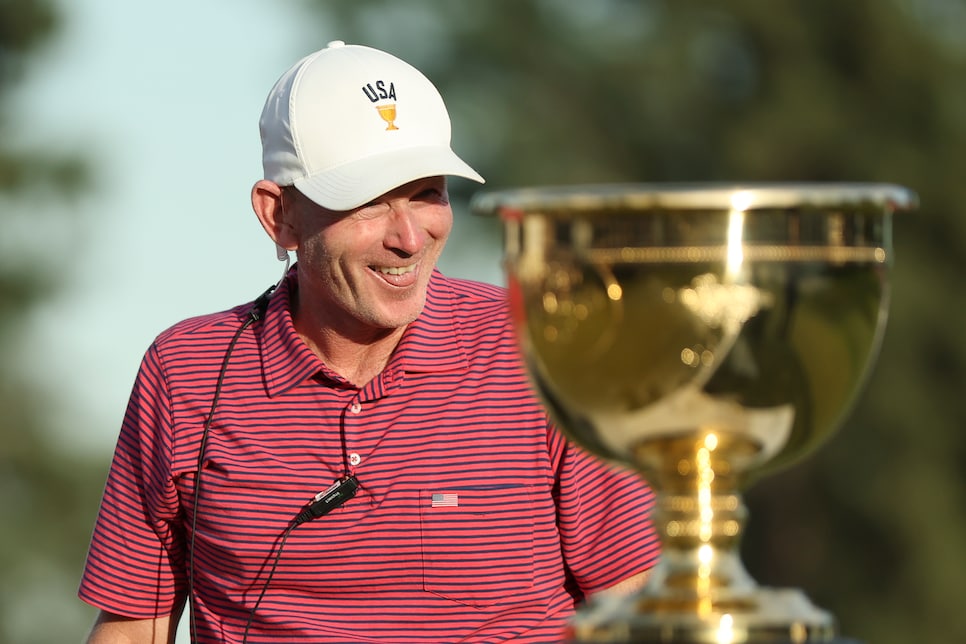
“I want these guys to really enjoy what they just did today,” said assistant captain Jim Furyk, who is taking over the reins for next year’s Ryder Cup in Ireland. “Walking into a Sunday three points down, having a lot of pressure, playing like they had nothing to lose, going out there and showing off for these fans, getting them into it, I really want them to enjoy what they did today because it’s pretty darn special.
“We’ve made some good runs on Sunday, but it’s hard to really get them over the hump and actually finish it off, and these guys finished it off like I’ve never seen before. I’m proud of them.”
Still, Sunday’s comeback handed American leadership a dangerous excuse to overlook the rest of the week.
This result should be received as a warning that the lessons from last year’s Ryder Cup remain unlearned. The Americans again appeared to ignore the statistical case for certain pairings, trusting friendship and instinct instead, then got run over in foursomes. They failed to shape the course to their strengths, an especially baffling oversight after making the same mistake at Bethpage. There were needless tactical errors; after sitting Scheffler on Saturday afternoon, Snedeker put him first on the board for singles, allowing the Internationals to dictate whom he would face. Poor results were once again explained away as poor putting, as if the Americans had merely been unlucky rather than outmaneuvered and outplayed. Snedeker even supplied future opponents with bulletin-board material by declaring, “This team is going to be a problem in Ireland.”
Hanging over all of it is the larger structural failure, as American team golf remains divided between two governing bodies and reinvented according to the preferences of a new captain each year. The Presidents Cup belongs to the PGA Tour, the Ryder Cup to the PGA of America, even though the same core of players competes in both and keeps encountering many of the same problems. Whatever is learned in one team room does not necessarily reach the next and each captain arrives with his own ideas about pairings, preparation, analytics and course setup, then leaves before those ideas can be properly tested or refined. The operation resets every year, carrying little institutional memory beyond the players’ scars. There is no permanent Team USA structure studying what works, correcting what does not and building a culture that survives changes in leadership. Until one exists, the Americans will keep treating recurring failures as isolated mistakes and asking a temporary captain to solve problems decades in the making.
Sarah Stier
Then there was this from Snedeker: “I’m tired of hearing how these guys aren’t close. I’m tired of hearing how we can’t play team golf. Guys just proved it right then and there.”
Snedeker deserves some latitude. He was speaking in the rush of victory, proud of the fight his players had shown. He was also profoundly wrong. For the second straight team competition, the Americans overwhelmed their opponents in Sunday singles. When left alone to play their own games, they proved themselves to be the superior players. Their continued struggles in fourball and foursomes against weaker opposition reveal the problem Snedeker insists does not exist. They have failed to make each other better, to steady a struggling partner or summon from one another something that would not be there alone. They may care about one another. They may believe they are a team. But too often, when the format requires them to play as one, they become less than the sum of their parts. Convincing themselves otherwise is how the same problems follow them to the 2027 Ryder Cup.
Whatever their unresolved problems, the Americans still possessed the one thing the Internationals did not. As his teammates engulfed Koivun, Si Woo Kim stood nearby, fresh off a lip-out that had conceded the hole, staring toward the sky in disbelief. He looked aggrieved, almost wounded, as if trying to understand why the prayers of his team had once again gone unanswered.
For once, the Internationals had not required divine intervention. They nearly captured Thursday’s fourball session, then swept Friday’s foursomes to build a four-point lead entering the weekend. Saturday brought the familiar threat of an American charge, but the Internationals absorbed it, giving up only one point across two sessions. They entered Sunday favored to secure their first Presidents Cup victory since 1998. After three decades of playing the underdog, they had finally done enough to make winning feel less like a miracle than an expectation.
They needed five points. They couldn’t reach three.
Every concern about being outmanned, outgunned and overwhelmed by the Americans’ depth came due. The collapse lacked one spectacular wreck that could be isolated and mourned. It was closer to a sandcastle surrendering to the tide, slowly, quietly, surely, until there was almost nothing left of the beautiful thing they had built. Early deficits hardened into losses. Matches that needed to turn never did. Each glance at the scoreboard brought another patch of red, the possibility of victory disappearing so gradually that by the time the scale of the collapse became clear, there was little anyone could do to stop it.
Only Tom Kim, Sungjae Im and Nick Taylor truly answered the bell. Kim deserves particular credit. Two years removed from an ugly Presidents Cup performance, he returned with the defiance and urgency that once made him the emotional center of this team. But three players could not hold back an American roster that finally began playing to its talent.
Ben Jared
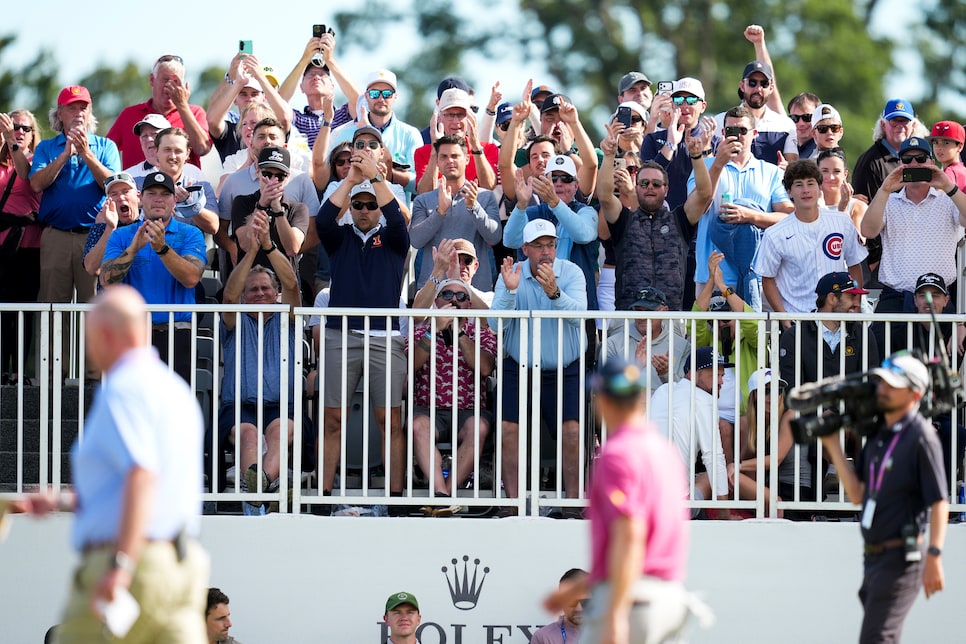
The crowd offered no relief. As the afternoon tightened, the atmosphere turned nasty. Not to Bethpage levels, but ugly enough to fall beneath what golf galleries, and American galleries, should tolerate. When a fan shouted during Echavarria’s swing, Scheffler conceded the Colombian’s ensuing 30-footer, a gesture of sportsmanship that doubled as an indictment of the behavior around them. It was one more indignity in a Sunday full of them.
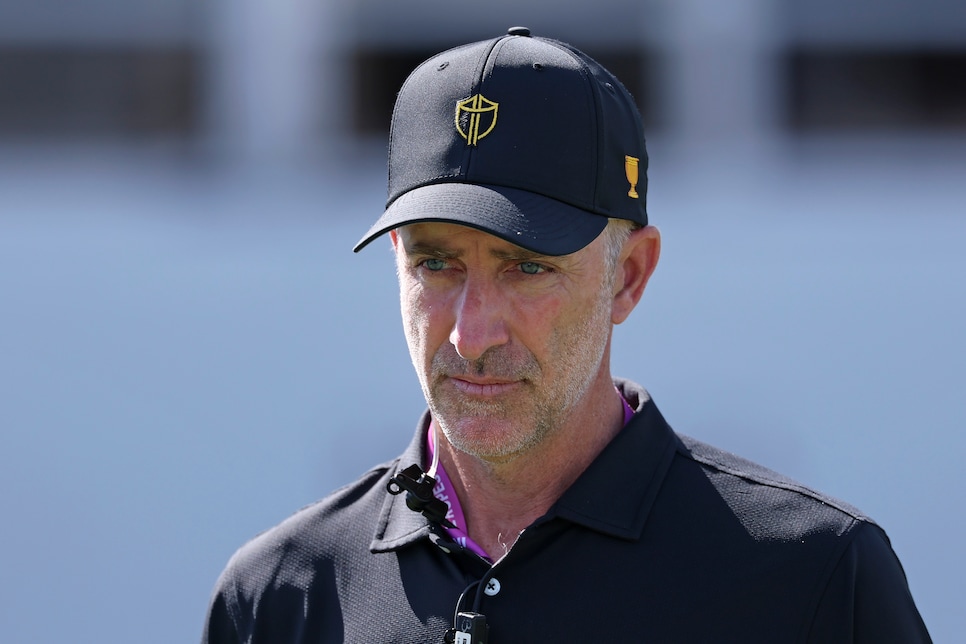
“It was just one of those days; it just felt like it was sort of right on a knife edge for a massive part of the day,” Ogilvy said. “If you hole a couple of putts at the right time and get a bit more yellow on the board at the right time, the momentum, and the crowd sort of stays out of it a little bit. It just started drifting away for us in the last few hours.”
The Internationals should be proud of what they accomplished at Medinah. They gave this event three days of tension it has spent most of its existence begging to produce.
Yet there is no gentle way around what followed. After spending three days proving they belonged on the same stage, they reached the moment that mattered most and revived every doubt that they belong behind the curtains.
It is fair to wonder how much longer anyone can keep investing faith in a different tomorrow. More than 30 years have passed, through different captains, generations, formats and venues, and the result has barely moved. This was supposed to be the breakthrough. The Internationals had the lead, the belief, the stronger pairings and a shaken opponent. They needed five points Sunday and ultimately lost by four. At some point, hope begins to resemble denial.
Kevin C. Cox
These are grown men and accomplished professionals. They do not need praise for trying hard, and they should not be asked to collect moral victories as consolation for another defeat. Frankly, the arrangement is beginning to feel unfair to them. Every two years they are assembled beneath the promise that this time might be different, then sent out as whipping against a deeper American roster. Their best weeks are remembered for coming close and their worst ones are offered as proof the competition does not work. Even when they supply nearly everything the Presidents Cup needs, they are left apologizing for failing to finish the job.
That is why a competitive week should not quiet questions about the event’s future. Sunday should renew them. One victory in 32 years does not make a rivalry, no matter how many flags are raised or how earnestly everyone insists otherwise. Over time, the Presidents Cup has begun to resemble an exercise in punching down, with the occasional close call used to justify doing it again.
The PGA Tour presents itself as a meritocracy, and Brian Rolapp has made clear that tradition alone will not protect a product that fails to serve fans. That standard should apply here, too. Crowds will continue to show up for patriotic golf, particularly when the home audience can reasonably expect to watch its side win. But attendance should not be confused with consequence. The Ryder Cup has established the standard for what team golf can be; the Presidents Cup continues to borrow its shape without matching its stakes. Eventually, the tour must answer the question that hangs over the whole enterprise: What, exactly, is this event for?
On Sunday, it was once again for, and only for, the Americans.
This article was originally published on golfdigest.com