Why is New Zealand attracting more investment in golf than Australia?
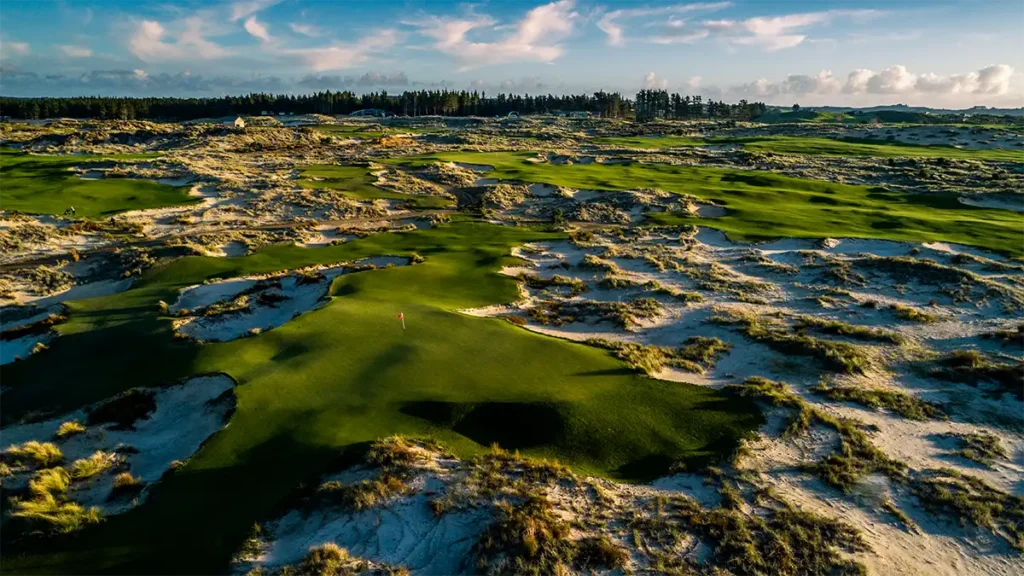
On a lonely coastal strip of New Zealand’s North Island lies what some would consider a non-descript piece of farmland. Yet this duneland in the middle of nowhere is envisioned to become one of the world’s great links courses. Five years after the signing of a contract with the previous land owner, construction is now underway at the ambitious Douglas Links project, 70 minutes north of the capital Wellington.
Douglas Links is located right on the coast at Ohau just 25 minutes north of Paraparaumu Beach Golf Club, the nation’s most historic links. With a build reported in the vicinity of $NZ50 million, the intent is for Douglas Links to pay homage to the ground game. Its business model includes green-fee public access with a very small membership.
Douglas Links has a distinctly Australian flavour. Darius Oliver is the golf-course designer while Lindsay Richter and Cameron Semple are the course shapers. Oliver, who designed Cape Wickham and The Cliffs Kangaroo Island, gushes about his latest project.
“It’s an unbelievable site. It’s all sand, it’s on the river, it’s on the beach, it’s kind of got a little bit of everything. It’s a very cool place,” he says.
The investor behind Douglas Links is Hamish Edwards, a Kiwi co-founder of Xero Limited that provides cloud-based accounting software for small businesses. With headquarters in Wellington, Xero is the fourth largest company in New Zealand with a market capitalisation of $12.31 billion.
Edwards is part of a new generation of entrepreneurs who are behind major investment in New Zealand golf. They’re responsible for new projects near major commercial centres: Douglas Links (Wellington), ‘Muriwai Beach’ (Auckland), The Kinloch Club (Taupo), Gibbston Valley Resort (Queenstown), Glendhu (Queenstown/Wanaka) and Hogan Gully (Queenstown).
CHANGING OF THE GUARD
Eight of the top-10 layouts on the New Zealand Top 50 Courses have been built since the turn of the century. The late Julian Robertson changed the perception of New Zealand golf when he funded construction of Kauri Cliffs (David Harman, 2000) at Matauri Bay in Northland. The ‘Father of Hedge Funds’ continued his love affair with New Zealand by building Cape Kidnappers near Napier (Tom Doak, 2004).
Jewish-American billionaire Richard Kayne was responsible for creating the world-renowned Tara Iti (Tom Doak, 2015), Te Arai Links – South (Bill Coore/Ben Crenshaw, 2022) and Te Arai Links – North (Tom Doak, 2023) on the coastline north of Auckland. Elsewhere, a consortium of private investors funded another American-style venture at The Kinloch Club (Jack Nicklaus, 2007) near Taupo.
At Queenstown on the South Island, charismatic Kiwi Sir Michael Hill set a benchmark for local investment when he established The Hills Golf Club (John Darby, 2007). Apart from hosting the New Zealand Open, the recluse of the late jeweller is known for an array of exotic sculptures scattered across the property.
Golf architect and Queenstown local Darby utilised his remarkable skillset when he pursued a residential/golf development at Jack’s Point (2008). It’s now regarded as one of the world’s finest lifestyle estates, which will ultimately comprise some 2,500 homes and 8,000 residents upon completion. Incidentally, the first homes at Jack’s Point sold for $NZ250,000. New houses are fetching well in excess of $NZ1 million. Another unrelated development will proceed next door. Homestead Bay by Hanley’s Farm is about to break ground with plans for several thousand homes.
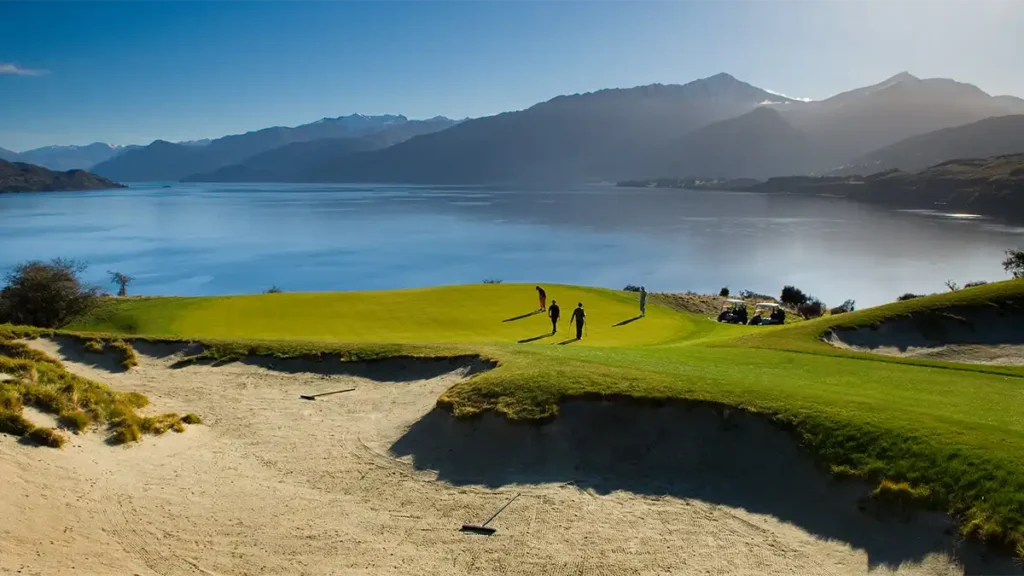
Glendhu on the edge of Lake Wanaka is the latest offering from Darby, which was anticipated to open this summer. Glendhu has been a labour of love given it’s taken some two decades to overcome planning, environmental and financial obstacles. At 69, Darby is showing little sign of slowing down. Nevertheless, it appears the baton is being passed to the next generation of golf-course developers.
Queenstown is a hive of activity some three-and-a-half decades after Japan’s Ishii family built the original 18 holes at Millbrook Resort (Sir Bob Charles, 1992). The boutique par-32 layout at Gibbston Valley Golf Club designed by leading professional Greg Turner opened in March this year. The golf course is part of a small residential development by Gibbston Valley Station, which owns the neighbouring resort and winery.
Hogan Gully, near the goldrush town of Arrowtown just outside Queenstown, is well underway. The Gil Hanse/Greg Turner layout features spectacular topography that will endear itself to aspirational golfers around the world. The Davies family is behind Hogan Gully. Sir John Davies, 85, is a former mayor of Queenstown and one of the most influential figures in Central Otago’s transformation. Once a high-country stockman, Davies forged a career in transport and later South Island tourism. He acquired the guided walks at the Routeburn and Milford tracks. As part of a consortium, he bought three ski fields from Air New Zealand: Coronet Peak, The Remarkables and Mount Hutt. Sir John is the sole shareholder of Trojan Holdings, which holds NZSki (owner of the ski fields), Tourism Milford (trading as Ultimate Hikes), and has a 40 percent share of Bungy New Zealand, of which A.J. Hackett is the public face. Sir John’s son, Mike, is overseeing Hogan Gully.
On the North Island, Chinese businessman Jonathan Lu is funding construction of the yet-to-be-named course near Murawai Beach west of Auckland, which is likely to open in late 2027 or early 2028. Lu is a former chief executive of Alibaba Group, the multi-national technology company that specialises in e-commerce. The 57-year-old from Hangzhou (dubbed China’s Silicon Valley) has a reported net worth of $US1.1 billion.
“I’ve known him for a little over 10 years. Always been a passionate golfer,” says Ryan Brandeburg, executive director of Golf Tourism New Zealand. “The first couple of days of New Zealand’s COVID lockdown, he called and said, ‘I’ve always wanted to build a golf course. I don’t think the government alone can kickstart the economy. Let’s do it.’ Like, three days into COVID, we started putting a team together. First day the border restrictions lifted domestically, we got out on site. The rest is history.”
The Kinloch Club west of Taupo is set for expansion. Auckland multi-millionaire John Sax, who acquired Kinloch in 2011, has announced a major development for the 243-hectare property that he anticipates will bring $NZ900 million worth of investment into the area. Plans include new amenities at Kinloch Manor & Villas, up to 20 additional luxury villas and a gradual sell-down of 178 sections under subdivision consent, according to The New Zealand Herald. Sax’s Southpark Corporation has extensive land holdings and is one of Auckland’s largest industrial-space owners.
WHERE THERE’S A WILL, THERE’S A WAY
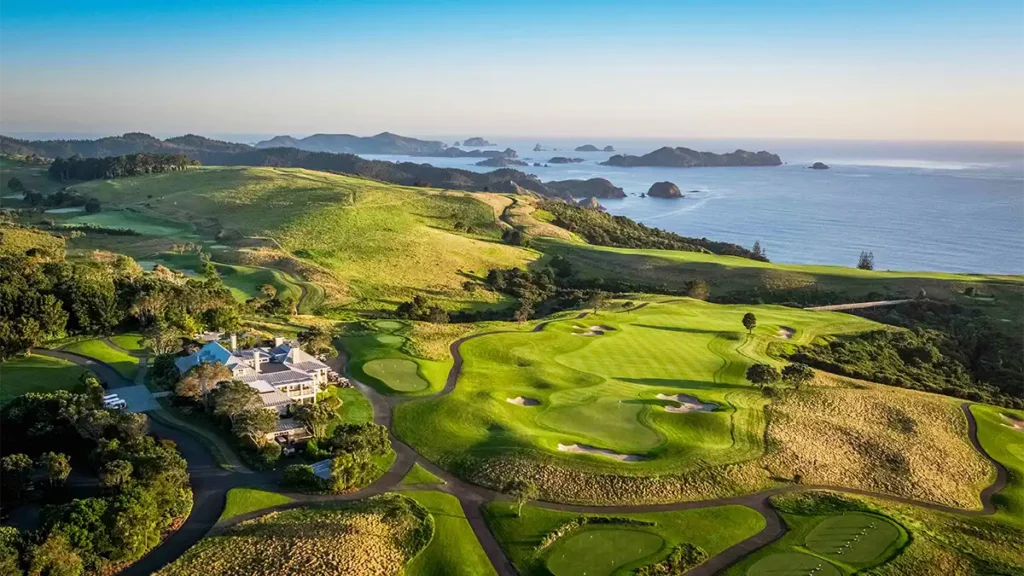
Construction on Douglas Links commenced in mid-2026. It will be a stark contrast to the American-style resort courses that enticed foreigners to New Zealand during the past quarter of a century. Kiwi owner Edwards considered various locations before settling on the farmland north of Wellington.
“We probably looked at 15 sites all around New Zealand,” Oliver recalls. “Mostly virtually, just before COVID hit – so late 2019, early 2020. All up and down on both islands. He wanted to build a links. He loves links golf. But we looked at buying kind of poor courses and re-doing them. We looked at leasing land. We looked at all these different sites.
“This one, to be frank, when I first saw the size of it, I wasn’t convinced it was going to be suitable. But as soon as I came out here, it’s like, ‘This place is amazing.’ He let me stay here for a week and produce a routing for it.”
Edwards is as golf-addicted as any person Oliver’s come across. The pair met in Queenstown when Oliver was designing the par-3 short course at The Hills where Edwards is a member. His obsession is evident with Douglas Links.
“It’s rare for New Zealand in that it’s a New Zealander who’s funding it. He’s very much focused on building an old-school, fun, British-style golf course – with a Kiwi vibe,” Oliver says. “He’s building it for golf, he’s building it for the region… This region is where his family’s from and so it’s really a passion project.”
Douglas Links is named after Edwards’ father, who was an accountant and Hamish’s mentor. It was the senior Edwards who introduced his son to golf, so he wants to name the course after his dad. Hamish even has a Scottish terrier by the name of ‘Dougie’ as the club mascot. Hence, the course-construction team wear hats with an embroidered logo of the little Scottish terrier.
However Edwards’ passion was severely tested during the arduous application process that stretched five years before a sod could be turned at Douglas Links. The project has been plagued by ‘cultural heritage’ difficulties. The Māori tribe on the other side of the Ohau River opposed the development and took legal action. The Land Court, then the High Court, ruled in favour of Edwards and progress is now underway with an anticipated opening in late 2028.
TREADING THE LEGISLATIVE TIGHTROPE
American investors are still “super-keen” to be involved with New Zealand golf. But the rules and regulations around foreign investment have become so much more stringent, says Golf Tourism New Zealand’s Brandeburg, who acts as a consultant for golf-course developers by helping them navigate what can be a tricky development-application process.
“We have a lot of people that reach out to us wanting to do something in New Zealand, and then start to look at the hoops to jump through,” Brandeburg says. “But then they look at the process of actually gaining a resource consent to build. I mean, that could be millions of dollars of pure-risk capital. At the end of the day, you may spend $3, $4, $5 million and get a ‘no’. And a lot of foreign investors look at that and just say, ‘Look, I’m willing to spend the money on building the place. I’m not willing to spend $5 million on risk to get a yes.’ I think that’s the challenge.”
History should acknowledge that American ‘philanthropists’ with deep pockets provided the catalyst for the current cycle of golf-course construction. They paved the way for Kiwis to take the baton and carry forward the momentum that may one day be described as ‘New Zealand’s Golden Age of Golf’.
“If I were to take a guess – and this is purely speculation,” says Brandeburg, “I think right now we’re building into demand. When Julian Robertson started, especially when the Ishii family built Millbrook originally, they were very much taking a pretty significant risk. Even when Darby did his projects, they were taking a fairly significant risk. I think now there’s more confidence in global markets coming to New Zealand. That if we build great golf, people are going to come and book a room and a tee-time.”
AUSTRALIA’S GOLF INVESTMENT MALAISE
Golf-course construction in Australia appears to have plateaued. Hobart’s 7 Mile Beach was the only new entrant to Australian Golf Digest’s ranking of Australia’s Top 100 Golf Courses for 2026. To put that into perspective, not a single Top 100-calibre layout opened on the Australian mainland during the past two years. That’s a staggering scenario for a nation of 28.5 million people experiencing the strongest growth in golf participation for three decades.
A primary reason is because the residential-golf phenomenon in Australia has come to a standstill. Developers require large parcels of land that can seemingly only be found on the outskirts of our mainland capital cities. Furthermore, the price of land makes it prohibitive to include an 18-hole golf course as part of a residential community. Lovedale Farm in the NSW Hunter Valley is the only ‘new’ residential-golf community under development.
A new trend has emerged, however. Established private clubs are seeking partnerships with developers to create seniors-living villages in exchange for a cash injection to replace existing amenities and fund course improvements. A prime example is Newcastle Golf Club, which is building several new holes designed by Bob Harrison.
The other major project on the Australian mainland is North Adelaide where the South Australian Government is funding a $60-million Greg Norman makeover. Away from the mainland are three new courses likely to feature in the 2028 ranking of Australia’s Top 100: 7 Mile Beach’s North course; Arm End on a peninsula south of Hobart; and The Cliffs Kangaroo Island.
Australia’s apparent malaise is in contrast to New Zealand, which has a similar number of golf developments but with a much smaller population base. Certainly, New Zealand arrived later to the residential-golf party than its neighbour. But it’s noteworthy that investors are building for demand. – Rohan Clarke