
It has been nine years since the Open Championship was last at Royal Birkdale and with this year’s return, it feels like the perfect time to reflect on what is the weirdest, most captivating finish to a men’s major championship in my lifetime: Jordan Spieth, 2017. Specifically, the final round. Hyper-specifically, the 13th hole.
I watched it all again for the first time in years last month and found it even more surreal and intoxicating than the original experience. The magic of it escaped me back then in the chaos of the finish, but it has aged beautifully, and I doubt I’ll ever go a full year without a re-watch again.
How best to commemorate it? Well, as Ty Webb would say, Be the ball. Let’s all live out a fantasy we never knew we had and “become” the Jordan Spieth of a decade ago.
What follows are the 10 necessary steps to manifesting yourself into the zenith of the Spieth Experience.
1: First, you must collapse at the Masters 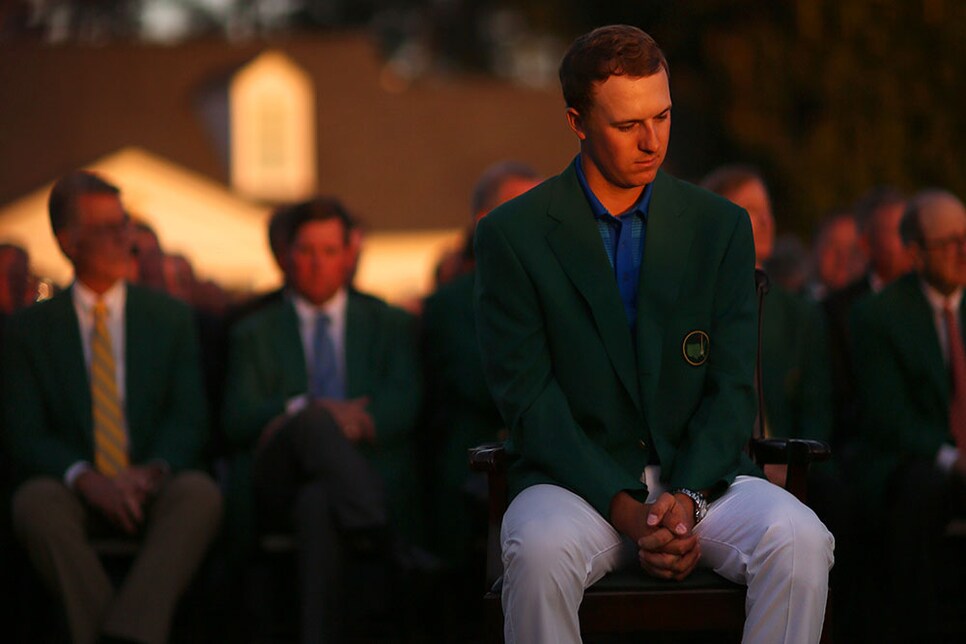
[Photo: Nick Laham]
There is no substitute for this particular stage-setting heartbreak. At the peak of your powers, when it seems like you’re bound to become the greatest player of your generation—when overtaking Rory McIlroy is close enough to be tangible and Scottie Scheffler is just some guy finishing his sophomore season at your alma mater—you, only 23 but spiritually so much older, must engineer the singular collapse of your entire career 15 months earlier. You must take a five-shot lead into the par-3 12th at Augusta National, hit it twice into the water and endure the humiliation ritual of placing the green jacket on the shoulders of a pretender who should never have slipped it on in the first place. You must rock your entire legacy, and wallow in ignominy, as the world wonders what will become of you.
2. You must seem to erase these memories through three glorious rounds at Birkdale 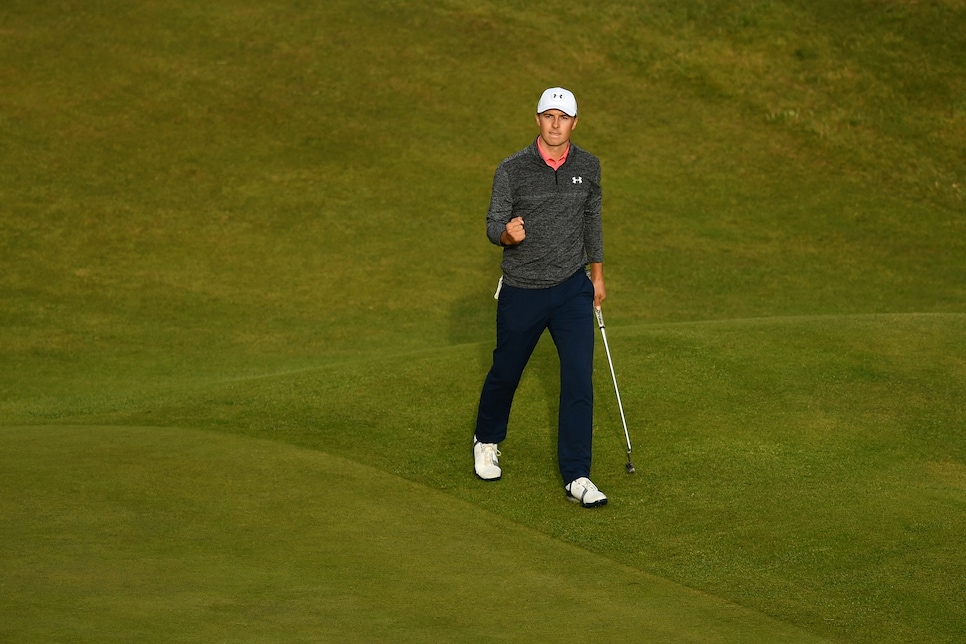
[Photo: Dan Mullan]
You must recover from the Masters with a win in 2016, and then two more in 2017. However, when five majors elapse without a single top-10 finish, your fans must wonder whether you are broken, whether the fire of your early youth has been snuffed out by the shattering memory of your slightly later youth. But when it’s time to tee up at Birkdale, all that must fade into the mist as you tie for the lead after Thursday, seize it alone by two shots on Friday and then vanquish the course and all your enemies with a Saturday 65, taking a three-shot advantage on Matt Kuchar and a six-shot margin on third place, which is shared by two players who will certainly go on to have glorious careers: Brooks Koepka and Austin Connelly.
3. You must suffer a lifetime’s worth of existential crises through 12 holes on Sunday 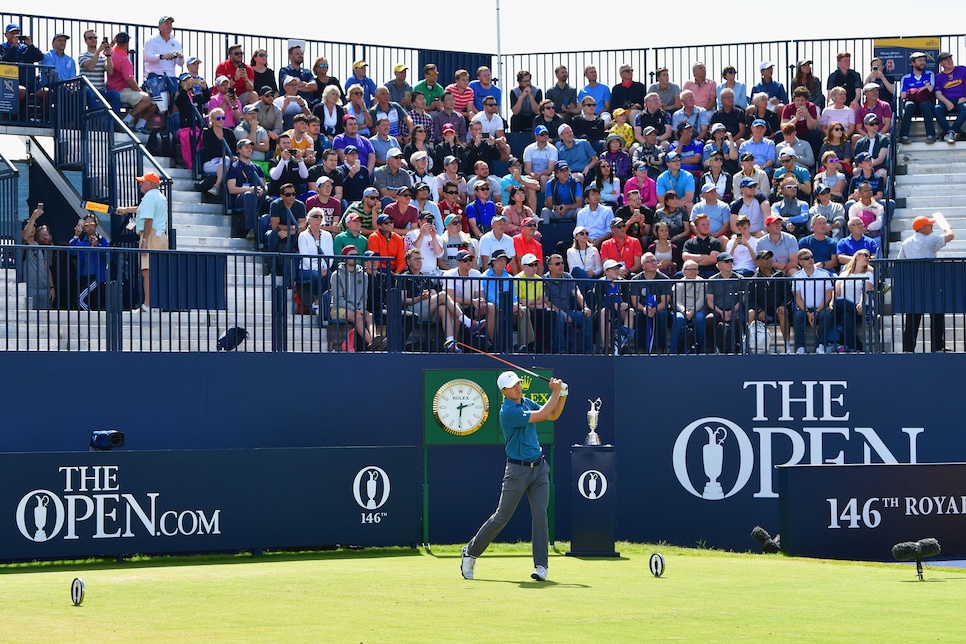
[Photo: Stuart Franklin]
You must fear the opening drive, to the point that you describe your dread in detail to your coach and caddie; then you must think you hit the shot well, but you must get a terrible break and make bogey. From there, you must start ruminating on the possibility of collapse, especially after you bogey Nos. 3 and 4, then you must recover slightly but cough up a devastating three-putt on nine. You must get to the 13th hole tied with Kuchar. (Lucky for both of you, all the other contenders will hit the skids, including Branden Grace, who shot a 62 the day before to break the men’s major 18-hole scoring record. McIlroy, you won’t be surprised to know, will spend the day fake-contending as part of his decade-long act. He’ll be fine in the end, mostly.) Through it all, the weather at Birkdale will match your mood—cloudy, misty, damp, miserable. You will wonder, both silently and openly to your caddie Michael Greller if you’re cracking again.
4. You must proceed to hit the worst drive of your entire life—or any pro’s life—on the 13th tee 
[Photo: Richard Heathcote/R&A/Via Getty Images]
Look, it has to be so bad Johnny Miller says it’s “about as poor as a pro could hit one.” It has to be so bad that you immediately adopt the Surrender Cobra pose, both hands on head, face looking like a lost boy until you remember, amid shouts of “Fore Right!,” to extend your arm to the east. The finger you point will not protect anyone, because the ball must hit a bald man on the head and carom to the far side of some steep marram-and-bramble dunes. For a while, nobody will have any idea where your ball went, except for the man who got hit and his friends, who will remain mysteriously silent until questioned by a referee. Until then, many onlookers will insist the ball ended up on the fairway side of the dunes, roughly 50 yards from where it is eventually found (most likely thanks to a cameraman in communication with his production truck). You will become mildly annoyed at all the people.
5. You must decide the ball is unplayable 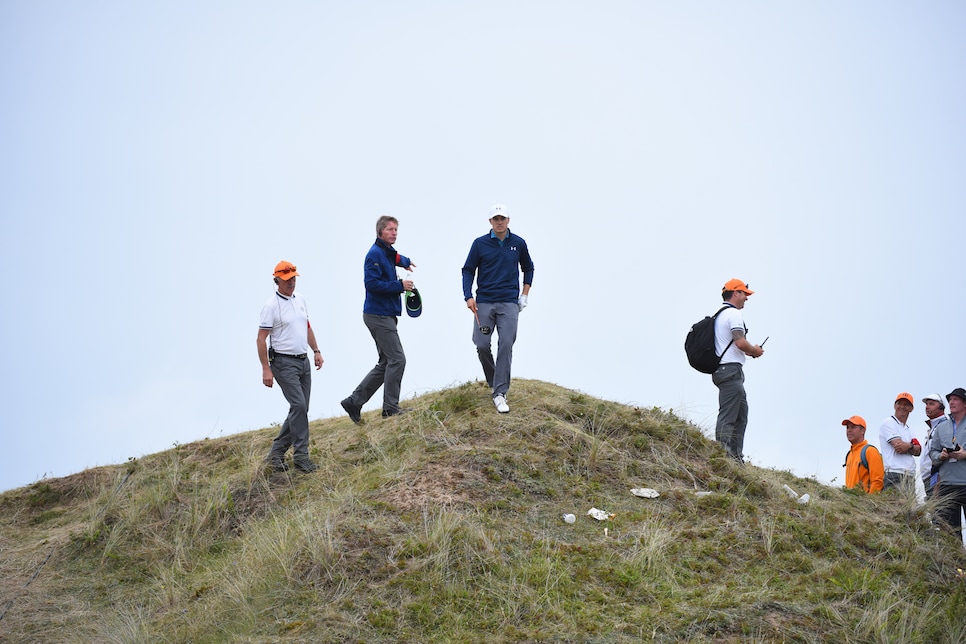
[Photo: Richard Heathcote/R&A]
This is the easy part, sort of. It will be stuck deep inside a patch of whatever sedge or moss or lichen or fescue or gorse abounds, and you’ll pick it up without a second thought. Greller will later say you have a gambler’s mentality and would have hit it if there were any prayer of advancing the ball, but you will sense, correctly, that there is a greater spectacle to be acted out than merely breaking your wrist on linksland bracken.
6. You must take the strangest of three relief options 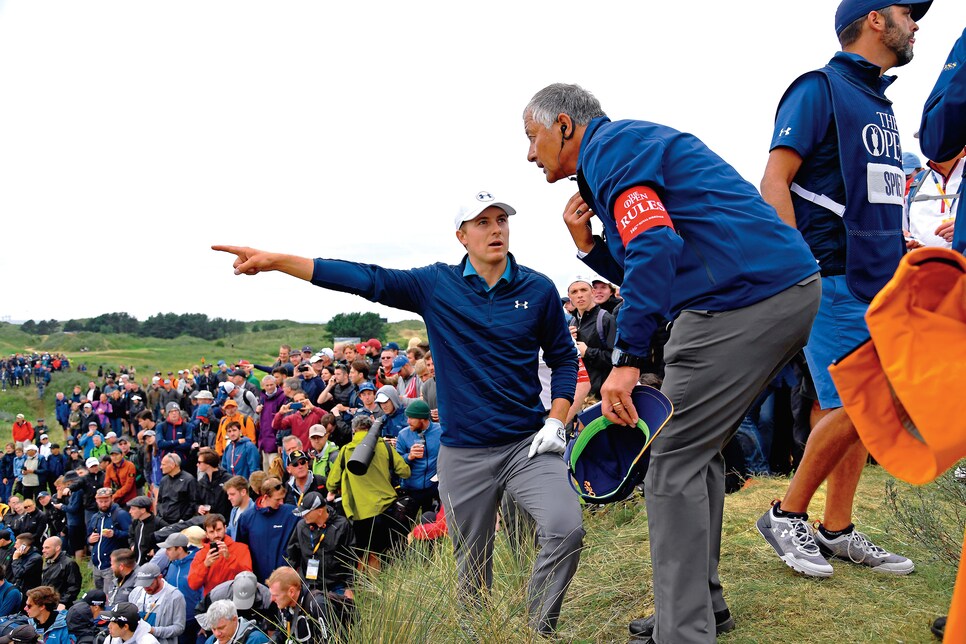
[Photo: Chris Condon/R&A/PGA Tour/Getty images]
[Photo: Stuart Franklin/Getty Images]
[Photo: Stuart Franklin/Getty Images]
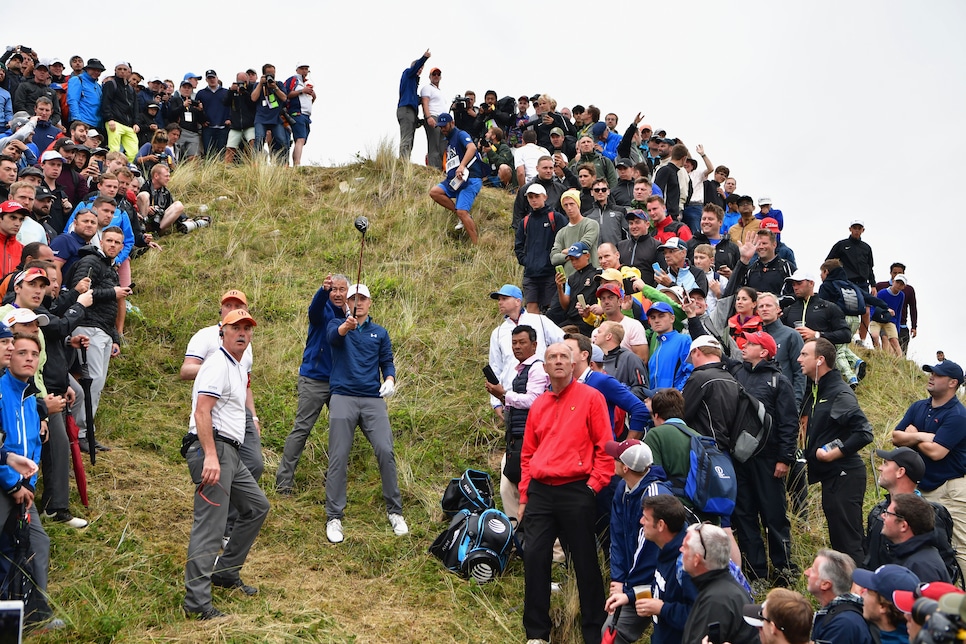
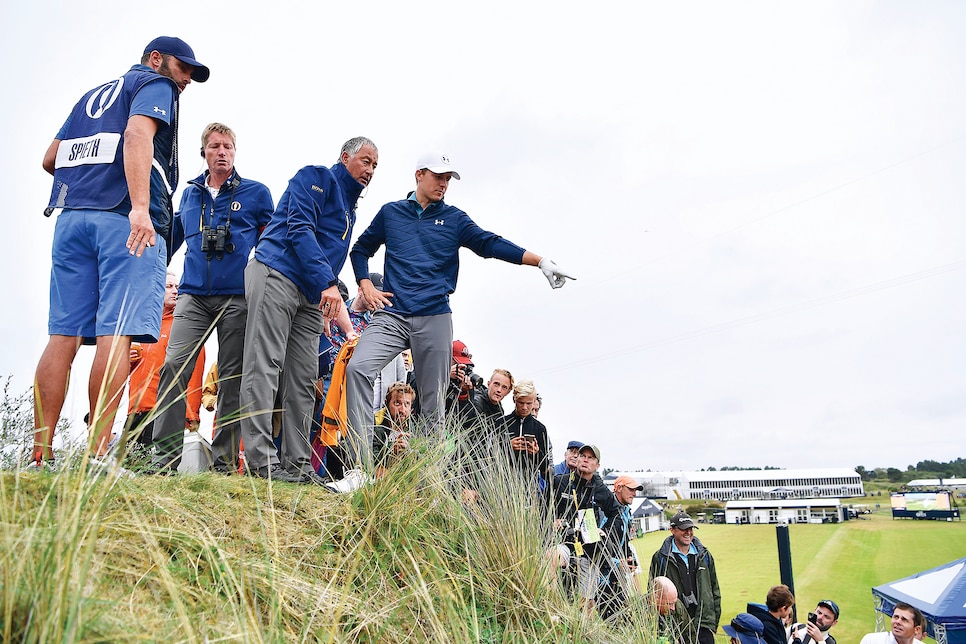
Using Rule 28 (now Rule 19), you must consider three ways to take relief after your penalty stroke. You’ll quickly dismiss the first one, stroke-and-distance, despite the suggestion from Greller and others who you can’t hear (like Johnny Miller). Down that road lies double bogey, at best. You’ll dismiss the second, dropping-within-two-club-lengths-no-closer, because you can’t be sure it would end up any more playable after the drop. Which leaves back-on-the-line relief. You must first look to the bottom of the dune, where you could drop in front of some equipment trucks, but there’s a problem: you’re still miles from the hole (actually 250 yards) but the dunes looming in front of you will only allow you to play something like a 7-iron, at best, which means you’ll still be hitting your fourth from a mile away. Down that road lies double bogey. See, at this point the mission must clarify in your mind: Come hell or high water, make bogey. At which point your eyes must drift beyond the dunes, beyond the equipment trucks, to a forbidden Eden with perhaps the best lie on the entire course: the driving range. In your mind, the siren song plays.
7. You must take 22 minutes and 20 seconds between shots, but you must be the most fascinating person on the course 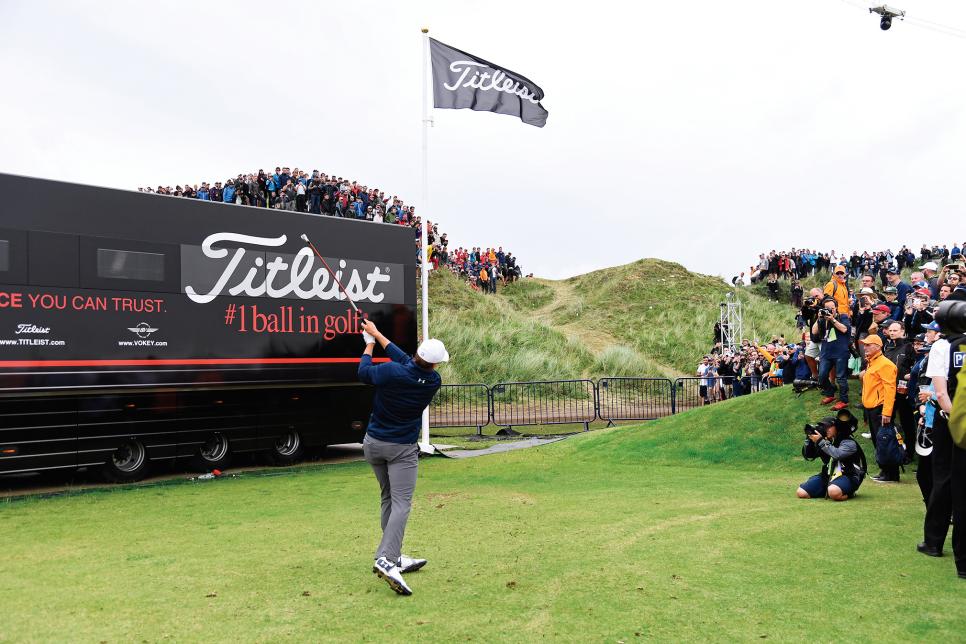
[Photo: Chris Condon/R&A/PGA Tour/Getty images]
You may wonder, “is it boring to watch someone look for the ball and wrestle with the rules for 22 minutes and 20 seconds?” In fact, it is not. The broadcast will cut away to show Grace holing out from a bunker, and McIlroy making an eagle putt, and Koepka doing various Koepka things, but somehow, you taking no shots will be almost painfully interesting, because you will look, by turns, like a mad genius or a man on the verge of a mental breakdown. At one point, the broadcast will show you wandering between two equipment trucks, seeming to have succumbed at last to insanity, but in fact you will be plotting out your great escape with a mechanical precision under pressure that can only be achieved by a man who lives on the cutting edge of madness. As you wander around the dunes and range and trucks, your brain will be in the cosmos, and the notion of feeling shame for the sheer length of it all will never occur to you. It won’t occur to anyone else, either, until afterward, because this odyssey, this batsh@$ magnum opus, is so compelling.
8. You must navigate a byzantine rule sequence that a thousand scholars with a thousand years couldn’t decipher 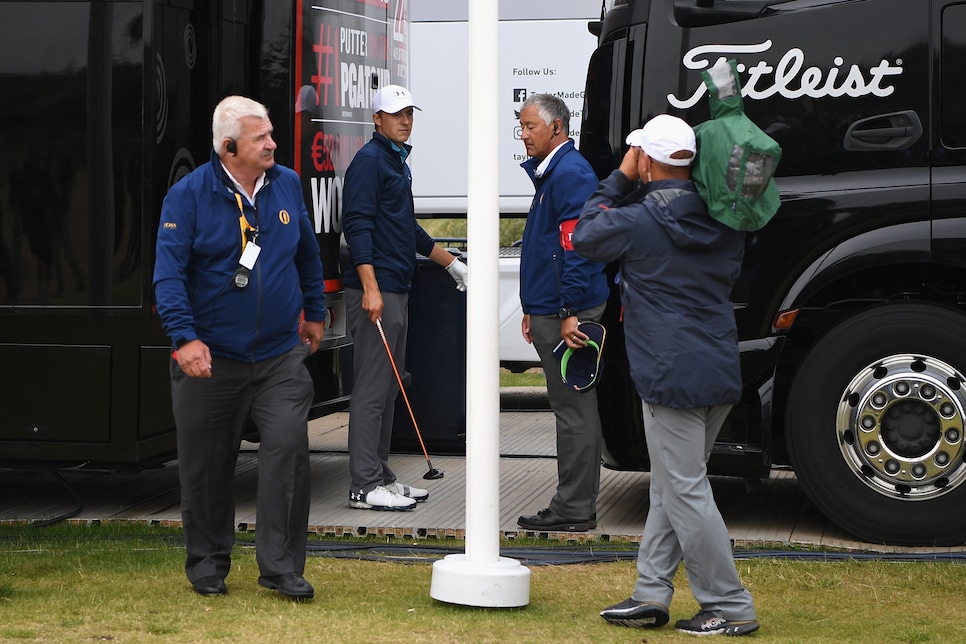
[Photo: Richard Heathcote/R&A]
There exist no souls in this world who love a rule more than the British, and there are no British people who love a rule more than those who rise to the level of rules officialdom at the R&A. But you, the 23-year-old Texan, will out-British them all. You will make them marvel at the rearguard action you conjure, as you cajole the land and its people and vision-board your salvation. The officials who are now dancing for you like marionettes will confirm the driving range is very much in play (the R&A, in all its wisdom, cannot plan for you, and hence nobody thought to make it verboten), and this will be your road out of perdition. You will get the trucks designated as TIO, but you’ll learn from a rules official who gave you a slow-play penalty a year earlier that if you go back as far as you’d like, relief will be to the left of the trucks, which is a disaster, but that if you creep closer and closer on the line between you and the flag, you will reach a point where relief defaults to the right, the realm of the fighting chance. This is why you’ll be caught by the cameras ambling between the trucks, and ultimately your drop spot will be dead in the middle of a Titleist truck. (Allergic to the whiff of scandal, the officials will unfortunately not make you climb to the top to execute your drop, and allow you instead to simulate it; the USGA would have made you climb, the PGA of America would have dynamited the truck, killing 12 bystanders, and Augusta National would have activated a trap door to make the trucks and all their occupants disappear instantly.)
9. You must, at last, make your heroic bogey 
[Photo: Richard Heathcote/R&A/Via Getty Images]
After one last piece of relief (this time from a flag on top of the truck), you must hit the 3-iron that Greller has begged you to hit instead of the 3-wood, become angry because after all that it seems you have missed right, but be saved by the fact that Greller fudged your line from the top of the dune because he knew how bad it would be to miss left. The camera will catch the ball cutting through the gorgeous mist, which in the overcast skies is no longer damp and miserable but romantic, with a tinge of imminent history. From a brutal spot behind the bunker—”it’s just a horrible chip there,” says one announcer—you will clip it perfectly, setting up the bogey putt that you, of course, will make, achieving in that divine bogey the apotheosis of the word “scramble.” As you leave the hole with Greller, trailing Kuchar for the first time all day, you will be ecstatic, both of you, and the caddie will later say that he could sense what awaited. That: “I could just feel it in how he was breathing, the words that he said.”
10. You must become electric 
[Photo: Matthew Lewis/R&A]
What is it about chaos, anarchy and the prospect of terror that utterly defeats most men but enlivens the chosen few? Why would the near-disaster on 13, and first loss of the lead since Thursday, be the exact thing that set you alight, that transformed your destiny that day? Why was the worst drive you could hit the best thing that could happen?
From here, everything will be easy. You must simply execute a few basic maneuvers. Like: Come close to acing the par-3 14th, make the birdie putt to tie, make an eagle putt of 50 feet on 15 to retake the lead, make a 25-footer for birdie on 16, make another up-and-down for birdie on 17. A fool could do it.
At which point Kuchar—who has gone two under through that same four-hole stretch, while starting off with a one-shot advantage—will slump his shoulders, knowing he has been relegated to the role of witness.
Yes, all you have to do now is deliver the most electrifying finish in the history of this tournament, leave veteran announcers who have been at it for decades with their jaws on the floor and strike a victory that an hour earlier looked impossible—and still feels that way now but for entirely different reasons.

[Photo: Andrew Redington]
And nine years later, you must make us wonder: Was that finishing stretch touched by something more than the gods of skill and fortune? Would it have been possible to mainline this rush of greatness if you hadn’t stepped out onto the ledge of 13, the ledge of infamy, yet again, to look that darkness in its cold eye and demand—demand audaciously, demand without an ounce of leverage—the recompense of reversal, revival and a deliverance bordering on karmic?
Sir:
We wish you the best of luck.