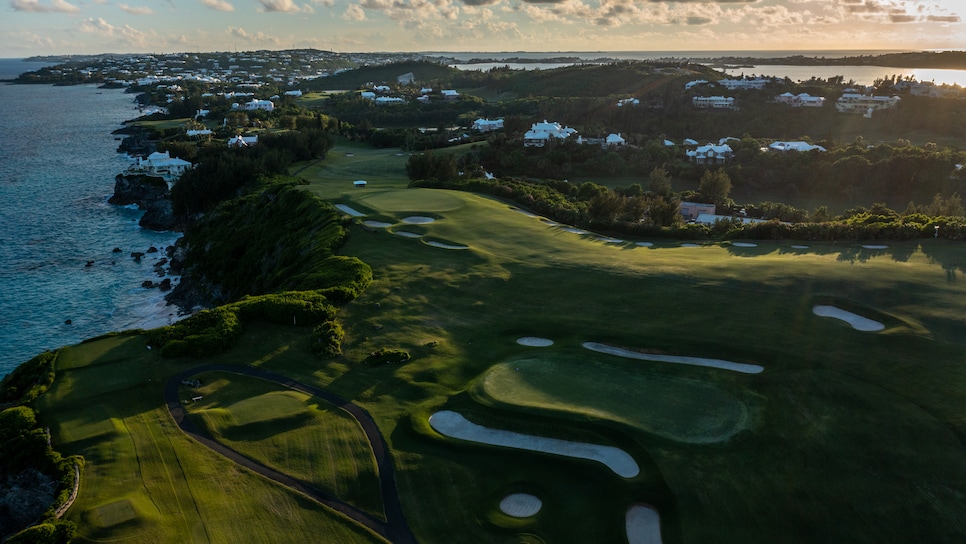
Mid Ocean Club is the only C.B. Macdonald design outside the United States, regarded since its opening as one of the world’s best, ranked 44th on our most recent list of the World’s 100 Greatest Courses. So when the club contacted Gil Hanse and Jim Wagner, who have tackled some of the world’s headiest restoration projects, the duo went to work on researching Macdonald’s original concepts in order to preserve his design intent.
1 / 4 
John Singleton
2 / 4 
John Singleton
3 / 4 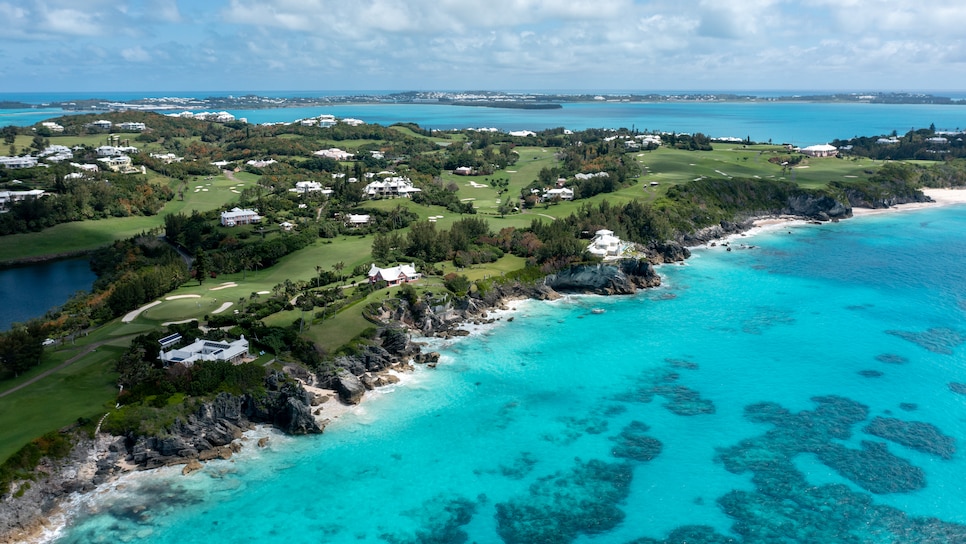
John Singleton
4 / 4 
John Singleton
Previous Next Pause Play false Mid Ocean Club St. George’s, Bermuda
- World’s 100 Greatest
This was C.B. Macdonald’s lone international design, done in the early 1920s with his faithful assistant Seth Raynor, who according to ship records, made most of the trips to the site. Spurred by the 18th Amendment, which established alcohol prohibition in America, Macdonald and his partners bought a collection of onion and potato fields on the northeast coast of Bermuda to build the course. Macdonald used his pet template holes mainly on the par 3s—Short, Eden, Biarritz and Redan are all represented—but the par-4 fifth is the standout, with its bite-off-what-you-dare tee shot over Mangrove Lake, perhaps the most famous version of his Cape hole. Gil Hanse and Jim Wagner have been renovating the course over the last several years. Read our full review
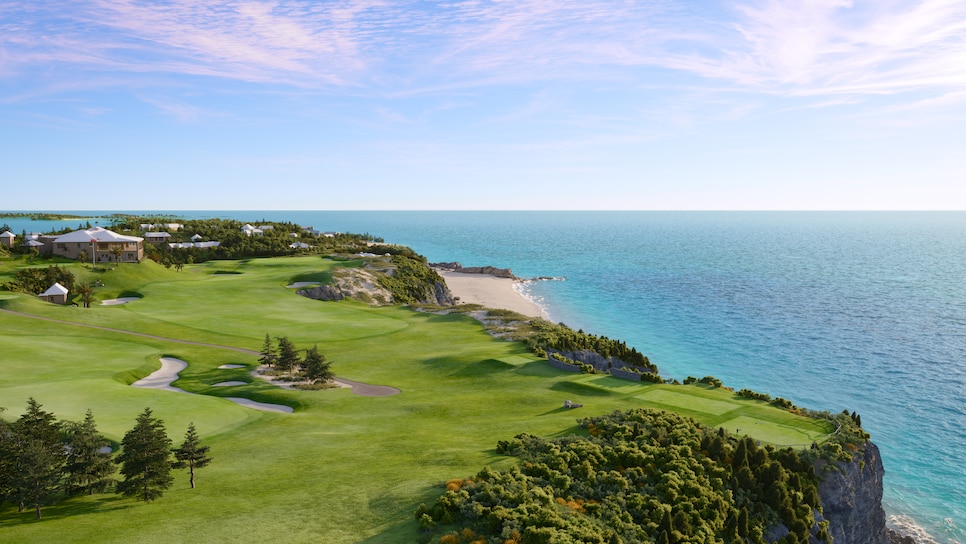
Hanse and Wagner will begin their work at Mid Ocean Club next fall with an anticipated reopening in late 2028. Restoration work will be done to all 18 holes, which include most of Macdonald’s famous template holes, notably the Cape fifth hole, which Hanse calls “one of the greatest holes in golf.” Hanse and Wagner are the game’s experts at preserving an architect’s strategic intent, but they were aided at Mid Ocean Club by an incredible discovery by a club member.
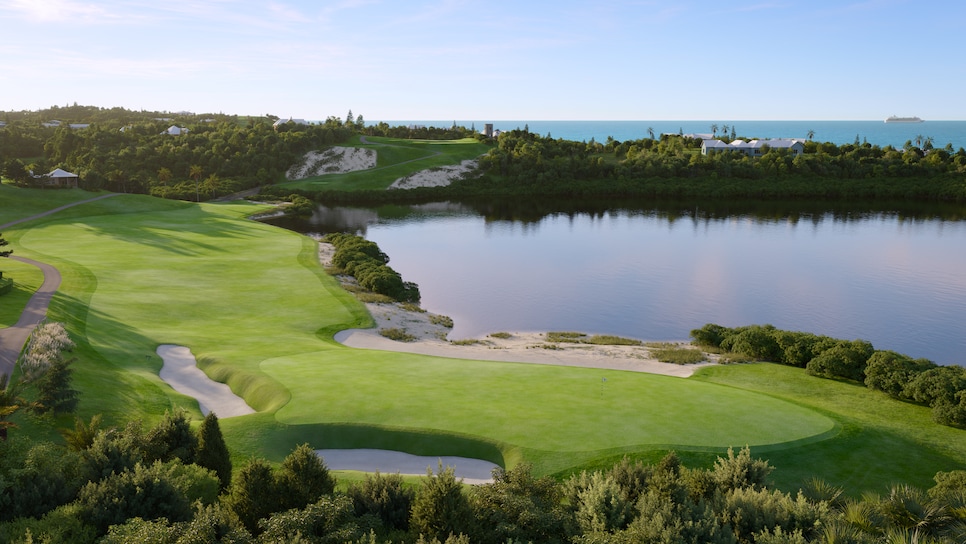
A rendering of Mid Ocean Club’s Cape fifth hole and what it will look like after Gil Hanse and Jim Wagner’s work.
Harris Kalinka
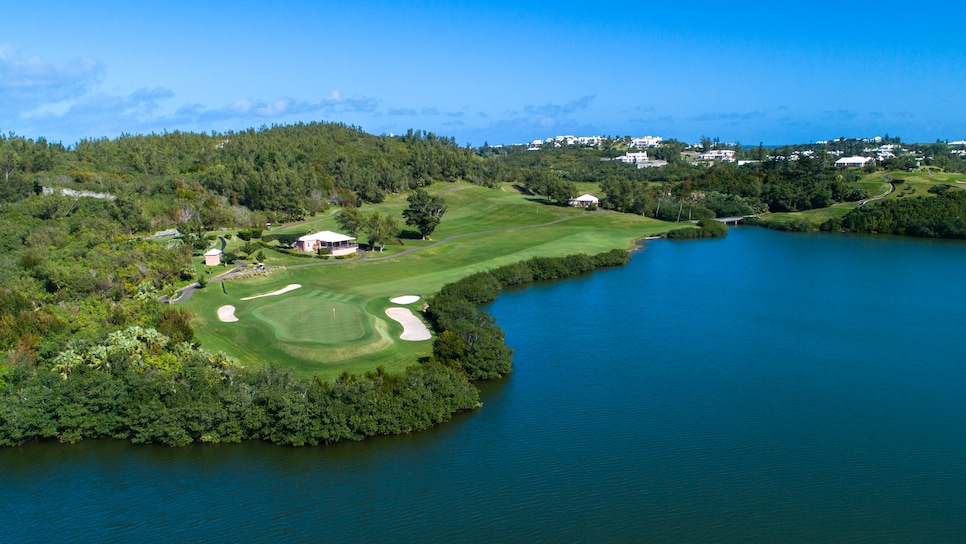
A look at the current-day Cape hole.
Mid Ocean Club member Rick Skelly unearthed what’s believed to be the only images of Macdonald on moving picture by scouring the archives of the Smithsonian Institution. He first delighted to find Mid Ocean Club on some footage of Bermuda, but a closer look revealed Macdonald actually playing the course in 1926.
“I was merely hoping to find imagery of the course to help the design team, but to seemingly find C.B. Macdonald at our club was really cool,” Skelly said. “It was only later we realized there was no known footage of C.B. Macdonald and what we had was probably something very special.”
Macdonald’s resume of courses is short but includes some of the game’s most revered layouts, such as National Golf Links of America, which helped shape course architecture in the U.S., Sleepy Hollow Country Club, Yale Golf Course and The Creek Club, all of which Hanse and Wagner have restored in recent years.
RELATED: ‘An almost supernatural backdrop for golf’: Inside the gates of Sleepy Hollow Country Club
As noted above, Macdonald, and his right-hand man Seth Raynor, believed that an ideal golf course should consist of some of their templates, like a Redan, a Biarritz, etc. But Hanse elaborated on what made their implementation of these holes at different sites so inspiring.
“Macdonald was so brilliant about, and certainly Seth Raynor, incorporating those concepts and those ideal golf holes into different settings,” Hanse said. “So when you think about a Cape hole at Fishers Island versus the fifth hole at Mid Ocean Club, they’re very, very different from an elevation standpoint. The concept, the construct is exactly the same philosophically, but the presentation, the way it sits in that different landscape is what ultimately sets it apart and creates the brilliance of his work.
“And I think at Mid Ocean we saw him understanding the scale and the scope of the property. Obviously whenever you can put your golf holes up alongside an ocean, you’ve got a significant scale for the horizon line. And then the ability to put it where you can actually see the surf crashing up against the rocks is another beautiful aspect of what happened in Mid Ocean Club.”
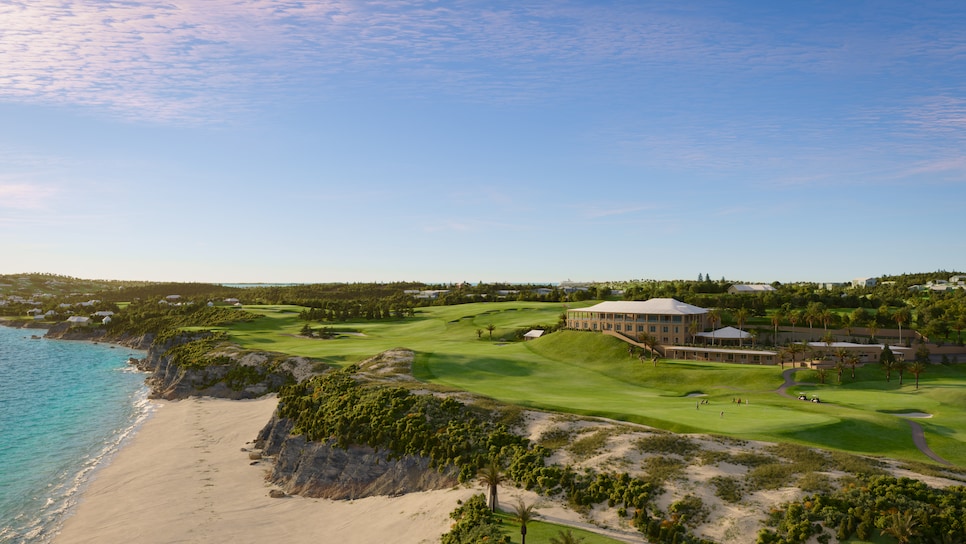
A rendering of Hanse’s upcoming changes to the 18th hole at Mid Ocean Club, which Hanse calls “one of the great, classic finishing holes in the world.”
Harris Kalinka
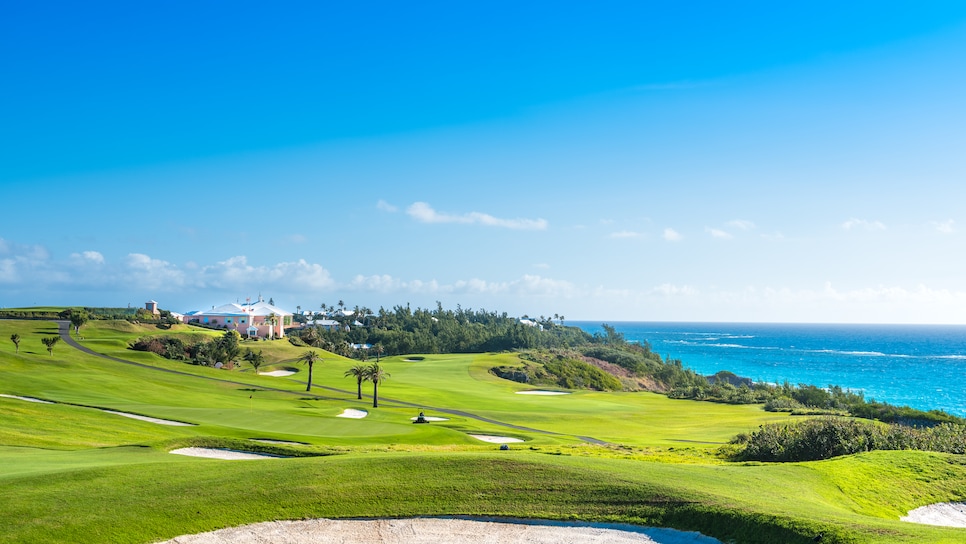
A look at the current day finishing hole at Mid Ocean Club.
Hanse also discussed his decisions on the 18th hole (above), in addition to reconnecting the fairway to the ocean, to move the existing 18th green further right and back to restore the relationship of the green complex and the visuals that Macdonald originally had before off-course development took away from Macdonald’s original intent.
Harris Kalinka
“It’s the only non-restorative feature of the entire project,” Hanse said. “If you look at the photographs of the original design, you got this long, expansive view of the water.
“We have such a high degree of confidence with laser mapping of green complexes that we can absolutely replicate that green complex as it was originally designed. The members will play it just as Macdonald intended. We’re just repositioning the green into a more dramatic position from a finishing perspective to capture the original views down the beach and still retaining the architectural principles of the hole. We usually don’t like to go off script like this, but it was too strong of an opportunity.”
If the work at Sleepy Hollow, Yale and others are any indication, Hanse and Wagner will make the most of that opportunity.
This article was originally published on golfdigest.com