“Man, they definitely didn’t want me to win.” —Wyndham Clark
SOUTHAMPTON, N.Y. — The best joke I made while following Wyndham Clark at Shinnecock Hills on Sunday as he pulled out a one-shot victory at the 126th U.S. Open was an accident. It came on the eighth hole, when Clark put his drive in the bunker. I was standing behind him with another reporter when he hit his approach from the sand. We couldn’t see the shot land, but there was silence from the fans in the grandstands by the green.
“It must be good,” I said. “Nobody cheered.”
My colleague laughed, and I thought, oh yes, that is funny. But I hadn’t meant it to be. I had just been conditioned by that point to understand the simple formula: Wyndham Clark fails, people cheer and taunt. Wyndham Clark succeeds, silence.
In fact, I had developed the unconscious heuristic in just three holes. I caught the final group on the sixth green, and by then the tweets and Slack messages about the crowd were flying. It was bad out there, they said; the police had already kicked at least two people out (one for shouting “crash and burn!,” the other for a piece of advice I’d hear over and over: “don’t choke!”), the heckling was merciless and all the hand-wringing the media had done all week about how to treat Clark’s various missteps was resolved far more decisively by the Long Island mob: They didn’t like him, and they didn’t care who knew it.
(You have to admire their commitment, although between this and Bethpage, I’m not sure most of these people should be let out of their homes without an ankle monitor and a metal cage, much less allowed to host a serious professional sports event.)
I wanted to see an example of the dynamic in action, especially the contrast my colleagues had teased—singing “Happy Birthday” to Scheffler on the first tee, then serenading Clark with one-liners like “the bogeyman’s coming!” and “nobody likes you!” and, just to prove that the sentiment was international, “Canada hates you!” Would the hatred have evaporated or at least dissipated by the time I tracked them down?
No. The endurance of these ghouls is impressive. I got a taste right away on the sixth green, when Clark hit a shot that teetered precipitously on the back right, threatening to roll off.
The braying jackals prayed to their pagan gods: “Go! Go! Go!”
The ball went, and they cheered.
Then Scheffler hit essentially the same shot, with the same uncertain fate, and they disguised themselves as respectable fans: “Sit! Sit! Sit!”
The ball did not sit, and they groaned.
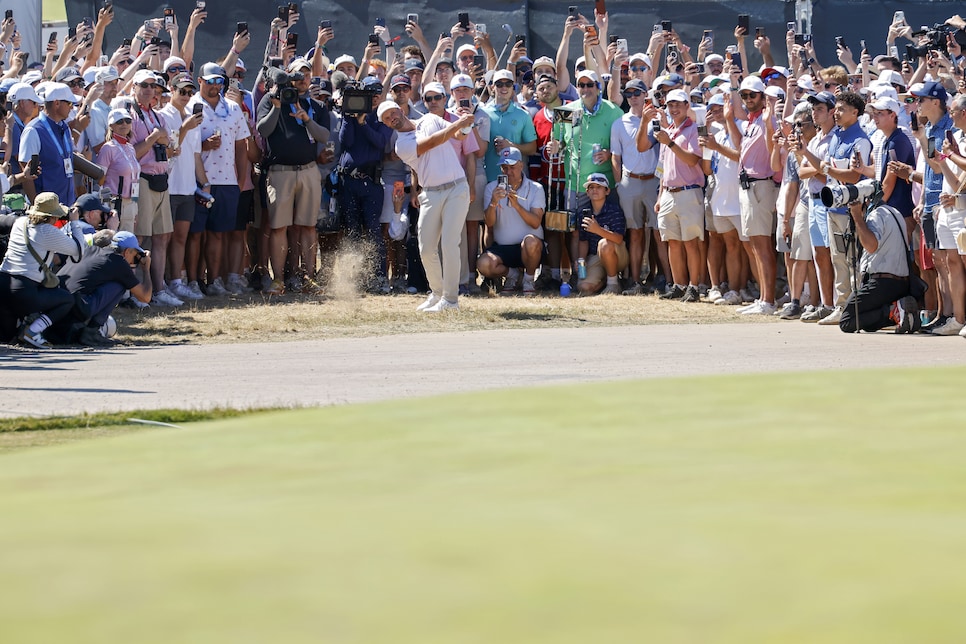
Wyndham Clark received only a smattering of cheers when he pulled off this recovery shot on the fourth hole Sunday.
Cliff Hawkins
I checked my phone for Wyndham Clark’s birthplace: still America. I checked the tournament website: Still the U.S. Open, not the Ryder Cup. We were in, I understood then, for a total circus.
(And by the way, the heuristic worked on the approach from the sand—the ball held the green, and he made par.)
I don’t think this “the crowd hated Wyndham” angle is going to be very original, judging by the fact that I was dreading the prospect of asking the question to Scottie Scheffler in his post-round presser, only to be bailed out two fellow reporters while I debated a cowardly dereliction of duty. I thought maybe Scheffler and Clark might try to deny it, to insist it was all media invention, or simply to be silent. But unbeknownst to me, Clark had already self-flagellated for Mike Tirico in his post-victory interview after he hoisted the trophy—”Yeah, New York didn’t really like me”—and Scheffler didn’t shy away either.
“New Yorkers, they are tough people,” Scheffler said. “You like seeing the fans cheer for you. I think sometimes it can get a little too much when, you know, balls are kind of going off greens and you start hearing cheers. That felt a bit much to me.”
I was correct that he became annoyed by the question, although he was pretty reasonable about it. Clark, too. After shooting a closing 73 that allowed him to win by stroke with a four-under 276 total despite being up by six at the start of the day, he handled himself well, as he has all week in spite of a checkered history of kicking in lockers, liking tweets with political conspiracy theories, getting caught on a hot mic saying that watching all the kids at the par-3 was “great birth control” and various other real or perceived offenses that you might love or hate depending on how thoroughly modern life has broken your brain. (In a different life, Clark might have made a good Long Island golf fan.) He carries himself like a work in progress, which is appealing when he gets a chance to address the demons in a calm space.
“Man, they definitely didn’t want me to win,” he said. “It’s pretty rare in an Open Championship or a major to have fans kind of boo against your shots or cheer for bad shots … I was kind of making jokes about it with Dave where if we heard someone cheer for me, I’d go, ‘Oh, there’s one person that likes me.'”

On the first tee, fans jeered Clark’s drive to “get in the bunker.”
Cliff Hawkins
And there were some, to be fair. They shouted his name, they slapped fives with him along the rope lines, and I saw one very drunk man on the 18th green shout out, “and he did it with the whole crowd against him!” before screaming in a way that made you feel he had his own haters in life, but also that those haters were all correct.
In general, though, it would be best not to read too much into the exceptions. Just as it would be wise to dismiss one of Clark’s own coping mechanisms, which is that the crowd was cheering for Scheffler’s grand slam. Sure, maybe. But I also saw them cheer for Sam Burns and Sahith Theegala and Tom Kim and Rory McIlroy (he’s pretty popular in these parts when he’s not wearing a European shirt) and even Sam Stevens, who they might have mistaken for an accountant or the assistant at a funeral parlor.
The pertinent fact, which we cannot and should not ignore, is that they hated Wyndham Clark.
And here’s the other thing: It’s fun to pick on Long Island, but I think this would have been the same everywhere. This wasn’t some genetic oddity that only finds expression between the Peconic Bay and the Atlantic Ocean. It’s a human reaction that was also playing out behind television screens and on Reddit and Twitter threads and Facebook posts and group texts and Slack chat rooms, all day.
You want to know the worst part, as long as we’re being honest here? The worst part is that beyond a few hooting morons, I didn’t find the individual harassment to be that rough. I set out to write down every nasty thing I heard, but there are only so many times you can write down “don’t choke!” and “get in the bunker!” I even began to wonder if they’d lost their form since Bethpage. Nobody shouted a slur at him, and as far as I could tell, his girlfriend escaped without any drinks hurled in her direction. Nobody yelled in his backswing. Nobody got in his face. Don’t believe anyone who tells you this was like a Ryder Cup—it wasn’t even close. I was a firsthand witness to the brutal bullying of Bryson DeChambeau during the Koepka feud in late 2021, and believe me, this doesn’t hold a candle to the toxicity on display in Memphis and Maryland back then. What happened at Shinnecock wasn’t nice, but it wasn’t armageddon.
Why is that the worst part? Because the expression of hatred for Clark played out in group reactions that felt more instinctual than premeditated, more honest than malicious. On 10, when it still seemed like he might collapse, Clark gathered his courage to hit a driver onto the upslope in front of the green, then executed the shot of the day with a 61-yard pitch that has stymied almost everybody in the field all week.
What did he get in response? The kind of ovation where, just by sound, you can count the number of people clapping. Then Scheffler holed his long birdie putt, everybody roared. When Clark converted his own birdie, and they were all silent again.
(Before they made it to the 11th tee, I overheard a cop predicting they’d have to kick even more people out before the day was done.)
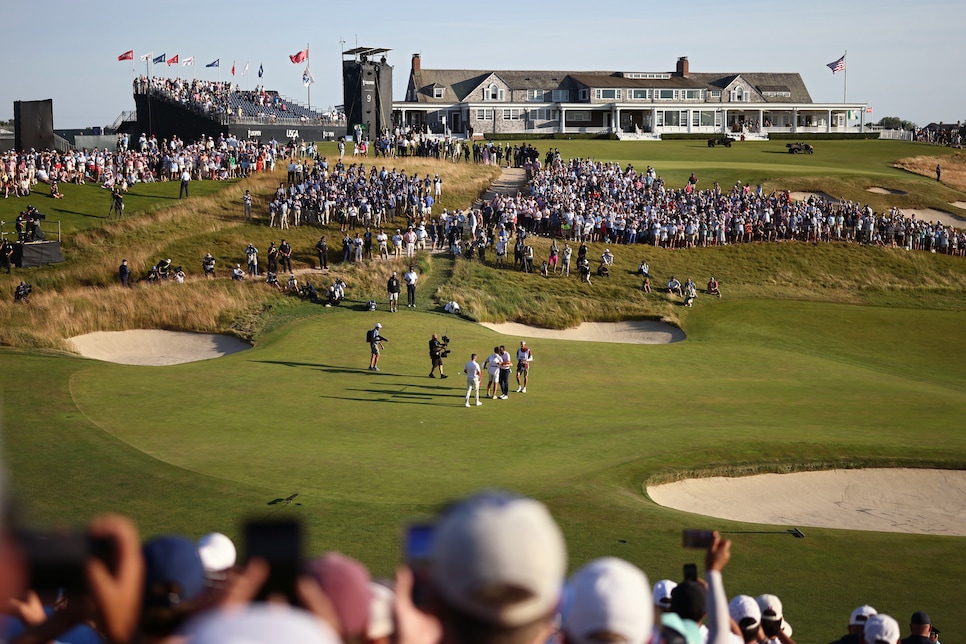
The applause as Clark claimed his second U.S. Open title were muted on the 18th green.
Mike Mulholland
This kept happening. On 12, when both players missed birdie putts and the reactions were on opposite poles. On 13, when the crowd had started to flatline, but rejoiced at his bogey, and made it abundantly clear that the only way they would bring any energy is if the leader floundered. On 16, great empty vastness filled only with murmurs of disappointment and a few scattered cheers when he made the birdie putt that nearly put it away. On 17, the silence when he hit a great lag, and then the surprise and glee when he missed the par putt. And on 18, with the most muted cheer I’ve ever heard for a major championship-winning putt.
Meanwhile, I heard the groans when Burns missed his putts on 17 and 18. I heard the same thing for Scheffler. And they just kept cheering when Clark missed a green, and barely doing him the dignity of stifling their groans whenever he pulled off his latest magic act to save another par.
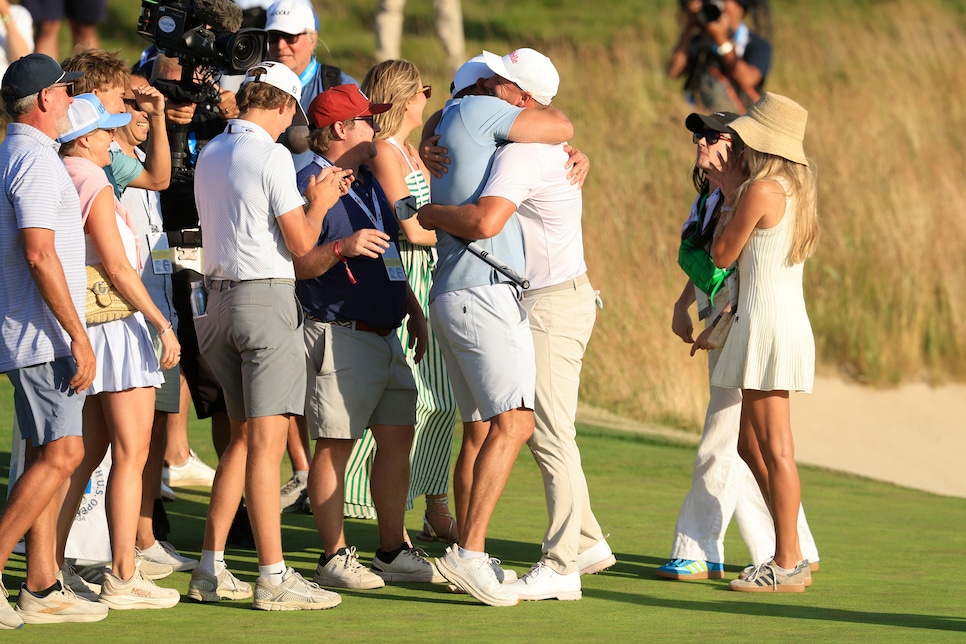
Friends and family helped Clark enjoy the victory, even if it “felt like an away win.”
David Cannon
It made for a crystal clear contrast, and one that doesn’t follow a lot of predictable patterns. Scheffler tried to make the comparison to last year’s Open Championship at Royal Portrush and the hostility he felt there, but that animus was geographical—he was in Rory McIlroy’s way—and thus he didn’t have to take it to heart. Ditto for Rory at Bethpage, unpleasant as it was.
But in the midst of this circus, Clark had to deal with the obvious truth of what he was witnessing and all its implications. He’s no dope—from his quote after, it’s clear he knows that an American crowd cheering against an American player at a stroke-play event at an American major is weird, and unusual, and extremely personal. But what could he do? Just perform whatever mental jiu jitsu they taught him in therapy, and press on.
I still have no idea how he won … the fact that he didn’t break down in tears or club a fan to death is itself a feat of great resilience. To win the U.S. Open? That’s Herculean. Whatever else you want to say about him, a lot of which is justified, he’s one tough cookie. Some people will view that toughness, and the fact of victory, as redeeming his errors, or cleansing his character, but that’s baby-brained stuff. We didn’t learn anything on Sunday that transcends the golf course, we certainly don’t know if he’s changed or just has good PR people, and we shouldn’t bother with that right now. But I think it’s OK, for a moment, to tip your cap to that undeniable, almost stubborn seed of defiance that runs through him, and that you can only call grit.
If you want something more redemptive or hopeful than that, I bet there will be plenty of people to feed it to you. All I can say, after the madness of Sunday, is that the hordes of Suffolk County loathed the man who was becoming their champion, and it wasn’t in their power to hide it. They didn’t need wit or irony or sarcasm to convey the message—it was all id with these people, and maybe they were thugs or maybe in some bizarre way they had it right.
It’s a hell of a victory for Clark, but novel as it felt to witness the battle of wills, amid all that beautiful fescue and choking dust, once in a lifetime sounds like plenty. What more can I say? This is deeply grim stuff with a paucity of good guys, and the sooner we get to Birkdale, the better. See you in 2036, Shinnecock, if another hell doesn’t come for us first.
This article was originally published on golfdigest.com