
It may not look like much. Just a few wobbly lines on a graph. These lines are what’s under the hood of every good golf swing. They make pros look so smooth yet hit it so far. Most amateurs quietly leak power without ever knowing it.
It’s called the kinematic sequence. Think of it as a chain reaction. It’s a series of handoffs between body parts. Each one passes energy to the next. Dominoes topple until the end result is a powerful golf shot.
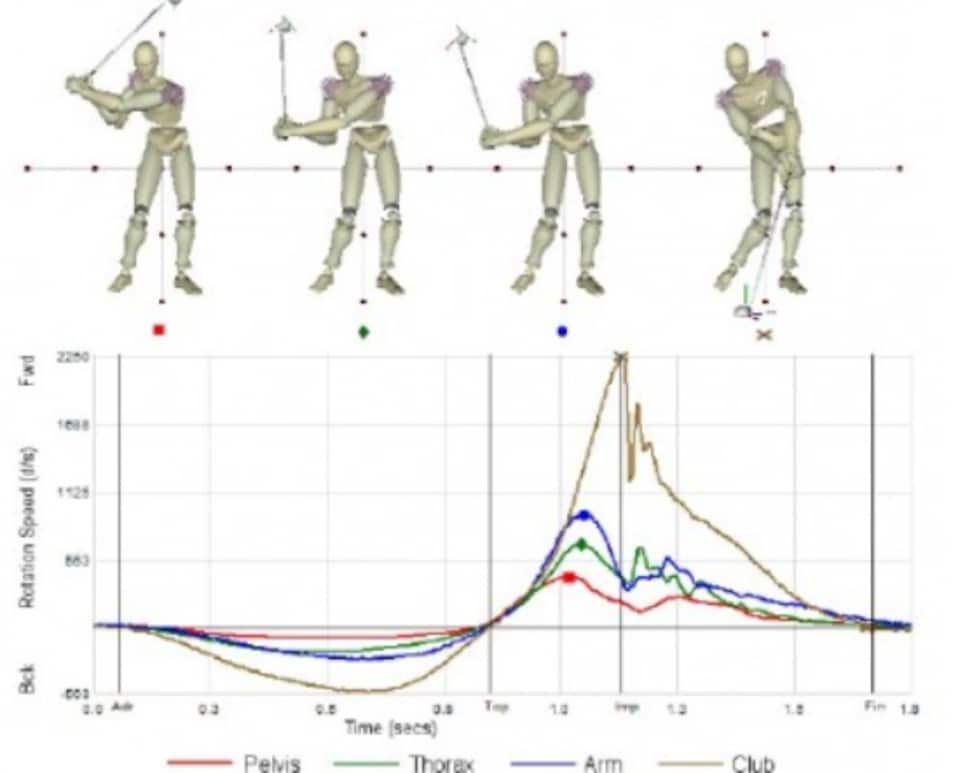
No one illustrates it better right now than Cameron Young.
The fix that made Cam a bomber
You’ve probably noticed the pause.
At the top of Young’s backswing, there’s a pronounced, almost full second freeze before he swings through.
It didn’t get there by accident.
As a junior golfer, Young had a common problem. He turned before he shifted. He dragged the club over the top and bled power in the process. The pause was a drill his dad and coach Dave Young used to fix it. It forced Cam to drive his lower body toward the target before his upper body began unwinding.
“He wants to get the lower body working toward the target while he pins his arms, club and upper body back,” Dave Young told Golf Digest. “There’s no conscious effort to pause.”
Respect if you can correctly guess which pro this is based on his junior golf swing… pic.twitter.com/1joPYypwVg
— LKD (@LukeKerrDineen) March 23, 2026
By shifting first Young stopped skipping the critical first step in the sequence. His lower body now initiates the chain and reaches peak speed before handing off energy to the chest, shoulders, and arms. Those parts accelerate in turn before the final move. A hard pull-up with the left side, almost a jump, snaps the clubhead through like a whip.
Shift, turn, jump- in that order
The sequence in its simplest form is shift, turn, jump. Body to arms to hands to club. Each body part accelerates, peaks, then hands off to the next. Get the order right and you’re building speed all the way to the clubhead. Get it wrong and you’re stalling out before you ever get there.
Cameron Young’s pause looks even cooler in slow motion.
Started as a drill to stop him coming over the top.
Get to the top.
Stop.
Fire lower body first.Still working! pic.twitter.com/WNbNoKWBQ1
— LKD (@LukeKerrDineen) March 16, 2026
Most amateurs do get it wrong and usually in one of three predictable ways. If you come over the top, you’re probably turning before you shift. If you early-extend, you’re jumping before you turn. If you slide through impact, you’re shifting so long you never have time to turn or jump at all.
What This Means For Your Game
None of this means you need to manufacture a pause in your own swing. What it means is that the next time you feel like you’re not getting everything out of your driver, the culprit is probably sequence, not strength. The fix isn’t hitting it harder. It’s getting the order right.
- Shift first
- Then turn
- Then jump
It won’t give you a perfect swing, but it’ll give you an efficient one. That’s the foundation everything else is built on. It’s the lesson hiding inside one of the most distinctive moves in professional golf.