
CHARLOTTE, N.C. — It was exactly 362 days ago that I wrote about the scourge of mudballs at the 2024 PGA Championship, and now, here we are again, talking about the same issue during the first round of the 2025 PGA Championship.
Let’s run through what’s happening…
Mudball Basics
Quail Hollow Country Club received more than four inches of rain in the days leading up to the tournament, leaving the course soft and wet.
When conditions are that soggy—especially in the South, where it’s already humid—golf balls can embed into the turf and pick up globs of mud when they reemerge.
Usually, when this happens, tournaments enact a lift, clean, and place rule. That allows players to pick up their golf ball, clean it, and replace it in a nearby spot.
But major championships have only used that rule once: during the final round of the 2017 PGA Championship.
 Why Are Pros So Frustrated?
In short, because they believe the lift, clean, and place rule should’ve been in effect today. Not applying it made things feel unfair.
Scottie Scheffler gave a thoughtful explanation:
“When you’re talking about the purest forms of golf—like links golf—there’s absolutely no reason you should play the ball up. It doesn’t matter how much rain they get. The course could be flooded and the ball would still bounce because of the turf and the ground underneath. American golf is significantly different. With overseeded fairways that aren’t sand-capped, there’s going to be a lot of mud on the ball—that’s just part of it. But when you think about a true test of golf, I don’t believe hitting it in the middle of the fairway should result in a penalty. This course is in great condition, and most lies are very good. So I get the ‘play it as it lies’ purist mindset. But I don’t think they understand what it’s like to work your whole life learning to hit and control a golf ball—only to have that taken away by a random rule decision. There’s already enough luck in a 72-hole tournament. The story shouldn’t be whether the ball is played up or down. I want a fair, pure test—and in my opinion, today, the ball should’ve been played up.”
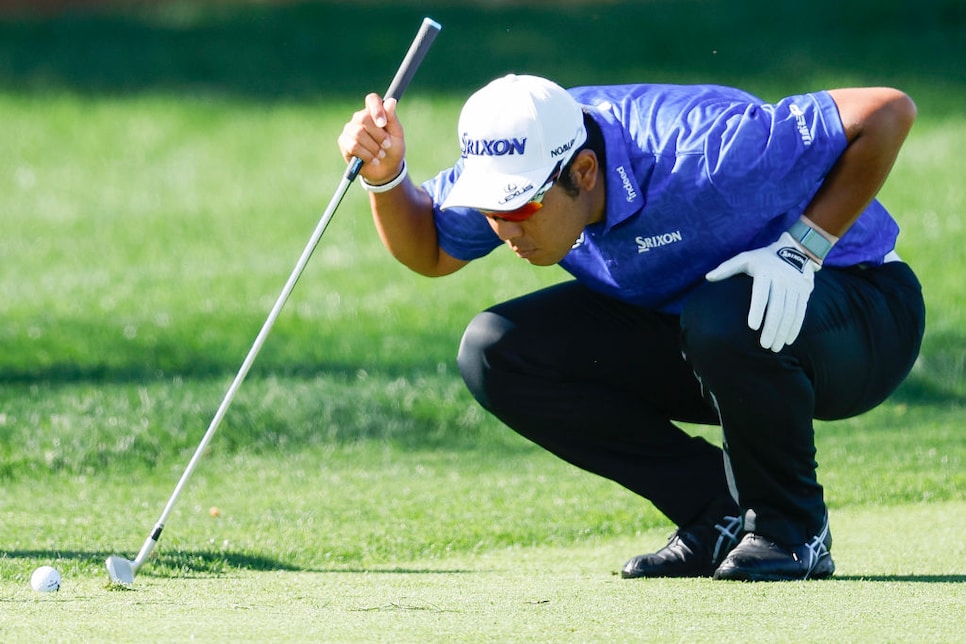
Cliff Hawkins
What Makes Mudballs So Difficult?
In a word: unpredictability.
The engineers at PING have done excellent research on this. When mud sticks to one side of the ball, it alters the aerodynamics—like hitting a lopsided ball.
According to PING’s data, the ball tends to fly in the opposite direction of where the mud is. If the mud’s on the left side, the ball goes right; if it’s on the right, it goes left.
The problem? You never know how much. No two mudballs react the same, so it’s nearly impossible to plan for.
Is There a Best Way to Play (or Avoid) Mudballs?
Not really.
You can budget for some curve opposite the mud’s location—but you won’t know how much.

Generally, pros try to take spin off mudballs to limit curvature. They do this by clubbing up and swinging softer.
Viktor Hovland has a theory: hit it lower off the tee with less spin. The idea is that a lower shot rolls more, giving the mud more time to fall off.
It makes sense, but according to people smarter than me, you’d need to significantly lower your ball flight to see meaningful effects—and even then, there are other variables at play.
If Hovland’s theory held true, you’d expect to see a trend in today’s Strokes Gained: Approach stats—players with lower launch and spin performing better.
So far, that trend hasn’t fully materialized. Here’s how each ball-flight profile group performed in SG: Approach in the first round:
- High spin, mid launch, high apex: +0.13
- Mid spin, high launch, high apex: +0.22
- Low spin, mid launch, mid apex: +0.37
- High spin, low launch, low apex: +0.32
Lots of mud balls this week at Memorial. Most players have felt they're unavoidable.
Unless you're Viktor Hovland, who was asked if he has a game plan to avoid mudballs. Predictably, the man who thinks through everything has thought through that. pic.twitter.com/NYERTs22Ke
— Paul Hodowanic (@PaulHodowanic) June 7, 2024
As for what happens next? It seems like this is going to just be something pros have to deal with. Roll the dice, and hold on.
This article was originally published on golfdigest.com