What I did to break through and win my first two majors and how you can go on your own run.
Last year at Royal Troon, after the speeches were done and the crowds were gone, my dad and I finally had a moment to reflect and enjoy it all. I remember, he was scanning the names on the claret jug, then looked up at me and said, “You still suck.”
We had a good laugh over that one. Maybe you have to understand my dad to get his little jokes, but those words actually packed a lot of meaning. He was reminding me that, despite the success of the day, there’s always more to do, more you can achieve, a higher bar. That’s how we look at it.
Winning the PGA last May and then following it with the Open Championship was amazing to me but not unbelievable. I’m a process person. Results come when you follow the right steps. I’m lucky to have a great team that helps me constantly evaluate my body, mind and swing, leaning into what’s
working and taking out what’s not.
I’ve made a few swing changes to hit the shots I want to hit more often, and I’ve gotten stronger, which has given me more speed. On a broader level, I’ve worked with my performance coach, Dr Ara Suppiah, to better control how I feel day to day – he calls it my “availability” – so I can get more out of all the other things I’m doing.
Let’s take a look at what I’ve focused on to push my game to the next level. I think you’ll see some ideas here that’ll work for you, too.
Prep for golf off the course
I’ve always been a pretty clean eater, but I wasn’t putting the right fuel in my body. I’d avoid carbs and go stretches eating less to try to feel fit. Ara had me add low-sugar carbs, like brown rice and sweet potatoes, and healthy fats – nuts, avocado, eggs. I actually increased my calorie intake. If your body isn’t primed for action, it’ll break down under stress.
When it comes to fitness, mobility was our first stop. One issue for me was something a lot of people struggle with- – thoracic-spine mobility, which dictates body turn. So we started with that and added strength work with my trainer, David Sundberg, also addressing my upper back and shoulders to fight the “caved-in” posture golfers tend to get.
Cardio was another target because a better cardio base helps me train harder, hit balls longer, compete six weeks in a row, and so on. Golf is sneaky-demanding on your body. I prefer the bike for cardio because my running form isn’t great, plus it’s way easier on your joints.
The last piece was rest and recovery. I was doing some goofy stuff, like cold showers and working out at night. Ara got me thinking about winding down, sleeping in a cool, totally dark room. Also, I’m better about chilling out without feeling lazy, letting my energy bounce back.

‘Commit, Execute, Accept‘
My dad used to make yardage books for me when I was a junior golfer, and that phrase above found its way into all of them. It’s in my DNA now, and it still jumps into my head sometimes during rounds. I take pride in being disciplined: quickly picking my shot and club, having a simple key to execute, then taking whatever happens. Good shot or bad shot, move on.
I also remember my dad asking me when I was about 15 if I was a Tiger or a Freddie. Tiger wants to know all the mechanics of the swing, what causes what, and Freddie doesn’t like the details. I’m definitely wired more like Tiger, so he started explaining everything we were doing, step by step. Either way works; you just have to be consistent and true to yourself.
Now, I’d tweak the phrase a little and lead with “accept” because I’ve learned that respecting the outcome before you do anything is so powerful. There’s a lot I can’t control, like the rib injury that kept me out of the first two months of this season. I spent a lot of time lying around, streaming TV shows and watching the guys play. I had to be OK with that. I did some feeling sorry for myself, sure, but that old phrase would snap me back.
Work to get your swing closer to neutral
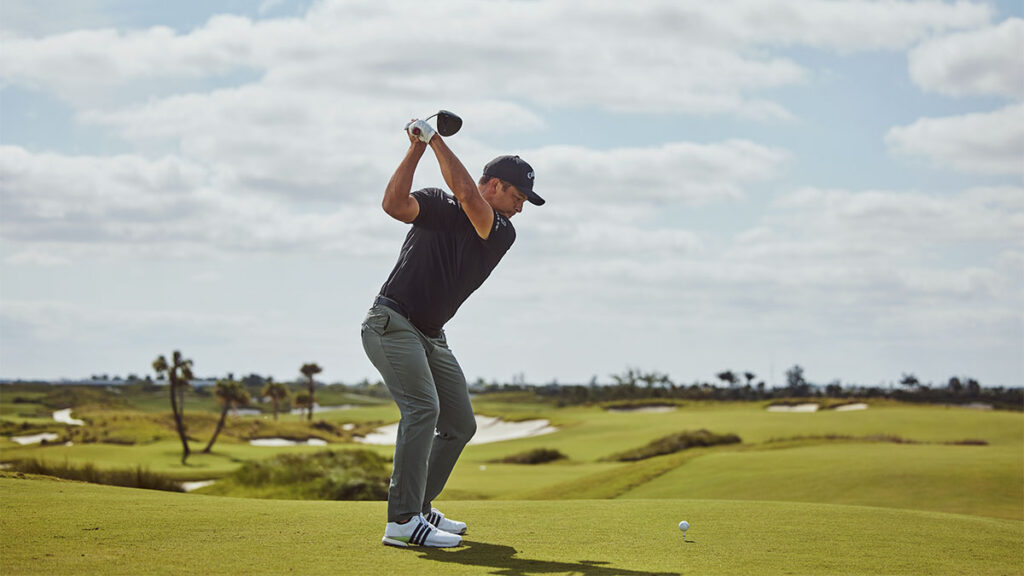
During Covid, I played a lot of golf at a little course in San Diego called The Farms. The fairways there are super-tight, so I started hitting low cuts for control. Problem was, I got into a groove of swinging out to in, with the club laid-off at the top (pointing left of the target). That made it hard for me to hit the draws I like when I got back on tour. I needed to break out of that.
In 2023, I asked instructor Chris Como to help me with my swing. To start, Chris had me track down all the old swing videos I could find. He noticed that my club at the top was a lot more on-plane a few years ago. We started retooling my backswing into more of an in-up-and-around shape, which to me felt like I was crossing the line at the top (the shaft pointing right of the target). We also worked to get my shoulders turning on a steeper angle going back. This put me in a more neutral position at the top, so I could hit fades or draws, which I always want to be able to do.
Two lessons here for you: first, video your swing a lot, especially when you’re hitting the ball the way you want, so you have a baseline to check against. Second, if you have a dramatically out-to-in or in-to-out swing path, try to work back towards the centre. The dispersion of your misses will be tighter, and you’ll be able to hit a bigger variety of shots.

Use uncomfortable shots to test yourself
I got my start in golf going to a local range, first trying to hit the 100-yard sign, then the 150, and so on. Like most kids, I loved experimenting, trying to pull off shots and, of course, swinging as hard as I could. Those early years taught me to love shot-making.
When I go to the range now, I still spend a lot of time working the ball different ways. I’ll hit five slices, then five hooks, calibrating how to deliver the face to create those flights. Trying to hit shot after shot the same way gets boring and also doesn’t prepare you for the course, where the situation is always changing. Playing golf is about adapting, not hitting stock shots.
That said, getting back to basics is an important part of practice. I have one of those formed grips on a 7-iron, so I can check my hand positions – my left hand tends to get turned too strong. I also use a T-square to monitor my alignment and distance from the ball. Little things that are easy to fix can put you back on track fast.
When I practise on the course, I try to take on uncomfortable shots. If there’s a water hazard on the left or right, I’ll aim in the middle of the water and try to turn it back to the fairway. Raising the degree of difficulty is good training. I’ll even do it in competition because it’s great prep for the majors. I want to be ready for those more than anything.

Don’t waste putting practice
The good news about putting is, you’re probably already dedicating time to it. When you roll some putts before you tee off, that’s legitimate practice time – if you use it well. The key is to make the reps good reps, not just rapid-firing putts from hole to hole.
I’m very intentional when practising putting thanks to my putting coach, Derek Uyeda. First, I read each putt like I would on the course. If the putt has some break, I figure out two lines: a high line for maximum break at slow speed and a low line for faster speed. Then, I check if the putt is uphill or downhill. A downhill putt, like the one I’m lining up here, will be close to the high line; an uphill putt will be close to the low one.
Once I like my line, I pick a spot close the hole, six inches to a foot, that the perfect putt will roll over given the break. Then, I track that back to the ball and decide where I have to start it to roll over that spot by the hole. When I’m comfortable with those two spots, I know I have a fair chance of making the putt.
I work very hard to be process-oriented when I’m putting and not think about results, in practice or competition. I know, success in putting is very clear-cut – you make it or miss it – and it can be hard to not react to that. But I can only read it right and get the ball on line with a good roll. If I miss, you won’t see me throwing my hands up. It’s commit, execute, accept.
‘A steady drip caves the stone’
This last phrase passed along by my dad fits how I want to manage my career – and I think it will help you with your golf. The “steady drip” concept to me means if you put in the effort, little by little, everything is doable. Big goals are awesome, but you can only work on the day-to-day stuff.
Ara’s first question to me years ago was: “What do you want to do?” Simple idea but exactly what I needed to hear. I told him it was the career Grand Slam and getting to world No.1. It seemed far off at the time, but I’ve got a couple of majors now, and I’m chasing Scottie and Rory. I have my team in place, and I love the process I’m following.
Maybe your goal is to break 90 or add 20 yards off the tee. Whatever it is, take a first step and get going, whether that’s keeping detailed stats or finding a local swing coach or assessing your fitness. You’ve got to get to the starting line to run the marathon.
The steady drip applies to individual rounds, too. Last year at the Open Championship, I knew the back nine was going to be tough. Everyone was talking about how brutal the 11th hole was, with the railway down the right and gorse on the left. I was fortunate to stick my approach close and make birdie there, which gave me a huge lift. After that, I knew if I could take it shot by shot, it was mine to win. I birdied three of the last six holes to finish off the best golf week of my life.
Photographs by Adam Riding