
Before questioning your next fee increase, it’s worth understanding what it actually takes to run a golf course in modern Australia, and why clubs have little choice but to adjust.
Rational people become irrational when it comes to three things: their family, their wallet and their golf course. It’s a line that rings true in clubhouses across the country, particularly when membership-fee notices land and the complaints quickly follow.
What is often missing from that debate is a clear understanding of what it costs to run a golf course in modern Australia. Behind every neatly cut fairway and consistent putting surface sits a business model under increasing strain. Costs are rising sharply, revenue is not keeping pace and the margin for error is narrowing.

No one is immune. Top 100 clubs, regional courses and council-run facilities are all facing rising costs, with general managers confronting the same reality. The cost base has shifted materially in the past five years. Labour, fuel, insurance, machinery and course inputs have all climbed, in some cases dramatically. The increases are not isolated; they are cumulative, and they are ongoing.
One club general manager describes the annual budgeting process as a balancing act between logic and emotion. “When you raise fees by $250, which is about $5 a week, and you come in to a stack of emails complaining, it’s pretty frustrating… particularly when it’s not the members volunteering their time who are doing the complaining.”
That tension reflects a broader disconnect. Golfers are experiencing rising costs in their own lives, from mortgages and rent through to energy and insurance. We just need to fill up the car to experience that in real time. Clubs are dealing with those same pressures, but with far less flexibility to absorb them.
Damien de Bohun, Golf Australia’s general manager of places to play, says the trend is nationwide. “Golf clubs right across Australia operate in very different environments, so it’s difficult to generalise. However, what we are consistently hearing is that many venues are facing significant increases in operating costs,” says de Bohun. “From labour and equipment through to utilities, insurance and course inputs. In many cases, these increases are outpacing membership and green-fee growth.”
That gap matters. Since 2020, many clubs have seen a rise in costs strongly outweigh the increase in member fees. The shortfall has to be managed somewhere, often through tighter operating margins or deferred investment.
The economics of a golf course are more exacting than many assume. Take this typical example: if a club spends $1.8 million a year maintaining the course and records 60,000 rounds, that’s $30 per round before a single staff member is paid inside the clubhouse. A $65 green fee leaves $35 to cover everything else: wages, utilities, insurance, administration and capital repayments. It is not a wide buffer.
Despite perception, most clubs are not producing significant surpluses. Many operate with lean staffing structures, and a substantial number rely on volunteers to remain viable. About 700 of Australia’s 1,900 courses fall into that category, highlighting both the strength of the golf community and the financial constraints many facilities face.
How expenses have increased for Australian Golf Clubs since 2020. We polled 40 golf clubs across the country on their costs and expenditure from 2020-2025. Here’s what they told us:
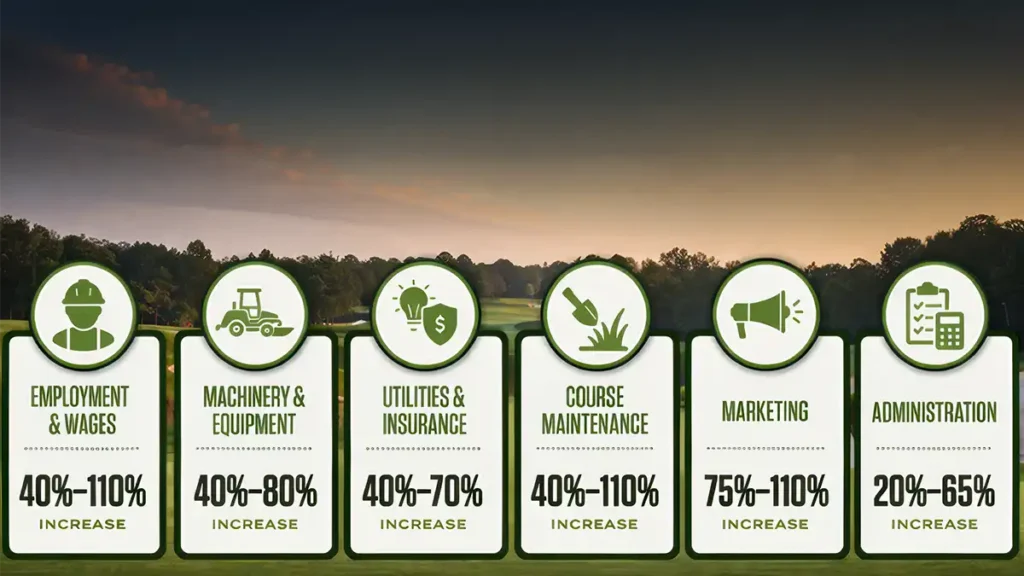
The cost increases themselves are significant. One club reported wages rising by 35 percent in five years, machinery and equipment costs up more than 80 percent, and course maintenance increasing by more than 40 percent. Another club recorded wage growth exceeding 100 percent, with agronomy costs up 150 percent. These are not incremental adjustments; they are structural shifts in the cost of doing business.
Machinery is a particular challenge. Turf equipment has not followed the pricing correction seen in other sectors post-COVID. Demand remains strong, supply is limited and replacement costs have stayed high. Clubs cannot indefinitely delay upgrades without compromising course presentation.
Fuel adds further uncertainty. With prices fluctuating regularly, especially in the wake of the global conflict in Iran, budgeting becomes increasingly difficult. Every aspect of course maintenance, from mowing to irrigation, is exposed to those changes.
Insurance is another area of pressure. Premiums have risen steadily, reflecting broader trends across property and liability markets. For clubs with significant assets or exposure to environmental risk, the increases can be substantial.
Even traditionally reliable revenue streams are under strain. Hospitality, once a consistent contributor, has become more challenging. Wage increases and shifting member behaviour have compressed margins. Some clubs report food and beverage profitability down 10 to 15 percent compared to pre-pandemic levels.
At the same time, expectations haven’t eased, they’ve sharpened. The standard of Australian golf courses is already world class, and it’s only climbing. New layouts like 7 Mile Beach and major upgrades to courses such as Sydney’s New South Wales Golf Club and Huntingdale in Melbourne are raising the bar even further. Meeting that level, however, comes at a cost.
“If you travel and play golf overseas, you see how expensive it can be,” one general manager says. “Australia is still amazing value by comparison. Costs are rising to meet these standards, and they’re not going backwards.”

That global context is important. Compared to the United States, the United Kingdom, Japan or even New Zealand, golf in Australia remains relatively affordable. Access to high-quality courses at reasonable price points is one of the strengths of the local game. Many argue there is no better place to play in the world when you add the standard, the value and the added aspects of food and wine.
De Bohun reinforces that view, noting that in many cases, annual membership compares favourably with other leisure expenses. “For the price of a weekly gym membership, golfers often receive access to a professionally maintained course, practice facilities, clubhouse amenities and a social network.”
Broken down further, the value becomes clearer. A $3,000 annual membership for a player who completes 40 rounds equates to $75 per round. Over four hours, that is less than $20 per hour. Few recreational activities offer comparable value, particularly at the quality end of the market.
Yet value is not always how increases are perceived. Members tend to focus on the absolute cost, not the relative return. That creates pressure for boards and management, who must balance financial sustainability with member sentiment.
“It’s a double-edged sword,” one general manager explains. “The same member who doesn’t want more green-fee players is also asking why fees are going up. But green-fee revenue is critical. Without it, increases would be higher.”
Hybrid models are now a key part of the equation. Many private clubs supplement member income with visitor play, corporate golf and interstate or international guests. Even modest growth in that area can have a meaningful impact. An additional 20 green-fee players a week at $125 generates $125,000 annually. That revenue helps offset rising costs and reduce pressure on subscriptions.
Clubs are also looking beyond traditional golf income. Weddings, events, technology-driven ranges and broader community engagement are increasingly important. These initiatives diversify revenue and reduce reliance on membership alone, but they also require investment and careful management.
That investment has become more expensive. Construction costs for new facilities or upgrades have risen significantly in recent years. Clubs must now generate larger surpluses simply to maintain existing infrastructure, let alone improve it. A redesign of even a few holes is significant and unless the club wants to go into debt, needs to be planned for.
Within this environment, governance matters. The role of the general manager and board is to ensure financial stability while maintaining the quality of the product. That responsibility is becoming more complex as external pressures increase.
“At budget time, you do question whether it’s worth the stress,” one general manager admits. “But we stand by what we deliver. The course, the experience, the overall product. It’s something members should be proud of.”

That pride, however, must be matched by perspective. Clubs are not immune to financial risk. Poor decisions or sustained underinvestment can have serious consequences. In extreme cases, clubs can fall into administration, with long-term impacts on members and the broader community. For that reason, financial viability is not just a management issue; it is a member issue. Understanding the cost structure of a club, and the rationale behind pricing decisions, is part of being an engaged member.
The alternative is not attractive. Reducing investment in course maintenance can quickly impact playing quality. Deferring capital works can lead to higher costs later. Failing to adjust pricing in line with expenses risks long-term instability.
At a national level, the health of the game depends on sustainable clubs. From elite private venues to regional public courses, each plays a role in the broader ecosystem. Strong clubs support participation, employment and community engagement.
Encouragingly, many clubs are adapting. Membership models are evolving to reflect changing lifestyles. Flexible categories, pay-as-you-play options and improved access are helping attract and retain golfers. At the same time, clubs are exploring new ways to engage with their communities and broaden their appeal. These changes are necessary, but they do not alter the underlying reality. Golf courses are expensive to operate, and those costs are rising. Maintaining accessibility and quality will require ongoing adjustment from both clubs and members.
The emotional connection golfers have with their clubs is part of what makes the game unique. But that connection can also cloud judgment when it comes to financial decisions. Rationality, in this context, means recognising the true cost of the experience and supporting the structures that sustain it.
Australia remains, by global standards, an amazingly well-priced golf market. That position is worth preserving. Doing so will require informed decisions, realistic expectations and a shared understanding of the challenges facing the industry.
“One of the great strengths of Australian golf is the diversity of venues and price points,” adds de Bohun. “Across most parts of the country, there are affordable options that enable more Australians to play more golf. But maintaining that accessibility requires careful decision-making, particularly in an environment where costs are rising, and clubs are working hard to remain sustainable.”
The next time a fee increase is announced or a policy shifts at your club, it is worth pausing before reacting. Behind that decision is not just a number, but a complex equation. One that clubs across the country are working hard to balance, often with far less margin than many realise.