
Few golf courses in the world have inspired more creative equipment tinkering than Augusta National. Players have shown up to the first tee with everything from extra wedges and one-off prototypes to unconventional setups built specifically for one week in April.
Phil Mickelson famously employed two drivers in 2004—one for a high, hard draw and one for a controlled fade—squeezing every possible advantage out of a bag designed for a single purpose. The pursuit of a Masters edge has always pushed players toward decisions they’d never consider anywhere else.
Related: Masters 2026: Aussie quartet buoyant ahead of first round
Tommy Fleetwood has his own answer. It happens to be a club he’s been carrying for a few years now.
“It’s a perfect 9-wood golf course,” Fleetwood said. “The biggest thing is the 9-wood for me. If I can put myself in position on the par-5s or the long par-3 fourth—for me, I can’t really hit that high 4-iron so the 9-wood helps me a lot.”
That might sound like a modest equipment confession but Fleetwood is hardly alone in this thinking. Over the past several years, high-lofted fairway woods have quietly become one of the most common additions to tour bags.

Players across all skill levels have been swapping out long irons and utility clubs in favour of 7-woods and 9-woods—clubs once considered the domain of recreational golfers—because the performance data simply makes too much sense to ignore. At Augusta specifically, where approach angles into firm, elevated greens demand height and stopping power, the trend accelerates.
The numbers back him up. In recent robot testing Golf Digest conducted with Golf Laboratories using Ping’s G440 long-game lineup, the 9-wood produced the biggest carry gains of any club in the entire test when delivered with a slightly descending blow.
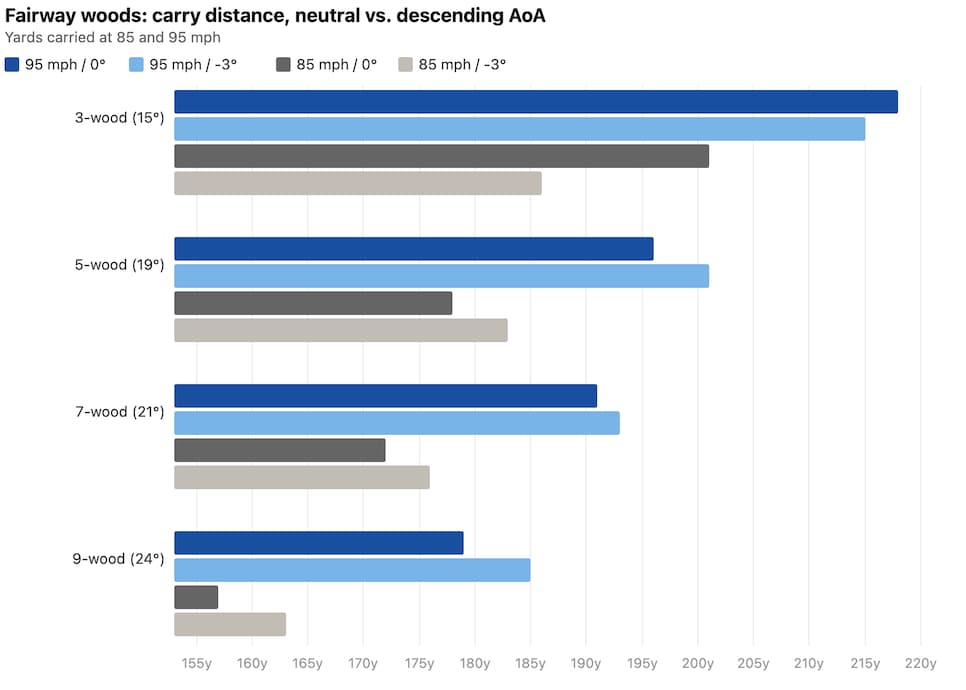
At 95 mph, a steeper attack angle resulted in nearly seven extra yards of carry compared to a neutral approach—a by-product of spin dropping from 6,300 rpm down to 5,835 rpm without sacrificing launch height. At 85 mph, the gain was still a meaningful four-plus yards. At Augusta, players chase that high, soft trajectory and shot-stopping spin above all else, but the fact the 9-wood can also add distance makes it an easier sell.
For Fleetwood, who has the swing speed to optimise those gains, the 9-wood is a calculated choice that lets him attack holes like the 8th, 13th and 15th on his own terms. It gives him the trajectory he wants, the confidence he needs and eliminates the guesswork that comes with trying to manufacture a high 4-iron he’s never fully trusted in those spots.
https://www.instagram.com/p/DWkGOkXERXb/?utm_source=ig_embed&utm_campaign=loading
“I can’t really hit that high 4-iron,” he admitted with the kind of refreshing candour tour players rarely offer. For Fleetwood, the high-lofted fairway wood doesn’t just fill the void—it might be his most important club this week.
Fleetwood may be leaning on his 9-wood to navigate the world’s most famous par-5s. For the rest of us, it might be time to look a little closer at what that same club can do on ours.