
Exploring New Bedford, Massachusetts: the birthplace of Titleist and the Pro V1.
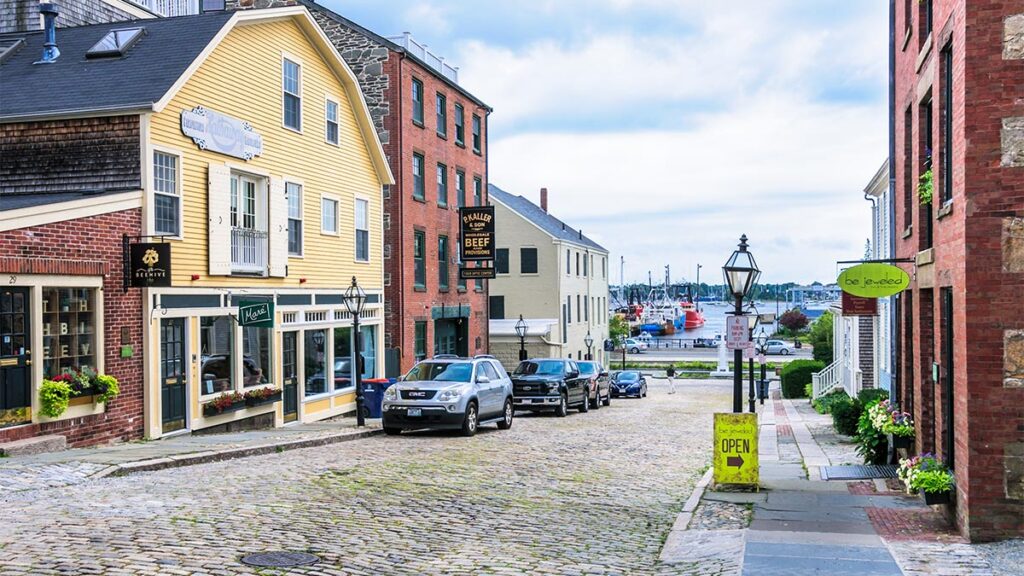
Cold winds whipped off the Acushnet River, just in from Buzzards Bay, causing a small fleet of classic and modern boats to bob in the marina as I walked through the former whaling city of New Bedford, Massachusetts. Here, in this small seaside village, 100 kilometres south of Boston, it was difficult to picture one of the most important cities in the world of golf was only minutes away via car.
It was, however, at least immediately upon arrival, far easier to visualise New Bedford’s maritime history and its enormous fame within the literary world. New Bedford is renowned as the city Herman Melville chose for the setting of his 1851 novel, Moby Dick. At its economic peak in the early 19th century, New Bedford was the richest city in North America, back when the enormous quantities of whale oil produced in this quaint area powered the lamps used in homes and businesses around the world.
In March, two weeks before the 2025 Masters, your correspondent was tasked with visiting the Titleist headquarters and its iconic Ball Plant No.3 in neighbouring Fairhaven, Massachusetts. I arrived the night before my tour, after a 3.5-hour drive from New York City, and stretched my legs with a walk along the marina. A series of cafés and restaurants have contributed to transforming New Bedford into a chic holiday destination laden with seafood restaurants, craft breweries and a growing arts and music scene.
As a lifelong golfer, I’d always been fascinated by the ball used in so many momentous victories – and losses – in golf’s history. So when our friends at Titleist Australia/New Zealand linked me with the good people at their US headquarters, the opportunity to tour Ball Plant 3 was met with an enthusiastic “yes”. After all, this was the birthplace of the Pro V1.
What I didn’t have any grasp of was the vibrancy of New Bedford, which left a lasting impression. For this writer, it ranks among the best non-playing experiences in the world of golf (although there are plenty of golf courses in proximity).

That stroll through New Bedford – where a lobster roll at the popular Black Whale restaurant and a craft beer a delightful Moby Dick Brewing Co. were among the highlights – was followed by an exploration of the cobblestone streets that led to the utterly fascinating New Bedford Whaling Museum. Here, towering whale skeletons hang from the rafters, bringing to life the brutal and complex world of 19th-century whaling.
But while New Bedford might be known for Moby Dick’s portrayal of the sailor Ishmael’s quest to find Ahab, I was chasing a vastly different legend. I wanted to explore why the Pro V1 was made, see how it is assembled and determine the Pro V1 and Pro V1x’s impact on golf’s biggest moments.
The why is a great story. The idea for Titleist was born on a Sunday afternoon in 1930 when Phil Young, an accomplished amateur golfer and the owner of a precision moulded rubber company (Acushnet Process Company), was playing an 18-hole match against a friend who headed the X-ray department at a local hospital. Young was certain a wobbling ball on the final putt caused him to lose his match to his mate, so the pair went to the hospital and X-rayed the ball in question. They found that its core was, in fact, off-centre. Young then convinced Fred Bommer, a fellow MIT graduate, rubber specialist and avid golfer, to head up the Acushnet Golf Division.
Parochially, I wanted some insight into recent Australian major winners Adam Scott (2013 Masters) and Cameron Smith (2022 Open Championship). Titleist certainly delivered on that front.
Nestled discreetly just a few minutes from New Bedford, Ball Plant 3 is located in Fairhaven. Here, precision and consistency are practised daily by golf lovers who have otherworldly engineering talents. After checking in to the plant, I was joined by some of the marketing, research and development (R&D) and tour-facing staff for some interviews and a behind-the-scenes tour.
I couldn’t help but notice – of course I couldn’t – a framed picture of Smith near the lobby, frozen in time at impact during his tee shot on the final hole of the 2022 Open Championship he won at St Andrews. I asked Fordie Pitts, Titleist’s celebrated ‘Head of Tour Validation and Research’, to choose a shot at the Old Course that Sunday at the 150th Open which represented the perfect marriage between Smith and Titleist’s optimisation of the Queenslander’s equipment setup.
“It was that tee shot on the 18th at the Old Course,” Pitts said. “To stand up there and hammer that driver just short of the green and make birdie, knowing he had to keep the foot on the gas, was really special.”
On that special day in Australian and global golf, Smith’s playing partner, fellow Titleist ambassador Cameron Young, had driven the Old Course’s 18th green and was about to convert his mid-range eagle putt. That meant Smith, leading by two, needed birdie for a one-shot win. Rory McIlroy was in the group behind and could have also forced a playoff with an 18th-hole eagle. Smith had produced six back-nine birdies for a score of 30 during an historic 64 that helped him wrest the claret jug away from 54-hole leaders McIlroy and Viktor Hovland. But Smith’s 315-metre drive on 18 will always stand out to Pitts, given the mullet-wearing Brisbane boy is not considering one the game’s longest hitters – even if he averages an impressive 285 metres off the tee.
“Yes, Cam’s Road Hole [birdie] putt around the bunker [and subsequent par save] was super-cool and the whole back nine was amazing,” Pitts says. “For a guy who is certainly long, but not the power player Cameron Young and Rory McIlroy are, to have them chasing him and stand up and hammer a drive just short of the green on 18 was memorable.”
In terms of the tour players Titleist have worked with over the years, Smith is among the company’s most easy-going ambassadors. Which makes it equal parts exciting and pleasantly surprising when he perennially contends at Augusta National, or when he won The Open at the Home of Golf – courses that should reward power hitters. Smith’s creative genius allows him to play well at such courses and his interaction with the Pro V1x is integral to that.
“Cam is pretty low-maintenance when it comes to his golf ball,” Pitts says. “He doesn’t over-analyse it. He doesn’t get too hung up on the numbers; if it feels good, flies good, he’s happy. He has pretty much transitioned into each generation of product we have released, but he’s sort of settled on the 2021 version of the Pro V1x. He has always been a guy we enjoy being around and working with. He is not a bomber or a big, imposing figure, and he’s the type of guy that I [cheer] for.”
Scott has impressed Titleist for decades in a completely different way. One of modern golf’s best ball-strikers, the 2013 Masters winner is more hands-on with Titleist about the spin and ball flight characteristics he’s chased in the varying chapters of his career.
“Adam has been with us for a long time,” Pitts says. “I’ll admit it, I’m old. I go back to the wound ball days, and Adam (who turns 45 this year) would have played a wound ball at some point in his life. I’ve spent a lot of time with him over the years.
“He was one of the reasons we started our CPO program, which means Customised Performance Option. We’ve got these two products (Pro V1 and Pro V1x) that fit about 80 percent of the PGA Tour, maybe 90 percent, but we have a few guys who need something unique. Adam was a big driver in that. Adam has played both Pro V1 and Pro V1x in his career. He re-invents his game about every 18 months to two years. He has varied in the amounts of spin he wants, and I believe he was the first CPO we produced.”

In a nutshell, CPOs are balls that are produced for a select number of tour players which Titleist closely monitors. Some characteristics have subsequently been adapted into a Titleist ball for the general market.
Mike Madson, the senior vice-president of golf ball R&D at Titleist, works diligently in this process. “Some players can be unique and need a characteristic that no one else is asking for,” Madson says. “We’ll investigate that and see if there’s something there. If we can fulfill that need, it’s great, but it also allows us to try other technologies.”
As an Australian, it’s fascinating to hear that Scott was the catalyst. But it’s more interesting to learn how one of these performance characteristics evolves from CPO to the wider market. And, specifically, how and when Titleist gives an advancement the green light.
“In R&D, the first of our two biggest pillars is product development, and that’s a group of engineers working on the next product for launch,” Madson says. “They’re going to get feedback from the players, the marketing group, and then look at the available design tools to maximise that product before launch. The second pillar is the research group within product and R&D, and their job is to go out and look at brand new materials, or brand-new processes, or new formulations. Put simply, one group uses the tools and other develops the tools for them.
“Where the CPO comes in is the research group might have a tool they think they have developed, but it hasn’t been proven out in the plant yet, so we can take that opportunity to put that in a CPO, then we get it into the plant, see how the manufacturing process goes. Can we control it? Can we make it consistently? And if we get it in the plant, and we get enough reps on it, we might say, ‘You know what, yes, this is a good process. This is a good material. Now we can use this going forward.’”
Pitts has an easy example of that transition.
“The Pro V1x Left Dash. It was originally a CPO and came out in 2017/2018, as a tour-only golf ball,” he says. “We needed a lower spin option for higher [swing] speed guys. With the trend of using launch monitors, pros were seeing the numbers, and we wanted a product that delivered low spin for the players who needed it but which was still fast and long.
“We produced the Pro V1x Left Dash. It had a lot of tour usage, with some success. It got to a point where it was a case of, You know what? There were more golfers who could benefit from a higher ball flight, like the Pro V1x, and a lower spin than the Pro V1. There was a market for it and the ball had won on tour, had won the US Amateur and it won the US Open.”
Madson adds: “From a technology standpoint, the original Left Dash used a newer dual-core technology that eventually ended up in Pro V1x. It used a new casing material that we had never tried that ended up on both the Pro V1 and Pro V1x. It used a new cover material that we had never done in the plant, that we used for yellow Pro V1 and Pro V1x. They are three specific examples of technologies we tried in smaller scale first that became transferable into the plant.”
Additionally, Titleist, through its Golf Ball Selector App, is also gathering significant fitting data on how many players fit into certain performance profiles. That also fuels the R&D team’s quest.
Finally, it was time to see how Titleist balls are made. In the lobby of Ball Plant 3, there’s a large container holding an enormous number of golf balls. When I ask how many are in the container, my friendly and wildly knowledgeable tour guide responds, “There’s approximately 14,000.”
As the tour starts, I throw on a lab coat and hair net for this 90-minute look at the precision engineering behind the Pro V1, Pro V1x and Left Dash. The state-of-the-art, 250,000-square-foot facility is a marvel of modern manufacturing. Titleist’s operations team consists of more than 1,100 associates with an average tenure of more than 21 years. That’s more than 23,000 years of collective golf-ball making experience. I met several staff who had each logged more than 30 years working for Titleist.
The process begins in the three-storey mixing mill, where polybutadiene and other raw materials are heated and blended into a dough-like sheet, cooled and sliced into small cylinders known as core preps. These are compression-moulded at tightly controlled temperatures and pressure, transforming the soft compound into high-speed, resilient cores. For dual-core models like the Pro V1x, exact centring is crucial – just four-hundredths of an inch (the width of a credit card) off can significantly alter shot dispersion.
Throughout the plant, more than 100 quality checks are conducted, from raw materials to finished product. A dedicated quality-assurance lab and automated systems continuously monitor every aspect – pressure, humidity, temperature, curing reactions – to ensure each ball performs to exacting standards.
Once the core is complete, a high-speed casing layer is injection-moulded around it, enhancing speed, spin and moisture resistance. A thermoset urethane cover is then cast using proprietary chemical formulations, creating the soft, durable exterior crucial to spin and short-game control.
Advanced machining tools called hobs create the dimple moulds with microscopic precision – ensuring uniformity that prevents deviation in ball flight. The final stages include vibratory tumbling, precision buffing, paint spraying, and pad printing using optical recognition systems, ensuring each Titleist logo and alignment mark is identically placed.
This detailed tour was both illuminating and felt more like a laboratory than a ball plant. Every step was meticulous, every machine purpose-built. I watched as hundreds of Pro V1 and Pro V1x balls spun down conveyor belts, each one destined to be crushed off the face of a driver or finessed with a wedge from a tight lie.
I couldn’t help but think of tour pros and major winners – Smith, Scott, Scottie Scheffler, Jordan Spieth, Nelly Korda – all trusting the same select balls in the heat of golf’s oldest and biggest championships, when inches and millimetres mean everything. When a tour pro needs to hit a ‘spinny’ pitch shot to an exact distance to get up-and-down to win a major, they put complete trust in the ball (or wedges, for that matter) to deliver in those moments. The astonishing attention to detail in this plant is why those tour pros surrender that trust to Titleist.
After the ball plant tour, it was time to explore the Manchester Lane testing and fitting facility in Acushnet, Massachusetts, which sits beyond a gate so casual one could swear it is a residential house. A long, winding driveway takes visitors into a sprawling compound with a cutting-edge research facility and a tour-level fitting centre.
Manchester Lane boasts an expansive driving range with country club turf conditioning measuring more than 275 metres, with a back tee reaching 350. The facility includes a 91-metre long, 27-metre wide putting green, while the wedge fitting area replicates various turf and sand conditions, including an Open-style pot bunker, allowing golfers to test Vokey wedges in diverse scenarios. When the weather is cold, which it often is in Massachusetts, the indoor centre of excellence is equipped with advanced fitting technology, including TrackMan ball flight monitors and the SureFit system to optimise loft and lie angles.
After a whirlwind day, it was back to New Bedford to sample more of the seafood this part of America is famous for. I wrote notes from the day while tasting a New England lager, and wondered how anyone could quantify how many pro careers (and weekend amateur scores) had been changed by one ball. I felt a sense of admiration for a company whose employees have made it their career mission to enhance golf performance.
Overlooking the marina, I watched the sun dip below the masts of the boats. Only then was it easy to see how this town has evolved from the 19th century whaling industry, to cultivating arguably America’s best seafood cuisine, and eventually to golf balls. This is a city of craftsmanship, and it always will be.
New Bedford surprised me. I came for a factory tour, but left with a deeper appreciation for both a sport and a city built on precision, pride and history.

The clubs Cam Smith used to win the 150th Open
Ball: Titleist Pro V1x
Driver: Titleist TSR3 (Fujikura Ventus TR Blue 60x), 10 degrees
3-wood: Titleist Tsi2, 15 degrees
Irons (3-4): Mizuno Pro Fli-Hi; (5-9): Titleist T100; (PW): Titleist Vokey SM9
Wedges: Titleist Vokey SM9 (52, 56 degrees); Titleist Vokey WedgeWorks, 60 degrees
Putter: Scotty Cameron by Titleist 009M tour prototype
Photography by BRENTON EDWARDS/getty images; matthew harris /livolf