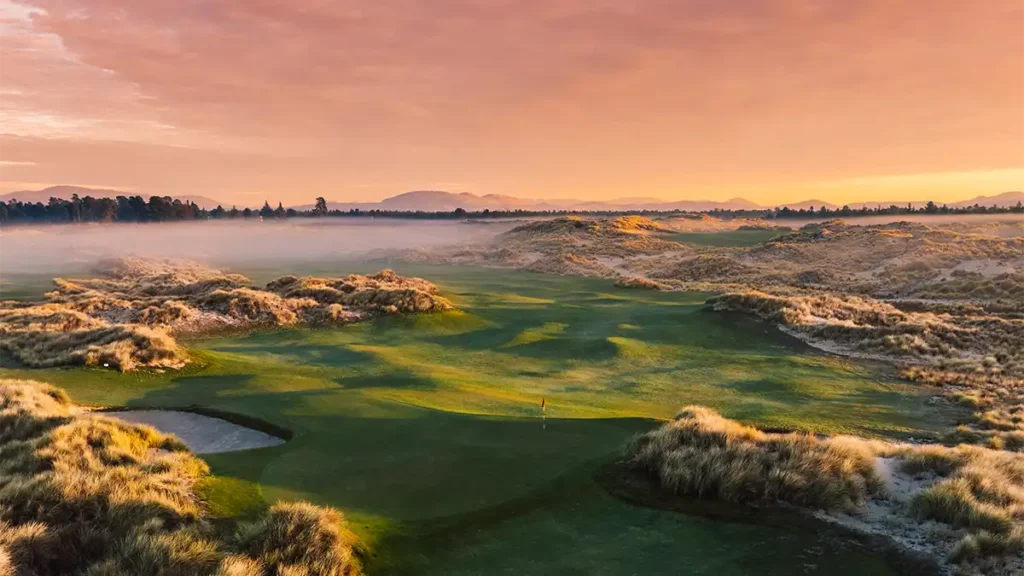
In 7 Mile Beach, Hobart has a new world-class golf offering that plays like multiple courses in one.
When a golf course that’s more than 30 years in the making finally opens, the stories behind its origins then its construction quickly meld with the tales emerging from its fairways and greens once play begins, often to paint a fascinating overall picture.
Such is the case for 7 Mile Beach, the passion project for long-time touring professional and proud Tasmanian Mathew Goggin on a perfect peninsular setting on the eastern edge of his hometown of Hobart. The beachside site’s suitability for a world-class golf course first entered Goggin’s mind during his junior days. Embedded there for years, the idea percolated in his brain and, since 1995, also in the grey matter of fellow player-turned course architect Mike Clayton. These things don’t happen quickly but nor did the concept ever dim for either man. And earlier this decade the course finally made the transition from a mere thought to reality.
Preview play began last May, with a restricted number of golfers touring 11 holes of the layout on certain days during the cooler months. Then on December 4, the full 18 holes officially welcomed play for all. It was a momentous date, a significant addition for Tasmanian golf, Australian golf, public-access golf and world-class course architecture.
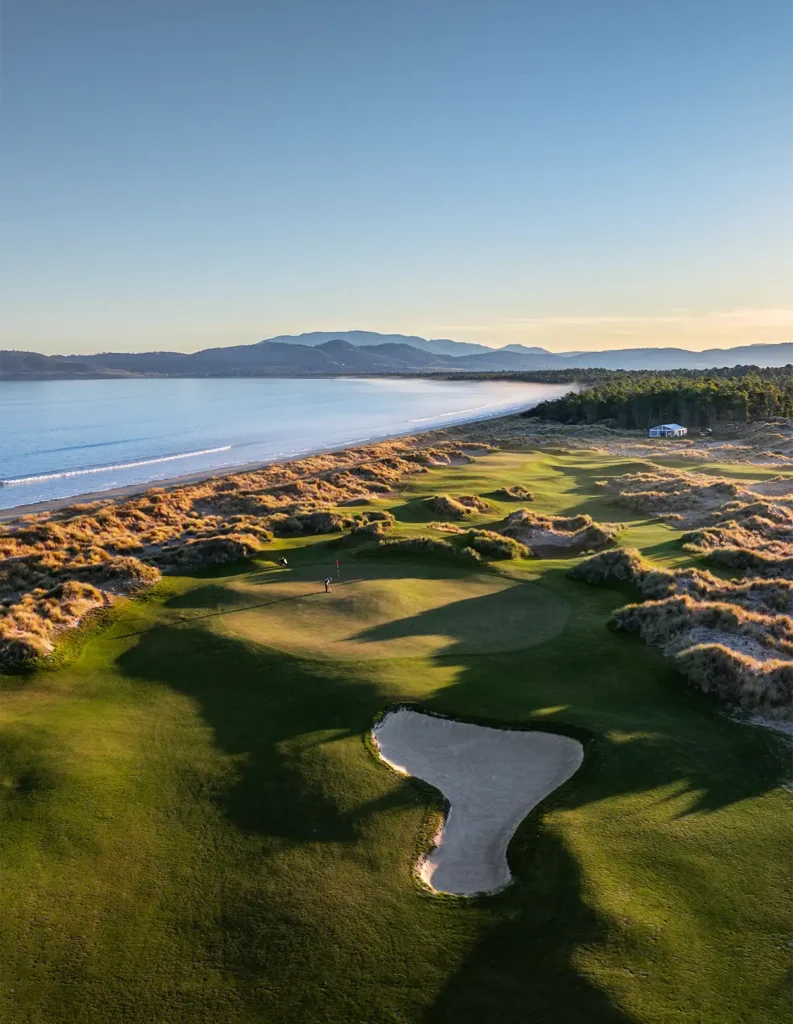
The site gives the impression that restraining themselves was arguably the most difficult task for co-architects Clayton and Mike DeVries from CDP Golf. Given ample space to work with, they instead opted for a more compact layout, which minimises distance between holes and makes each feel connected. The result is very much an 18-hole golf course rather than a collection of 18 holes. Not that the duo landed on a defined plan from the start.
“The original routing had nine holes on the west side of the clubhouse and nine to the east,” Clayton told Golf Course Architecture. “When Mike [DeVries] first visited in 2020, he switched all 18 to the east. This routing is obviously more compact – without ever being cramped – and more intimate, allowing us to create short green-to-tee transitions between every hole. It’s much more like a traditional British links than a modern, wide and sprawling links.”
While the second course – King Collins Dormer’s North course (formerly known as 5 Mile Beach) – will operate from the same eventual clubhouse site, the rearrangement of the first course will allow any future layout to also begin from one clear hub. The untouched land to the east of the first 18 is too small to accommodate anything larger than a short course, meaning any third, fourth or otherwise layouts would need to be to the west of the first two, which fits with the original.
That’s the big picture at 7 Mile Beach. For now, it’s a newly opened course with a second 18 in the early stages of construction. Clayton says that once their South course’s general orientation was decided, the routing was as least partly obvious.
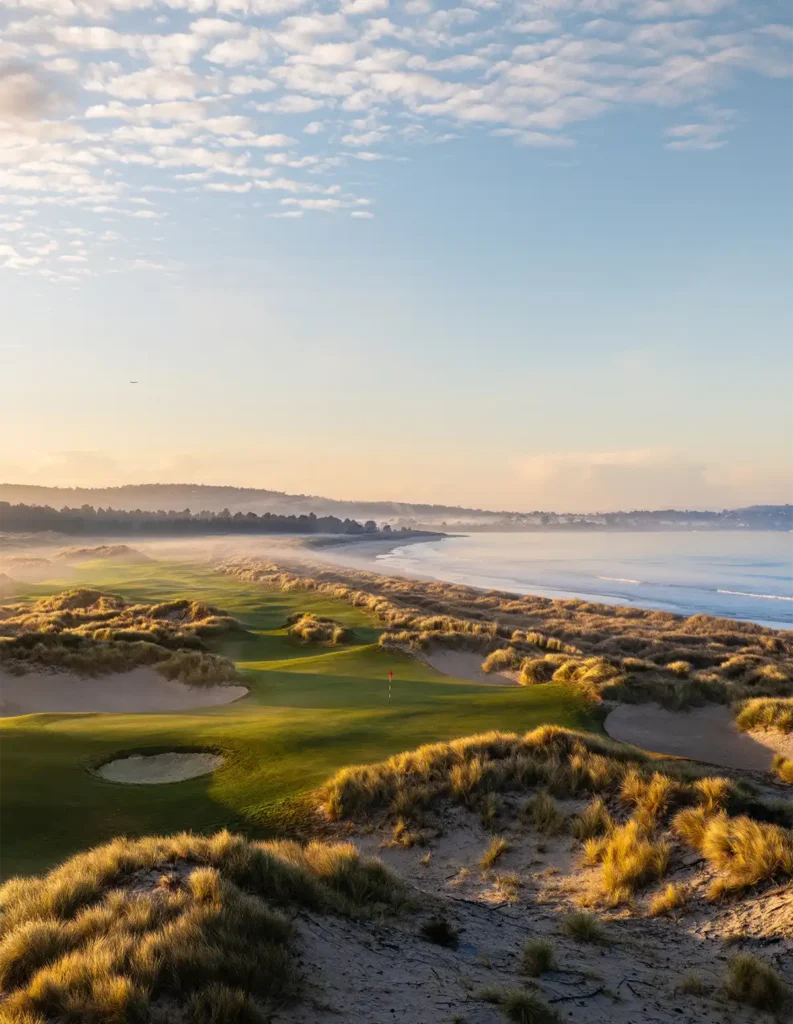
“The first hole was always clear because the land was less infested with pines,” he told Golf Course Architecture. “Mike found the short second, which set up the third and fourth holes that, in turn, set up the fifth playing down to the beach and the sixth, which goes along the beach.
“It is, of course, a visually attractive course, but the strategies and the shots you have to hit are ultimately what makes the golf enduringly interesting. We didn’t overdo the strategy of a clear shot from one side of the fairway and a blind shot over a dune from the other, but it works well at the fourth, fifth, 11th and 15th holes. The greens also set up the strategy because once you are familiar with the contours you understand how to use the ground to move the ball towards the hole.
“Aside from the setting and the drama of the dunes, it’s special because there are a number of world-class holes,” Clayton added. “Ultimately, that’s what stamps Royal Melbourne as the greatest course in Australia and anything even coming close to it is bound to be a fun place to play golf.”
Fun in golf closely courts variety, of which there is plenty at 7 Mile Beach. Golfers and visiting groups who play the course multiple times across a handful of days will enjoy different experiences each time. The design features built-in variation simply through moving the tee markers and pins, to say nothing of the varying wind strengths and directions. Several holes, mostly par 3s, feature teeing grounds with differing hole lengths and approach angles, while the greens are shaped in such dramatic fashion that they ensure variety from pin to pin. At the par-4 eighth hole, where Clayton and DeVries designed two greens, the flag switches daily between both targets, which are different in contour and alter the entry angle. However, one thing about the course will remain the same.
“Tasmania is the only state in Australia where you can grow fescue without a companion warm-season grass, and it plays beautifully,” Clayton says. “The ground/club/ball impact is unmatched.”
Indeed, that unmistakable ‘fescue thud’ is a hallmark of playing the layout. Although for 7 Mile Beach, such physical attributes are just the beginning.
A healthier site and masterful design
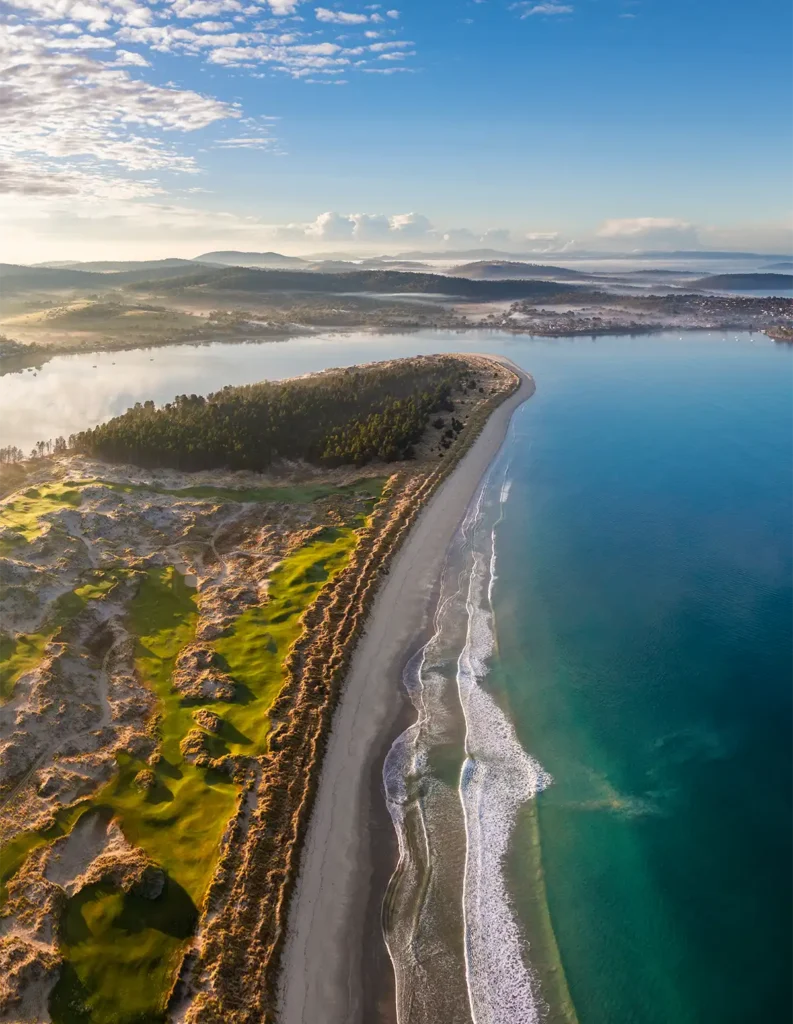
It’s rare for a new golf course to emerge so close to an established city. The Hobart area’s 250,000 residents are fortunate to have something so majestic so close to their doorsteps. And the wonderful aspect to that proximity is: no one has lost out. The narrowing peninsula adjoining Tiger Head Bay was largely unused. Trail riders who did utilise the space have retained the same paths and tracks they accessed before, while the 7 Mile Beach site is now more stable and environmentally healthy than prior to construction of the golf course. Birds that had departed the peninsula have returned, while there are now fewer radiata pines, which choke the fauna and other flora. The pines are a registered weed in Tasmania and covered the site pre-construction.
While walking the 15th and 16th fairways, it’s impossible to miss the flock of huge Pacific gulls in the sand dunes, while 7 Mile Beach general manager Will Kay says blue wrens, black cockatoos and small ground-dwelling birds are now more far more prevalent.
“We’ve made the site a lot healthier than when we arrived,” Kay says.
Due to the location of the temporary clubhouse, play begins from what is the 18th hole before flowing in order into the conventional routing. The semi-blind approach to the 18th green – depending on the distance of your shot in – can cause some initial confusion. The sprawling practice putting green sits on the far side of a huge waste bunker, which gives the impression that that’s your target if the landforms obscure the real one. Then, at the first hole, there’s an alternate tee far below the high dune that houses the main tee and will eventually be the site of the clubhouse, giving you an entirely different way of playing the actual opening hole.
Such built-in variety is a hallmark. The alternate tees are a feature, most notably at the second hole, an uphill par 3 with a horizon green and a huge fallaway to the right. The chain of tees flowing up the hillside gradually shortens the hole and alters the angle of play.
From there the course moves into what ‘the two Mikes’ view as three distinct areas. There’s the initial ridgeline that is most prominent for holes three and four, there’s the central section of the layout below that ridge where play visits several times in a round as you walk through mini-valleys. Lastly, there’s the beachside holes, which the course touches at various points between the fifth green and the 17th hole. Only three times are consecutive holes played in the same direction and never more the two in a row.
Sandy waste areas are an ever-present feature of the course and dominate the landscape in the absence of more formal bunkers, which number only 37 across the 18 holes. Eleven greens are unbunkered and while the beach is in play in parts, there’s not a red or yellow stake to be found as the layout instead relies on contours while accentuating that most magical part of links golf: the ground game.
“The ground is so variable and interesting, and the green sites are so diverse,” says DeVries. “On such a spectacular site, bunkers really become superfluous.”
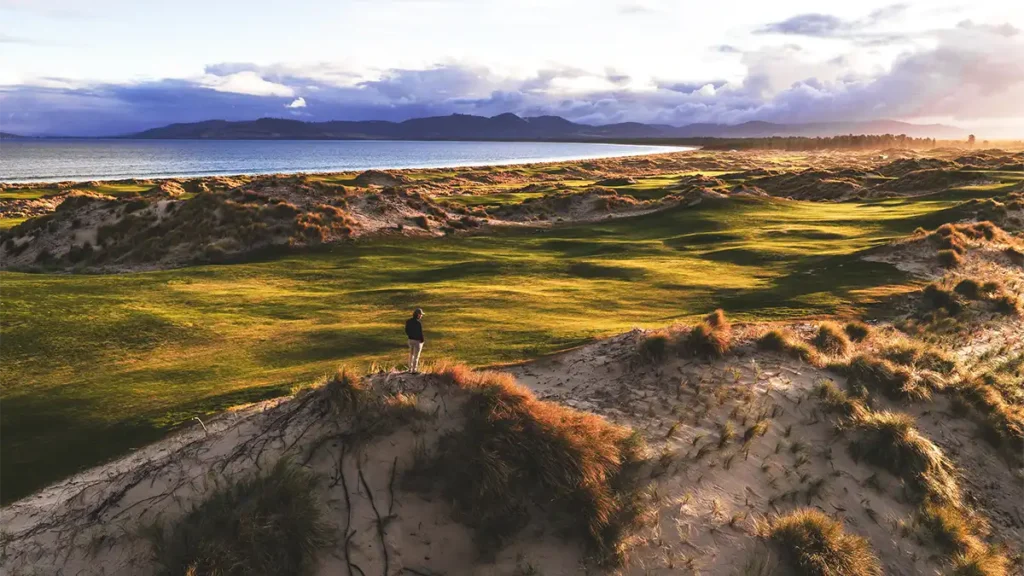
Adding to the elasticity at 7 Mile Beach are the half-par holes. For instance the sixth, which is the first to run alongside the beach, doesn’t quite feel like a par 4 unless you get a good drive away, but it’s too short to be a par 5 from the everyday tee. Therefore its true par is something in between (it’s listed as a 4 on the card, although an extra tee behind the fifth green can make it play as a par 5). There’s more half-par feels at the seventh, a 205-metre brute that plays longer to a rear pin and moves gently uphill to a two-tiered green. It’s clearly a par 3 yet is best handled as a short 4 by most golfers. The par-5 15th and long par-4 16th will play more like a combined ‘par 9’ in certain winds that might make the former play closer to a par 4 than the latter.
Clayton and DeVries penned a layout rich in excellence that doesn’t lean on individual holes to elevate its overall stature. It’s very much a greater-than-the-sum-of-its-parts course that ‘speaks’ to golfers in different ways, leading each first-time visitor to instinctively reflect upon differing aspects on review [see panel]. In the same way that art critics will see something new each time they appraise an artwork, golfers at 7 Mile Beach are likely to detect another clever nuance with every lap of the course.
Hobart, which is famous for its quirky and sometimes outrageous Museum of Old and New Art, has a glorious new masterpiece to show off – one with no exhibition closure date and one that will tempt, tease and titillate for generations to come.

The power of the right logo
Australian golf courses aren’t missing much, but if we’re splitting hairs, there aren’t anywhere near enough mystical, eye-catching and symbolic logos among our very best golf courses. Having lived in the US, I saw the buzz that a logo creates for a golf club in addition to the course’s architectural merit. I think of some of my favourite logos in golf and they are quirky, simple and thought-provoking: Aiken Golf Club in South Carolina with its leaning tree and founding year, 1912, underneath; the lone Palmetto tree logo of Palmetto Golf Club, an Alister MacKenzie design also located in Aiken; the wicker basket on the flagstick from Philadelphia’s famed Merion Golf Club; and the intertwining winged foot and golf clubs from its namesake club in New York.
Which brings us to 7 Mile Beach Golf. It is fascinating and a genius move that 7 Mile launched merchandise before the course was officially open for public play in early December. The club’s founder, former PGA Tour pro Mat Goggin, was inspired by the Lacoste logo – a brand synonymous with tennis but also golf. Tennis player René Lacoste was given the nickname “the Crocodile” by American media after he bet his team captain a crocodile-skin suitcase that he would win his match. Goggin commissioned golf course constructor and logo designer, Nicklaus Mills of Sandbuilt Studios, to create a logo of a Tassie tiger with a golf club in its mouth. Why? Goggin explains.
“For years, the tiger has been a shorthand for Tasmania, its image stamped on tourism campaigns, sports jerseys and corporate logos,” he says. “When the idea of using it for our own venture first surfaced, it struck me as a cliché but there was something in the story of René Lacoste that brought me back to it. His crocodile wasn’t just a logo, it was a statement of character. I think of the Tasmanians I’ve known – quiet but resilient, tough yet unpretentious, often underestimated but fiercely loyal to the place that shaped them. It’s a quality I call being ‘Tassie tough’. For me, our logo is no mere design. It’s a reminder of what it took – patience, resilience and passion – to bring 7 Mile Golf to life. It represents the unyielding spirit of a place and its people.”
“We’ve prioritised the logo over branded items so that there is apparel that features only 7 Mile Beach’s logo, which means there are pieces you’ll find at 7 Mile Beach’s store that you can’t find anywhere else,” adds general manager Will Kay. “I think our logo is different and fun, and they are two central themes for our golf course… distinct and enjoyable.” – Evin Priest

Our panellists’ thoughts
On reflection, it is a course you could play 10 times and have a different experience every round. The combination of varied tee positions and constantly changing cup locations – especially given the size and shape of the greens – really transforms how each hole plays. Even the eighth hole, with its two separate greens, adds a unique dimension. – Andrew Dalgairns
It is seriously good golf land and featured more dramatic undulations than I realised. My favourite hole was the eighth because it is so unique with the two greens and the back-right pin position made for a really fun shot using the backboard. – Edward Dowling
I loved the vistas, the routing and the decision to avoid heavy greenside bunkering – it gives the course a really distinctive feel. The only thing I’m still mulling over is whether there’s yet a truly “iconic” hole in the way the seventh at Barnbougle Dunes has become a postcard hole. That may well emerge as the course beds in and more people get to know it. – Robert Loewenthal
I thought the shape, contours and shelves on the greens were the best part. You could see on most greens they had three or four different shelves for pins to be put on. Off the tee felt so claustrophobic in places. Although quite short off the white tees on some holes, I still couldn’t trust hitting driver and needed to play irons and woods to keep the ball in play. You can’t overpower the course and have to be in the right spots/angles of attack to the greens to find the right contour or level. – Dan Madden
It’s different to anywhere else we have. It has feels of Magenta Shores and both Barnbougles at various points. Lots of undulation, so feels more Irish than Scottish. Not long, but a very tight driving course. – Ben Martin
The uphill, par-3 second hole leaves the strongest impression. You can’t see any other hole or what lies beyond the hill, and then suddenly the green opens up to reveal almost the entire course and views looking outward onto the beach and beyond. I initially disliked the long par-3 seventh, but after a week of thinking about it, I’ve realised it might actually be my favourite hole. – Lachlan Miller
I saw the course on the flight in and from the air it looks unreal and I can confirm that’s what I thought once on the ground. The fairways were tight on some holes for a links course, while the greens were unreal, with the first hole’s green being 42 metres long. – Jacqui Morgan
The hype is real and 7 Mile Beach steals your heart and wants you coming back for more and more. I can’t wait to come back and no doubt when it settles in, it’s only going to get better. It plays with your mind off the tee as it is much wider than what you visualise and the green contours are outstanding. – Grant Naylor
The course doesn’t wow you from go to woah, but it grows on you as you meander in and around the dunes, in total isolation. You can see all holes from the top of the amazing par-3 second, but you always feel you’re playing in the dunes. The green sites are phenomenal with them benched, perched and created from within the land. – Heath Okely
7 Mile Beach was worth the wait. It is certainly unique to Australian golf with its dunes reminiscent to the great links courses of Ireland. It’s different to its celebrated links cousins up in Bridport – 7 Mile is much tighter off the tee and has less bunkering. Its greens are also much smaller on average but still have some wicked slopes. – Kevin Pallier
I loved how so many holes felt narrow when they were quite wide and then wide when they were quite narrow. The course is going to require strategy for people to score well. – Tom Pearce
Photographs by Will Watt and Ricky Robinson