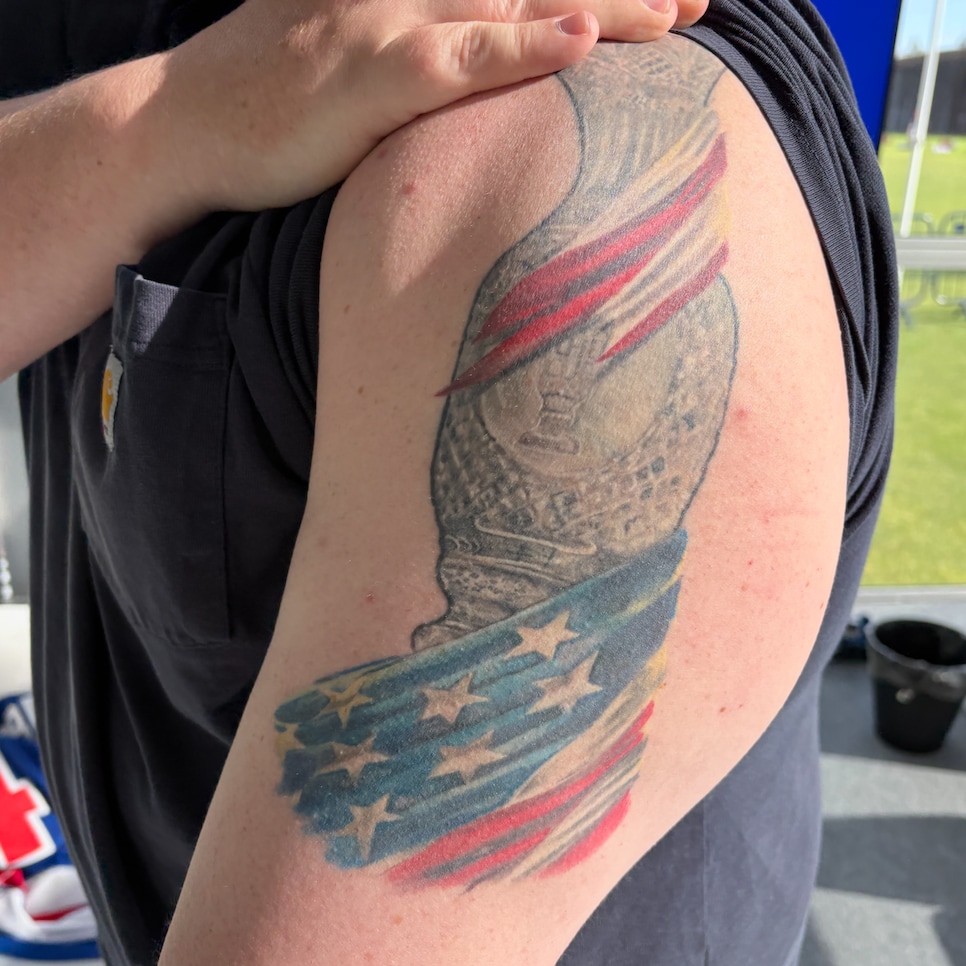
CROMVOIRT, Netherlands — The Solheim Cup is so meaningful to Justin Ray that he got a gigantic tattoo of the trophy on his left arm last year.
“Go big or go home,” Ray said of the tattoo in an interview Wednesday from Bernardus Golf Club.
He does live in Texas after all, just like U.S. captain Angela Stanford.
“You never know if you’ll get another opportunity to do something like that,” Ray said. “I just valued the experience so much … shoutout to my man Joseph in DFW. I had to wait about six months [for the tattoo]. He’s in high demand. Twelve hours in the chair. Second day is a lot tougher. When it’s already kind of sensitive and they have to go back over it, it’s not fun. It was well worth it and something I’m proud to carry with me the rest of my days.”
If the U.S. wins in Europe for the first time since 2015, Ray might add what he calls an addendum onto the already can’t-miss ink, as long as it’s approved by his wife, Vanessa.
Ray is a golf analyst and stats guru that is working his third Solheim Cup, having done 2023 and 2024. He’s been hired to produce and analyze stats for the LPGA, too. He crunches all kinds of numbers to help the Americans find any edge over the Europeans on their home soil.
The Americans won the Solheim Cup in 2024 at Robert Trent Jones in Virginia. Asked what he learned from that, Ray said: “You’re always learning. I try to keep an open mind in everything I do, but especially when you’re trying to help a team. You’re always learning, whether it’s communication in practices with players and captains, whether it’s something you can pick up strategy-wise, just constantly trying to evolve and add to the repertoire of things you can bring to the table.
“I’m always trying to do that. This is my third Solheim Cup now. Everything feels much more comfortable. Anything that comes with experience and repetition, I’ve had the benefit of that this week.”
One thing that’s cool about Ray is that he’s approachable and personable, certainly not what you’d envision as a numbers whiz. He oozes approachability walking around a golf course in a sports jersey. He’s hard to miss and so are the conversation-starter jerseys he wears.
In 2024, Ray wore a basketball jersey he had made that featured Nelly Korda’s name with the No. 5 for the amount of consecutive victories she had that season. This time around, he’s wearing a hockey jersey with Stanford’s last name and the No. 4. That signifies how many wins the Americans would have in Europe if they can win here this week.
“I’m basically a billboard walking around,” Ray said. “That kind of draws it in a little bit, too.
It’s all about supporting the team and again, if I can be a figure of any kind of notoriety that brings attention to the players in the event, I’m happy to do it.”
The U.S. won in Europe in 1996 in Wales, 2007 in Sweden and 2015 in Germany. Alison Lee is the only player on this year’s team that was on the last team to win in Europe, when the U.S. came storming back in singles after being behind 10-6.
For this week, there’s things like rain and wind and injuries and rust and compatibility that mix in with the numbers. Ray finds that players and captains can ask him for anything, and that takes time.
“What’s been really fun is that since this is my third Cup, everybody has been more comfortable coming up to me and asking questions,” Ray said. “My goal from the first time I ever did this was that I didn’t want to be a scary numbers guy in the corner. I didn’t want to be the big, ominous person with the laptop who only talked to the captains. I try to be as personable as possible. Your message resonates so much better when the people who are receiving the message trust you.
“What’s been cool is that I show up on Monday and the people know me. That’s been one of the most rewarding things, getting to know the players. If someone knows you and trusts you and can relate to you, they’re more likely to use your piece of information and they’re more likely to trust it and go with it. You can bounce ideas off each other.”
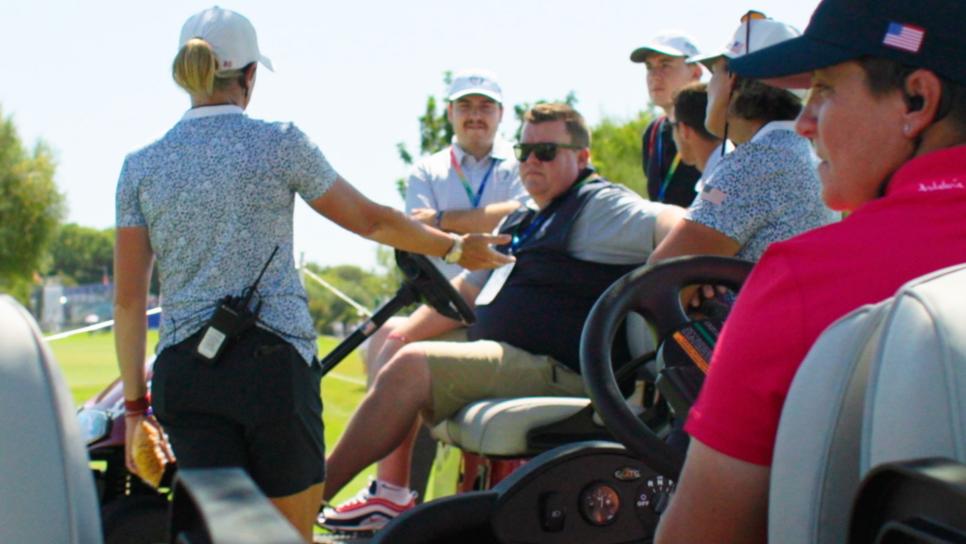
Ray said he gets to know caddies, boyfriends, partners and each player’s team of people that are there to help. He’s in the team room as well. He’ll play a game of pool, make drinks for anyone and chat with anyone in bonding moments.
He prepares for all the knowns and then is constantly on the ready to deal with all of the unknowns that a Solheim Cup will offer, especially when in Europe.
“Always be prepared for any possible thing that can be thrown at you,” Ray said. “Something is always to be said about the road crowd and momentum when you’re at a road event being more difficult to ascertain and hold onto, but really, from my perspective it all starts with the golf course.
“The great thing about this sport is that nothing is ever uniform. Every week you go to a different place and things are different. It all originates from the golf course and the challenges and patterns it lays out. It’s a dorky way to look at it but that’s sort of what my role is. I’m not telling a player where to hit a golf shot. I’m taking it from 10,000 feet and looking at how I can help the team from an overall strategy perspective. The golf course is the thing that presents the most interesting part of the formula.”
This article was originally published on golfdigest.com