The Spanish superstar shows you how to master ‘the scoring zone’, from 150 yards and in.
I consider the ‘scoring zone’ to be anywhere between 150 or 125 yards and the hole, so it’s your wedges and maybe even a 9-iron. The scoring zone covers those situations where you can give yourself a chance for birdie if you hit a good drive or perhaps a par 5 where you had to lay up. Maybe you hit a bad drive and had to chip out, so it could also be a great save for par that can really keep your round going. It’s a very important part of the game and can help you save a lot of shots.
I carry three wedges. A lot of players carry four, some even five. My most lofted wedge is a 58-degree. Then I have a 52-degree as my sand wedge and then a pitching wedge, which is 47 degrees.
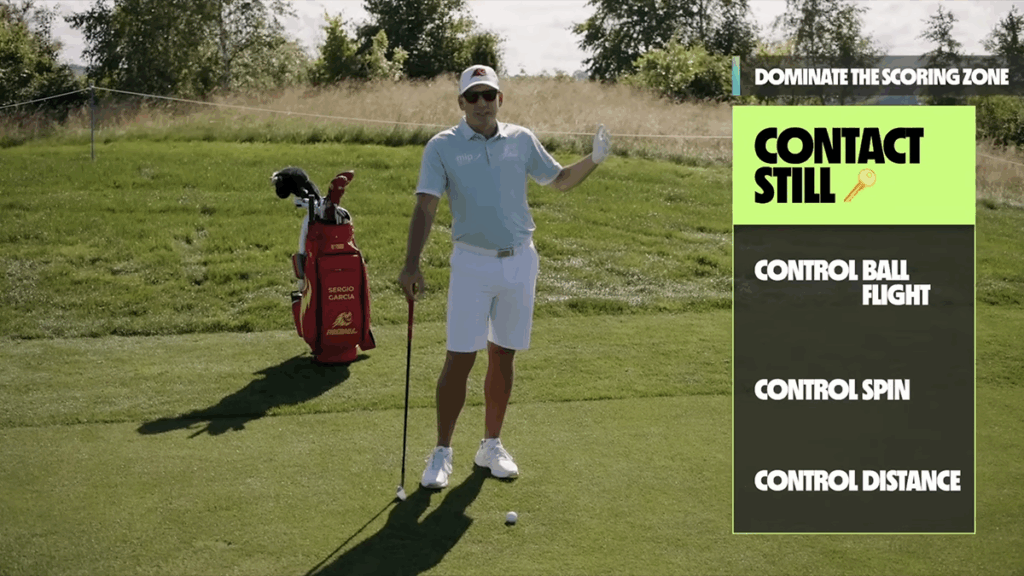
TOTAL CONTROL
The most important thing is making good consistent contact. A good strike is going to give you the ability to control ball flight, spin and distance. If you can do that from this distance and give yourself a lot of good looks for an up-and-down, you’re always going to be doing great – whether it’s for a birdie or a par save. Sometimes a par save from this distance feels even better than a birdie because it keeps your momentum going.
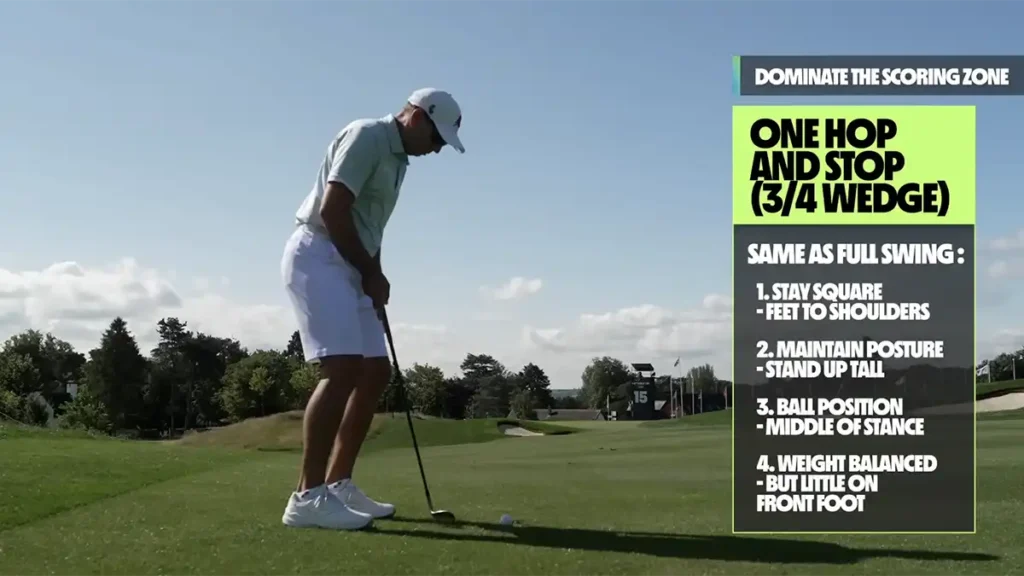
My 52-degree wedge is my 125-yard club. It’s a shot where, if it’s into the wind or if the greens are soft, I’m trying to control the spin of the ball. Unless the flag is behind a bunker or behind a slope, what you try to do from this distance is hit a one-hop-and-stop shot. That quick stop is the easiest aspect to control; it’s not easy to control eight yards of spin. I’ll often hit a three-quarter shot with this club inside this distance range, so with that shot the trajectory’s going to be a little lower.
When hitting more of a full shot, the trajectory will go up and the ball should spin back more. Then a full shot with the 58-degree wedge should see more speed, more spin and a slightly different trajectory compared to the 52. The beautiful thing about when you get comfortable and proficient with the wedges is that you can hit so many different shots to get to the same spot. It’s always fun to have a lot of different possibilities.

THE ONE-HOP-AND-STOP THREE-QUARTER WEDGE
Whenever I’m not hitting a full shot, everything is a little bit ‘tighter’. I like my stance to be a little bit narrower (the ball is still in the middle of the stance with this shot), although I’m still doing the same things I do with a full shot. I’m still making sure that I’m set up square, that my posture is still the same and my weight is a bit more on the left leg. But I’m going to grip it a tiny bit shorter down the handle and my feet are a bit closer together because I don’t need to make a full swing. These adjustments help prevent me from making a full swing. They shorten my swing a little bit, and that’s what I need for this kind of shot.
There’s a couple of things to do to be able to control spin. One of them is to make sure your club is clean. It’s very important because if there’s dirt on the grooves, it changes the way the ball flies and the spin that it comes out with. It’s never as consistent.
You’re going to control the spin mostly with the speed of your swing. The more speed you put in the swing with the shorter clubs, the more spin you’re going to create. If I’m hitting a three-quarter shot with the 52, I’m hitting a smoother shot. The clubhead speed is going to be slower and the spin you generate is going to be slower, so the ball is not going to back up as much once it hits the green.

REMEMBER THE SHOT’S ‘SECOND HALF’
I usually hit my most lofted wedge, my 58-degree, about 105 to 108 yards. My stance is a little bit wider for this club and my swing is a little bit longer with a little more speed. You’ll see a slightly different trajectory and reaction on the green.
One thing to gauge first is how firm the greens are and what the contours of the green are doing. You need to calculate these factors when you’re hitting a club that produces more spin – including how the ball is going to react on the green. You might hit a great shot that bounces next to the hole, but if it’s soft and there’s a slope there and you put too much spin on it, it’s going to take the slope and trickle away from the hole. On firm greens, there might be a contour you can use to help you get the ball closer to the flag. So you need to think about these things to make sure that not only do you hit a great shot, but you hit the right shot.
GOING LOW
A useful shot to have in your wedge armoury is a lower shot with a little draw plus some sidespin. When I want the ball to stay lower, I ‘back foot’ it a tiny bit so that my angle of attack is more descending, plus I shut the face a touch. This takes a bit of loft off the club to help drive the ball in lower. You also need to release the hands through impact to make sure the shot has that draw.
I’ll still swing out to the right because I’m trying to hit a draw. When I’m trying to hit a fade, my body will aim a touch left and my swing will be going more from outside to in, and my top hand will hold on a bit more to keep the face open so that it cuts. When you’re trying to hit a draw, you’re doing the opposite. You’re making sure that the lead hand rotates so that the clubface releases and so that you’re catching the ball in such a way that it puts the right-to-left spin on the shot.