
Scottie Scheffler has his share of equipment quirks, which makes perfect sense when you think about it. Nobody reaches the top of the sport by blindly following the crowd. At some point, every elite player figures out what works, locks it in, and refuses to budge.
Scheffler is no different. His quirks range from the merely unusual—gaming a driver with zero hot melt—to the downright extreme, like never changing his grips. It’s a long list that underscores just how much detail goes into every club, shaft and grip in his bag. It’s borderline Tiger-esque.
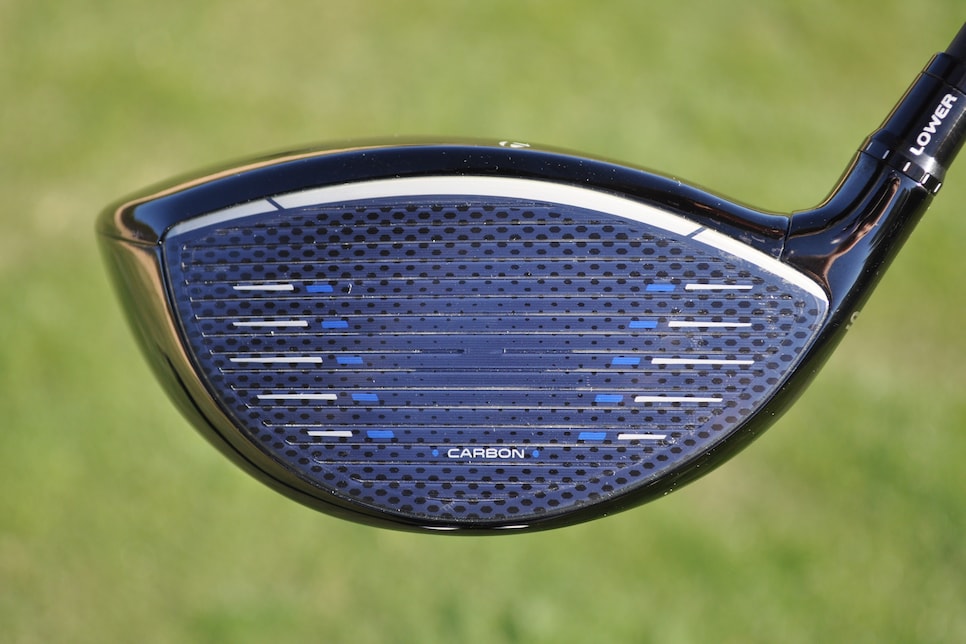
All of this matters because Scheffler’s latest TaylorMade Qi4D prototype driver isn’t something you’ll find sitting on a retail shelf come January. Peruse photos of the latest weapon and his previous Qi10, and you’ll notice the bright blue face is actually from Stealth 2—a driver that predates the Qi line entirely.

Scheffler initially found that the red face on TaylorMade’s Stealth 2 made his low-lofted driver look like it had more loft than it actually did. (Jonathan Wall/Golf Digest)
For Scheffler, the name on the sole matters far less than the precise recipe of parts that gives him confidence. In this case, the blue face design offers an important visual at address that he hasn’t been able to replicate with recent releases.
“[Scottie] plays low loft at 7.5 degrees,” TaylorMade tour rep Adrian Rietveld confirmed to Golf Digest. “This face gives him the impression that there is more loft than there actually is. It’s more contrast for him personally, and he has just grown comfortable with the blue.”
According to Rietveld, Scheffler started to notice how colors changed the amount of visual loft he was seeing at address during testing with the red face found on the Stealth 2. When he moved to Qi10, he found the blue face achieved the same visual and didn’t look out of place alongside the understated Qi10 cosmetics.
Too much loft—or even the appearance of excess loft—can cause golfers to subconsciously manipulate their swing to help the ball climb, whether or not it needs the help. So when Scheffler made the jump to Qi4D, he had TaylorMade’s tour team carry over the same blue face design. It’s a simple cosmetic tweak that’s become part of his driver DNA.
A look at the standard face found on TaylorMade’s Qi10 driver. Scheffler opted for a custom bright blue version. (Jonathan Wall/Golf Digest)
For those without access to a tour truck, the easiest way to alter face visuals is far less scientific: a Sharpie. Keith Mitchell and Xander Schauffele have both used markers over the years to adjust how the face looks at address.
Two years ago, Schauffele added white lines to the face of his Callaway Paradym Triple Diamond to mimic the scoring-line pattern from his previous Mavrik.
“With the dark face, it’s tough to see those grayish lines they print on the face,” Schauffele said. “For me, they’re a little light in color. I know it’s kind of a mixed bag with players on if they want to see the face or not, so we figured it’d be easier to just make one that’s harder to see. And if someone like myself wants to see lines, we can just add them.”
At the highest level of professional golf, visuals are everything. If a driver looks shut at address, it might not even earn a single swing. The same goes for how much of the face appears to be showing when the club is set down.
It’s why pros like Scheffler and Schauffele are so particular about the smallest details—like how the face looks when they set the club down.
And that’s really the takeaway: for the best players in the world, confidence doesn’t just come from numbers on a launch monitor. It comes from the look, the shape, the color—the tiny cues that tell them the club in their hands is the right one.
Scheffler’s blue face may seem like a quirk, but in a world decided by fractions of degrees and millimeters, it’s another example of how the smallest details can separate the greats from the merely good.
This article was originally published on golfdigest.com