
As much as the USGA and R&A have done to simplify the Rules of Golf, there never seems to be a shortage of gaffes occuring on the professional tours and at major amateur events. In 2025, there seemed to be more than a fair share of controversies and violations, some bizarre, most by accident (but not all).
Here’s a look back over the past 12 months on nearly two dozen rules incidents that got our attention. There was everything from cheating accusations to slow-play enforcement to … well … sprinkler abuse. (Seriously.)
For your reading pleasure …
More 2025 Year In Review  Year in Review 2025 Newsmakers of the Year—Our annual countdown of the top 25 players, events and moments in golf
  Year In Review The definitive list of the best social media posts of the year in golf
  Year in Review The top golf equipment stories of 2025 Akshay Bhatia starts season by hitting it OB—on purpose
Playing in DP World Tour’s Hero Dubai Desert Classic in January, Akshay Bhatia thought he had a simple solution after hitting his drive into trouble on the 13th hole of the Emirates Golf Club. His second-round tee shot found a cluster of trees, and it seemed his only option for advancing the ball was to chip into the adjacent eighth fairway.
Unfortunately for him, the eighth was deemed internal out of bounds for the tournament. Bhatia claimed he wasn’t informed on the rules sheet, but the notification was there. He received a two-shot penalty and chipped again, this time into the 13th fairway, on his way to carding a double bogey. He still made the cut and finished tied for 37th, so this one could have turned out a whole lot worse.
Hey, it was white, round and had dimples. Anyone would be fooled 
It’s not all that unusual for an everyday golfer to fish a ball out of a pond and begin using it, regardless of prior ownership, but a tour pro?
Lee Westwood was playing in the LIV Golf Riyadh tournament in Saudia Arabia in February—and was playing well as he reached the par-4 16th during the second round. Unfortunately, he plunked his tee shot into a penalty area. He and his caddie, Mick Doran, were able to fish a ball out, and Westwood went on to hit it on the green, hoping to save a bogey.
That’s when Westwood realized it wasn’t his ball. In fact, not only wasn’t it the same model, it also was a different brand. Huh? Well, the tournament was played under the lights, so maybe that had something to do with it.
Regardless, just like the PGA Tour, LIV Golf has a Model Local Rule that says you have to play the same type of ball throughout the round. Thus, he was given a one-shot penalty and wound up with a double bogey for the hole. He finished 25th at the event.
If you’re wondering, the Rules of Golf do allow you to play a different ball in a regular round of golf.
Sometimes you got let the anger out 
At the Mexico Open at Vidanta in February, defending champion Jake Knapp was battling to make the cut when he hit a bunker shot on his final hole (the ninth) of the second round. The ball didn’t make it out of the bunker, and in frustration, Knapp swiped the sand with his club.
Shortly after doing it, he was given a two-stroke penalty for touching the sand in a bunker before making a stroke (Rule 12.2b). The decision put Knapp outside the cut line and would have sent him home early if not for getting a second opinion on his rules incident.
After reviewing what had transpired and confirming that Knapp had struck the sand in anger, the penalty was rescinded. That was big for Knapp, since it allowed him to make the cut on the number.
While it’s true that you can’t deliberately touch the sand in a bunker before playing a shot from within its confines—and that means with your club, your hand, a rake, etc.—there are some exceptions that aren’t in violation of the rule. Among them is striking the sand in anger (Rule 12.2b), which means Knapp did not deserve a two-stroke penalty.
Another wrong-ball incident gets Ben Crane to DQ himself 
Emilee Chinn
At the Corrales Puntacana Championship in the Dominican Republic in April, five-time PGA Tour winner Ben Crane made a huge mistake.
On the eighth hole at the Corales Golf Course, Crane hit his tee shot into a hazard, arrived at where he believed the ball went in and took a drop to hit his third shot. But then he saw a second ball in the fairway and realized that his first shot must have caromed off the rocks and landed safety in play.
As Crane then explained on social media after: “Now I have two balls in the fairway, I assume that my ball hit on the right was the … second one I put in play. And I play that golf ball and putt out and realize there’s a big rock stuck on that ball. And you know you do a good job of identifying when I took my drop of what number I was playing. And I realized I had played the wrong golf ball through the hole.”
Under the Rules of Golf, it’s a two-shot penalty if you play the wrong ball (Rule 6.3) and you must correct the mistake by playing the correct ball before teeing off on the next hole. Crane didn’t realize his mistake until he began playing the ninth hole, which is grounds for disqualification. And Crane grudgingly called himself out, even knowing it would end his tournament.
Wyndham gets a pass 
Mike Ehrmann
Wyndham Clark has a reputation for having a bad temper (just ask a locker at Oakmont), but he kept his cool at the Arnold Palmer Invitational in March when a rules controversy ended in his favor.
In the second round, Clark took a free drop after finding his ball embedded in the fairway at the par-4 third hole at Bay Hill Club. Broadcasters on PGA Live questioned whether his ball came to rest in his mark or someone else’s. Rule 16.3 allows players to get relief for a ball embedded in its own mark, but not a mark created by another shot.
As Clark continued to play, the PGA Tour released a statement saying that rules officials reviewed video of the incident and determined that Clark’s drive bounced forward slightly and then settled back into the pitch mark. It was deemed then to be embedded and the relief he took was permissable.
It’s 167 to the pin, but you’re now hitting 4 instead of 2 
Michael Reaves
The PGA Tour’s six-week test period of allowing laser rangefinders during tournaments got off to a shaky start for Davis Riley at the CJ Cup Byron Nelson in May. In the second round at TPC Craig Ranch, Riley used a rangefinder that gave distance to the pin (OK by the rules) but also indicated elevation changes (not OK). Riley noticed the elevation feature, which can be toggled off, and notified rules officials of his error. He received a two-shot penalty, but it could have been worse. Had the elevation feature remained on, he would have been disqualified.
He ended up shooting a 71 despite the penalty and made the cut in the tournament on the number.
But did he wash his hands afterward? 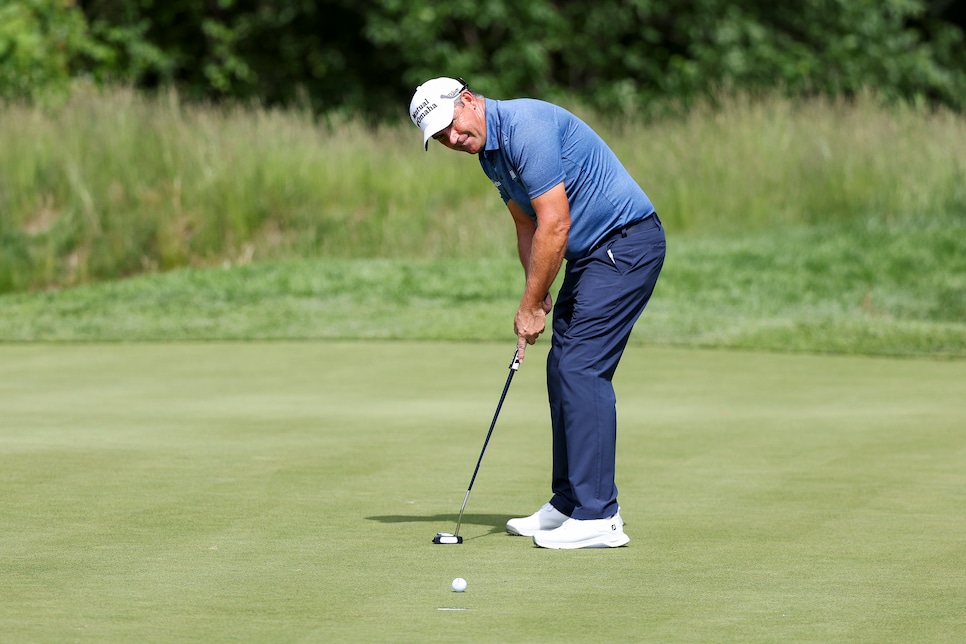
Mike Mulholland
Padraig Harrington fell just short of winning the Senior PGA Championship at Congressional Country Club in May, losing by a shot to Angel Cabrera, but he also might remember the tournament for a birdie that involved, ahem, a birdie.
When he reached the green of the par-4 14th during the final round, he had a one-shot lead and was looking at a makeable birdie putt—but there was one problem. Between his ball and the hole was a noticeable mass of, well, bird poop. Harrington knew that animal droppings are typically considered loose impediments and can be cleared anywhere on the course, but this particular mass was different in that it was adhering to the green.
The Rules of Golf says in its definition of loose impediments that the natural objects can’t be growing or “fixed.” Did the sticky bird droppings qualify as fixed? Fortunately for Harrington, the answer was no. He got the pile out of his way and then sank the 30-footer.
More 2025 Year In Review Year in Review 2025 Newsmakers of the Year—Our annual countdown of the top 25 players, events and moments in golf Year In Review The definitive list of the best social media posts of the year in golf Year in Review The top golf equipment stories of 2025 Adam Hadwin goes ballistic on a sprinkler head
Jessica Hadwin jokingly called it a “sprinkler malfunction” on social media, but the reality was that her husband lost it during a frustrating second round at the Valspar Championship in March. En route to shooting a 76 and missing the cut at Innisbrook Resort’s Copperhead Course near Tampa, Fla., Adam slammed his wedge down in anger not realizing what was on the ground.
A fan caught video of Hadwin setting off a sprinkler in spectacular fashion, then spending the better part of a minute trying to fix the situation, even offering a “sorry” after getting things under control.
Received this via DM: Adam Hadwin learning the consequences of his actions on Friday at the Valspar Championship. pic.twitter.com/ZiitjOdao3
— Alex Gelman (@agsnetworks) March 22, 2025
Hadwin was not fined, but he did buy lunch for the grounds crew at Innisbrook and paid for the damage.
At least it wasn’t Stephen A. Smith 
Shane Lowry’s experience at Quail Hollow Club during the PGA Championship in May wasn’t, shall we say, the most enjoyable. He missed the cut with rounds of 73 and 71, and wasn’t thrilled about an incident that occured on the eighth hole during the second round. After hitting a good tee shot, Lowry walked to his ball only to discover it was in a pitch mark in the fairway.
Lowry called a rules official over to determine if he could take free relief, but before the discussion concluded, an on-course reporter for ESPN came over and told the rules official (and Lowry) that it was not his ball’s pitch mark.
This rules official will not be receiving a Christmas card from Shane Lowry. pic.twitter.com/D7Ed9Z1n6G
— GOLF.com (@GOLF_com) May 16, 2025
Lowry played it as it lies, hit his next shot in a bunker, then lashed at the ground and shouted an expletive we won’t repeat here. Later, he said this about the incident:
“I was just asking the referee and the ESPN guy comes straight over and he’s like, ‘That’s not your pitch mark’. And I’m, like, that’s not for you to talk about,” Lowry said. “That’s for me to call a rules official and decide what happens. I just said, the rules official, what happens to the guy at 7:10 who’s not on ESPN Live? I guarantee you he’s down there arguing that’s his pitch mark.”
Guessing that didn’t make the SportsCenter Top 10 highlight package that night.
LPGA gets tough on slow play 
Stuart Franklin
The LPGA has long had a reputation for five- to six-hour rounds, but it took big steps to move things along faster in 2025, including penalizing players up to two strokes for slow play. The first two-shot penalty came in May at the Black Desert Championship when Chisato Iwai was assessed. Another came at the Amundi Evian Championship in July when China’s Yan Liu (above) was handed a two-stroke penalty in the second round and missed the cut by three shots.
The LPGA updated its pace-of-play policy to make it stricter after many players requested it including Charley Hull and Nelly Korda. The policy gives fines to any player who is 1 to 5 seconds over the allotted time to hit a shot, a one-stroke penalty for anyone 6 to 15 seconds over and a two-stroke penalty for a player taking longer than 16 seconds.
RELATED: LPGA rules guru explains new policy in place and why it could make a difference
Leave the big stick in the trunk 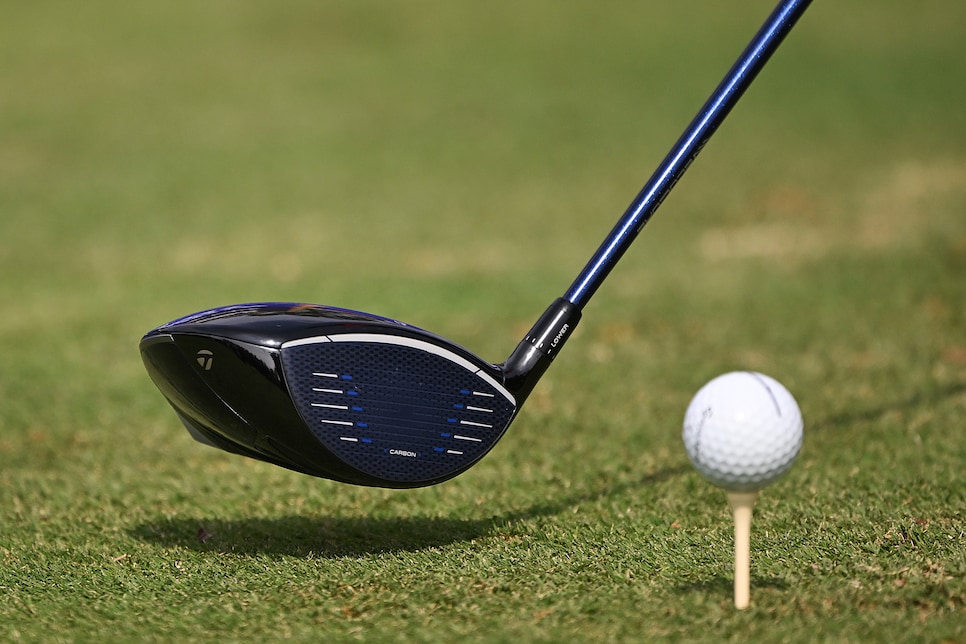
Ross Kinnaird
Before the start of the PGA Championship at Quail Hollow Club in May, Scottie Scheffler and Rory McIlroy had their drivers tested by the PGA of America, and both player’s tournament club was ruled non-conforming. They were among 50 players tested, according to the PGA of America.
Both players were planning to use a TaylorMade Qi10 driver (above).
“The driver testing is something that regularly happens on tour. My driver did fail me this week,” said Scheffler, who won the event anyway. (Take that, PGA.) “We had a feeling that it was going to be coming because I’ve used that driver for over a year. I was kind of fortunate for it to last that long.”
Scheffler was referencing the fact that over time, the face of a driver can get more springy as a result of the metal being stressed from repeated impacts. “CT creep” as it’s called on tour—short for characteristic time—is common among players who deliver tour-level clubhead speeds, with the distance advantages that come from clubs just outside the tolerance zone considered minimal.
While McIlroy did not address the issue—in fact he passed on talking to the media all week despite news of his failed driver test being reported—at least two of Scheffler’s peers had strong opinions about driver testing. Xander Schauffele says every player’s driver should be tested, not just a random sampling. Lucas Glover raised some concern when he said, “most guys don’t give them their real driver anyway.”
No penalty here, but it was close for DeChambeau 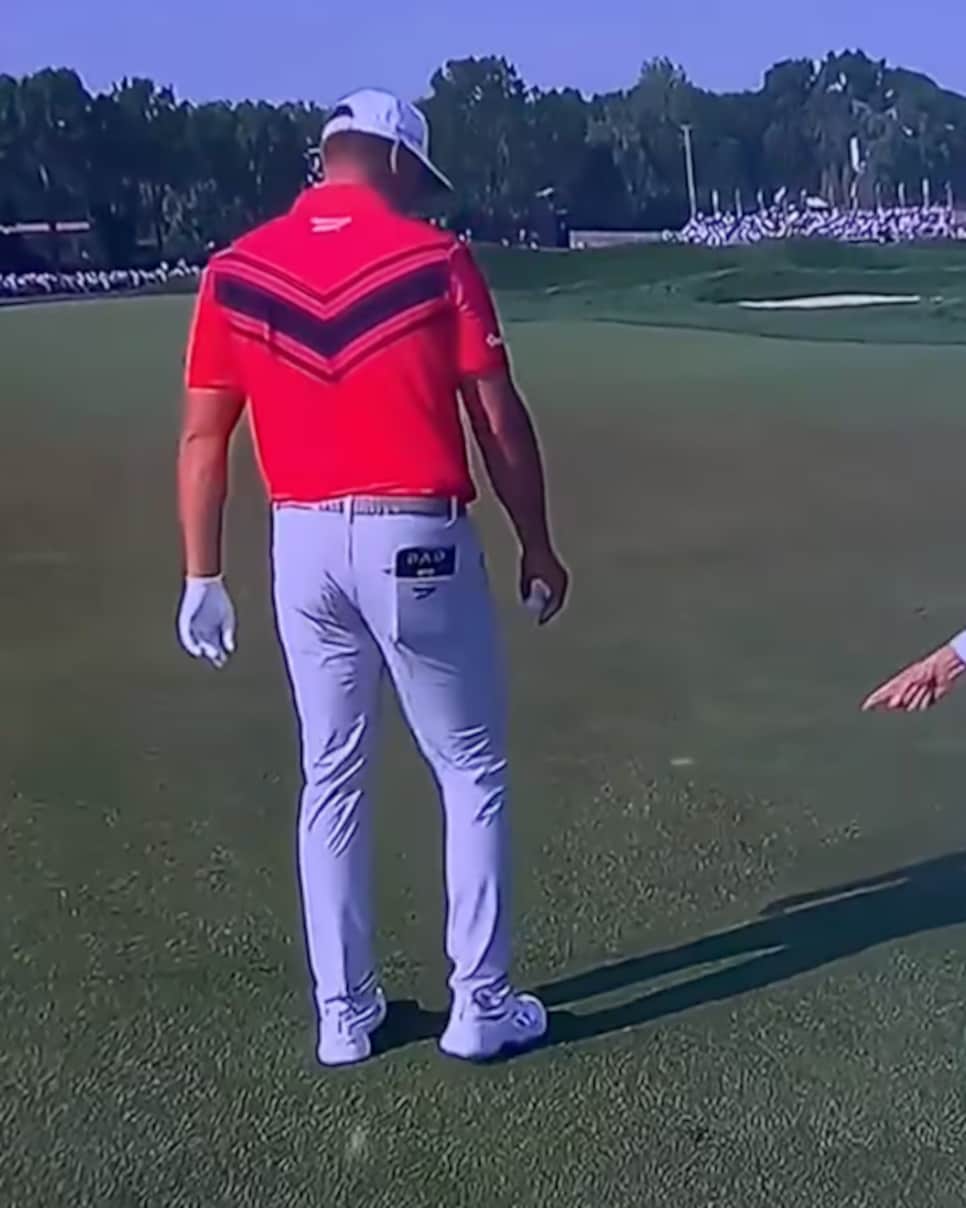
At the U.S. Open at Oakmont Country Club in June, Bryson DeChambeau almost found out the hard way that there are times when you drop the ball and there are times when you place the ball—and not knowing the difference can be costly.
During the first round, after driving it in a fairway bunker on the fourth hole, DeChambeau hit back into the fairway, but his ball came to rest in a spectators’ crosswalk. The area is treated as ground under repair, which meant he was entitled to free relief.
Instead of dropping outside the walk, DeChambeau placed his ball on the ground. A rules official was watching and quickly alerted him to his mistake. On the broadcast, DeChambeau appeared to say, “Oh, gosh,” then quickly picked up his ball and then dropped it.
It would have been a two-stroke penalty under Rule 14.3b. DeChambeau instead made a par, shot 73 that day and finished the U.S. Open in a tie for 10th.
Lowry again? This one is funny 
You can blame the Western Pennsylvania heat or the nasty course conditions, but poor Shane Lowry had a major brain fart during the second round of the U.S. Open. He was well on his way to missing the cut when he approached his ball on the 14th green.
What happened next? He picked it up without marking it, which is a one-stroke penalty (Rule 14.1). After realizing what he did, Lowry started laughing and so did good friend and member of Lowry’s group, Rory McIlroy. Just one of those days.
We all forget to mark a ball from time to time, Shane! pic.twitter.com/vzM1ukesWt
— USGA (@USGA) June 13, 2025
It wasn’t Mayakoba bad in terms of strokes, but it was pretty bad 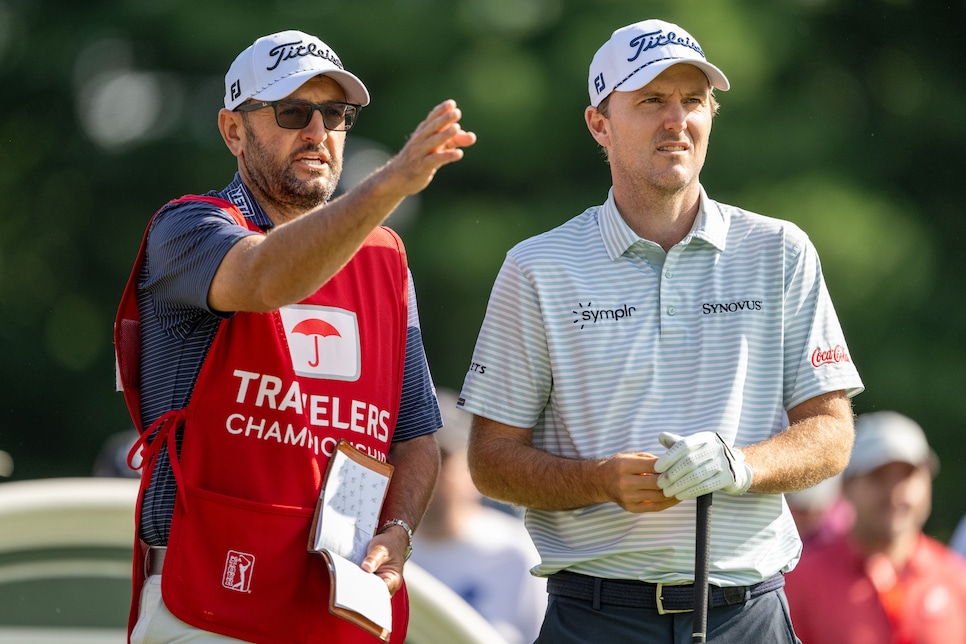
Mark Smith/ISI Photos
Russell Henley famously was penalized eight strokes for violating the PGA Tour’s one-ball rule at the Mayakoba Classic in 2019, which led to a missed cut and a few less dollars in his bank account. Fast forward to this past June’s Travelers Championship, and Henley found himself again marred in a rules incident that might have cost him the first-place check of $3.6 million.
Playing the second round at TPC River Highlands in Connecticut, Henley called a penalty on himself after his ball moved ever so slightly on the eighth hole. He did so after a discussion with rules officials where it seemed they were prepared to give him a free pass since it was so hard to detect. But Henley said he was certain it moved.
Hard to say that one stroke was the difference, but Henley ended up finishing second in the tournament by one shot. He called it a “teaching moment” for his son. Might be one for all golfers.
Like Henley, Rose also calls a penalty on himself 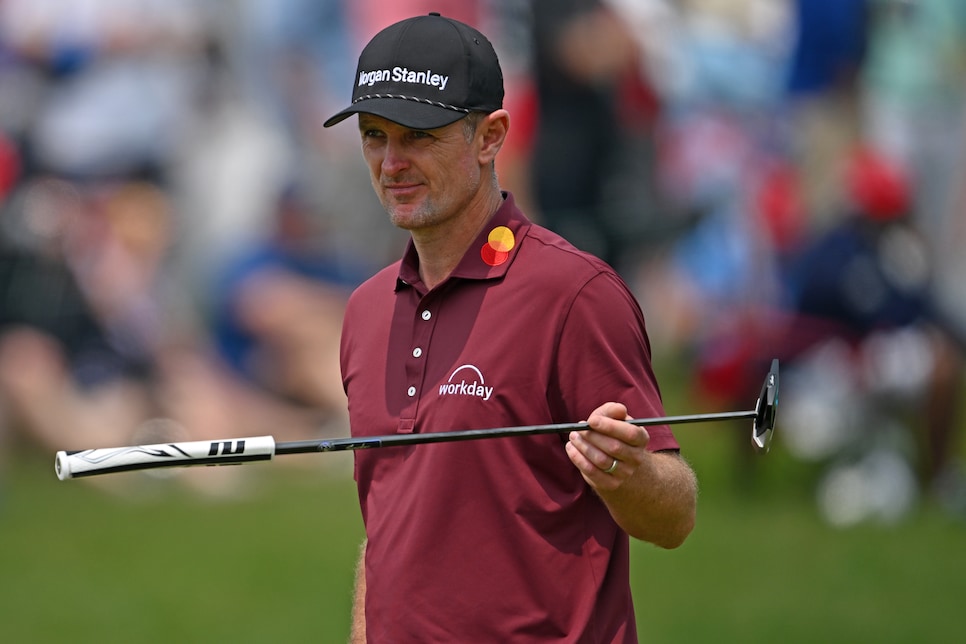
Minas Panagiotakis
You probably won’t see a hockey defenseman confess to boarding an opponent and an offensive lineman admit to football officials he held on a long pass play. Golf, however, has a long history of players calling penalties on themselves. Yep, there’s still honor out there.
Justin Rose did it at the RBC Canadian Open in June. On the seventh hole of the second round at TPC Toronto, Rose hit a terrible tee shot on the par 3, his ball winding up about 50 yards from the green in thick rough. He tried to remove a loose impediment near his ball and the ball moved. Instead of putting the ball back in its original resting spot and taking a one-stroke penalty, Rose mistakenly played it from the new location, which is a two-stroke penalty.
He reported the incident, made a double bogey and likely wound up missing the cut in the event because of the rules blunder.
Andrew Redington
Sam Bairstow learned the hard way that you never know who’s watching—or filming. Playing in the DP World Tour’s Nexo Championship at Trump International in Scotland in August, Bairstow was first disqualified and later fined for failing to acknowledge a two-stroke penalty he should have taken on his scorecard before signing it.
Bairstow signed for a bogey 5 on the 14th hole during the opening round, but it should have been a 7 as he was found to play a ball that moved after he addressed it. He didn’t know it at the time, but a spectator was filming the incident and video showed Bairstow address the ball, the ball moves, then Bairstow steps away to speak to his caddie before addressing the ball again and hitting the shot.
The spectator reported the incident to DP World Tour officials and they confronted Bairstow after the round and he withdrew. Two weeks later, the fine was handed down. “After further investigation, Bairstow was found to be in breach of the DP World Tour’s Code of Behaviour and sanctioned accordingly,” the tour said in a statement.
Bairstow, in a statement to The Telegraph, said: “At my address position I could not see the ball at all but I could see the markings on the ball when I moved to the side where the video was taken. Something looked different when I re-addressed the ball for a second time so I checked my markings on the ball to ensure they were in the same position, which they were. I know I should have called a referee, and I really regret that I didn’t. I know who I am as a person, and so do the people who are close to me. I fully acknowledge by not calling a referee at the time, I didn’t play my part in respect of the tour and my fellow players.
“After being shown the video after my round, I did what I could at the time by disqualifying myself from the tournament. I completely respect the tour processes and I accept the additional sanction. I hope I can now move on and concentrate on playing the game I love.”
Was that a hard 4-iron or an easy 4? 
Grant Halverson
At the Korn Ferry Tour’s Memorial Health Tournament in August, two pros were disqualified for doing something most golfers know not to do—share information about club selection (Rule 10.2a).
Cole Hammer, once the top-ranked amateur in the world, notifed rules officials that he had shared information with his playing partner’s caddie, Nico Torres, on the par-3 17th during the first round. Hammer reported the incident to tournament officials the following morning, which led to a DQ for himself and Nelson Ledesma after the two began playing their second rounds. Hard to believe two pros would go beyond taking a peek into another player’s bag to see what was just used, but it happens. Torres flashed four fingers to Hammer, a sign that Ledesma hit a 4-iron—and Hammer responded.
“I feel like I know the rules really well, and I’ve always tried to uphold them to the best of my ability,” Hammer said. “It just didn’t sit right with me last night, and when I woke up this morning, I felt compelled to go talk to the rules official and tell him what had happened.”
Amazingly, Hammer didn’t realize his actions would lead to Ledesma’s disqualification, too. What???
Two ‘little thieves’ might have saved Matt Fitzpatrick a couple of shots 
Andy Lyons
Playing in the DP World Tour’s BMW PGA Championship at Wentworth outside of London in September, Matt Fitzpatrick hit a bad tee shot on the final hole of the first round right before a lightning siren went off, forcing players off the course. During the 90-minute weather delay, Fitzpatrick and his caddie wondered if some spectator would find the errant tee shot and pocket the ball.
“There had to be a good chance of that happening,” Fitzpatrick said. “So we called over a referee and explained the situation and asked whether we should look for the ball then, rather than risk it being taken. He took us over to the crowd where we reckoned my ball would have landed. A few people there said they’d seen two young boys dive into the bushes and come out grinning with a golf ball.
When it’s known or virtually certain that an outside influence has moved or taken your golf ball, you can take a free drop approximating the location where the ball would have been under Rule 9.6.
“So we decided the balance of probability was that it was my ball, and that I would take a drop in that spot when we got back,” Fitzpatrick said. “I made a 6, but if I’d had to play [a] provisional ball, it could have been worse. So those two little thieves who made off with my ball probably saved me a shot.”
Fitzpatrick still managed a 66 with the double bogey and finished the tournament in a tie for fifth.
He says he ‘didn’t cheat’ but his actions suggested otherwise 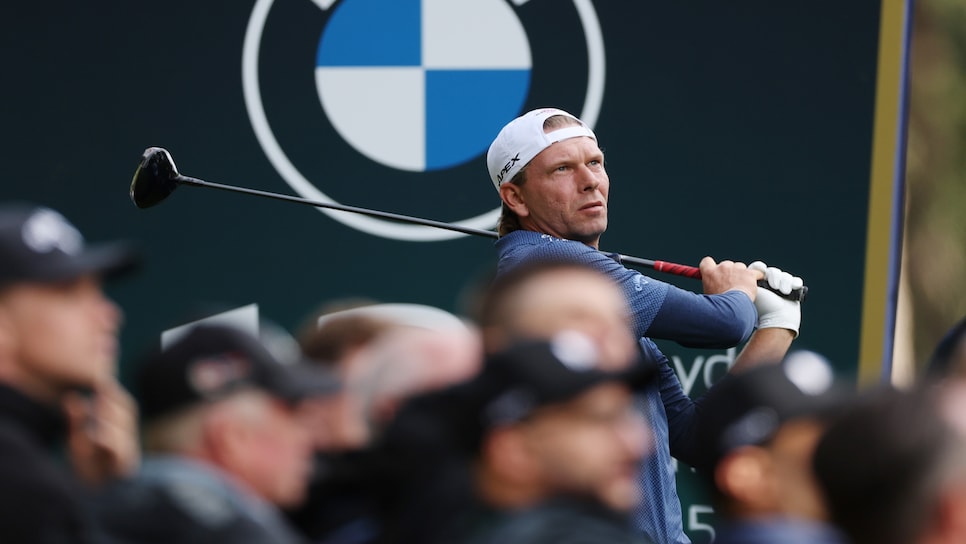
Richard Heathcote
As much as some golfers would rather not find a ball hit way off line—just ask Shane Lowry about that—the Rules of Golf do not give you the option to abandon a ball that is spotted by anyone in the vicinity. It’s covered under Rule 18.
Most pros know this rule all too well, but for some reason, Marcel Siem chose to ignore it during his first round at the BMW PGA Championship. His actions then prompted him to go on social media after the round to clarify he wasn’t cheating, although he was disqualified.
Here’s what happened: Siem got to the 18th hole in a fairly bad mood after struggling throughout his round. He then pumped his tee shot right, into an area off the dogleg on the par 5. Although there was no out-of-bounds markers on that side, he decided to play a provisional off the tee.
As he was about to hit his second shot (his fourth stroke) with the provisional, spectators alerted him that they had found his original ball in a wooded area off the right side of the fairway. It was in play, albeit not in a great lie. We’ll let Siem take it from here.
“I was just about to hit my provisional, so my fourth shot … and one of the spectators found my ball, my first one. I walked in there, tired of the whole day already. And the ball was underneath a branch, couldn’t chip it out. I said, OK, this is unplayable. Picked the ball up, and then just stupidly hit my fourth shot [with the provisional],” Siem said. “Just kept going, made birdie with my second ball, so to say, made a bogey.”
Siem finished the round with the provisional, and then was informed he was going to disqualified in the scorer’s tent after explaining to rules officials what had happened. He then went on social media to plead his case:
“Hey guys, just wanted to give you a quick insight on what happened today. I just wanted to let you know I didn’t cheat. I would never do that, so I got disqualified, unfortunately,” Siem said in the video.
If you are wondering what he should have done instead, he could have hit a provisional if he feared his ball was lost or, if it was known or virtually certain it was in a penalty area, he could re-tee with a stroke penalty. In his case, he should have hit a provisional, gone and searched for his ball, and if found within three minutes, kept playing it. Hard to believe Siem didn’t think to do that, but he didn’t.
Yeah, but it was only a short ride 
Steve Gibbons
Caddies get paid to walk and carry a golf bag, right? Well …
In a bizarre rules incident at the U.S. Mid-Amateur at Troon Country Club in Scottsdale in September, a caddie lost a match for his player by riding in a golf cart from one hole to the next. Even worse, it happened during extra holes as Paul Mitzel (above) battled Ryan O’Rear in a highly competitive showdown.
Mitzel’s caddie (we won’t mention his name) rode on a golf cart from the 19th to the 20th hole, which led to a loss of hole under a Model Local Rule in place for USGA events.
The rule says: “During a round, a player or caddie must not ride on any form of motorized transportation except as authorized or later approved by the Committee.”
If a breach occurs between the play of two holes, it applies to the next hole. That meant Mitzel and O’Rear’s match ended on the 19th with O’Rear 1 up.
NCAA champion gets sponsor’s exemption in a PGA Tour event, then commits penalty 
Raj Mehta
Michael La Sasso, the reigning NCAA champion and a senior at Ole Miss, was invited to play in the PGA Tour’s Sanderson Farms Championship in October largely because he plays his college golf in the same state. Perhaps the pressure of playing a home game got the best of him as he was penalized two shots for improving the conditions affecting his lie (Rule 8.1a) during the first round.
La Sasso was given the penalty after carding a 66, which would have put him in second place. The incident took place on the 15th hole, but La Sasso declined to comment on specifically what he did wrong. He went on to shoot 68 in the first round because of the penalty and 76 in the second round to miss the cut at even par.
European pro receives one of golf’s all-time harshest penalties 
Octavio Passos
It’s not often that a pro receives anything worse than a fine or disqualificaiton for a serious breach of the rules, but Swiss golfer Cedric Gugler was handed a 10-tournament suspension for repeatedly replacing his ball on the green in the wrong place during the Raiffeisenbank Golf Challenge in June. That event is part of the HotelPlanner Tour, the DP World Tour’s equivalent of the Korn Ferry Tour. The incidents were reported by his two playing partners, Adri Arnaus and Aron Zemme, to tournament officials after Gugler carded a 75 in the first round. The suspension announcement came in November.
Gugler says he admitted to officials “that it might have been possible—out of simple inattentiveness—that the ball was not placed back exactly on the same spot,” he said. “However, it was never my intention to gain any sort of advantage. Unfortunately, this imprecise statement triggered a long and burdensome process, which has now resulted in this decision. I deeply regret this mishap.”
This article was originally published on golfdigest.com