
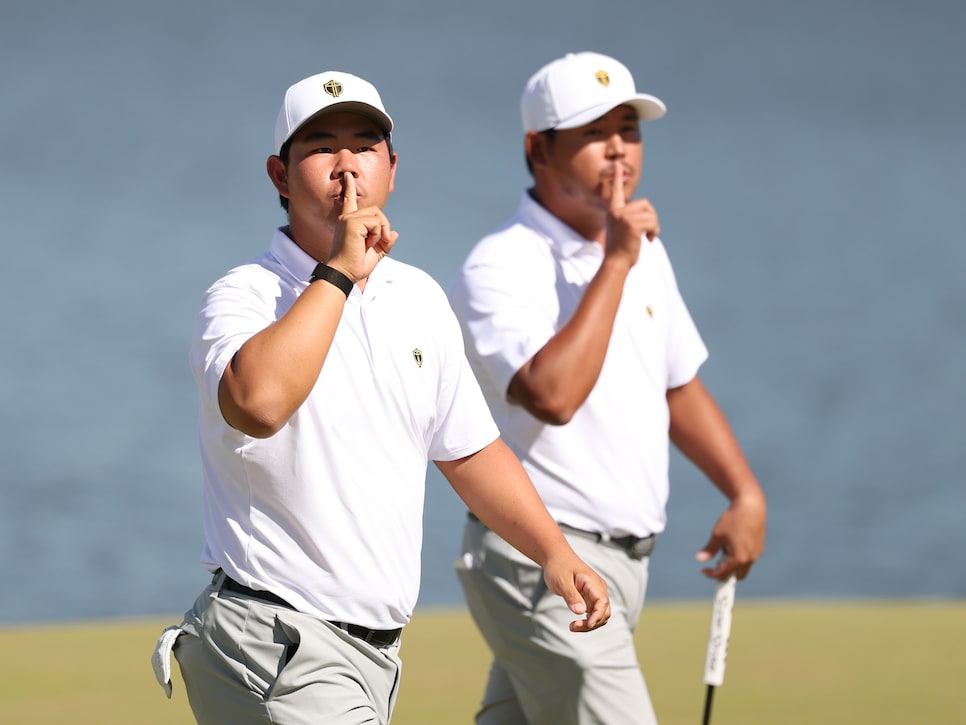
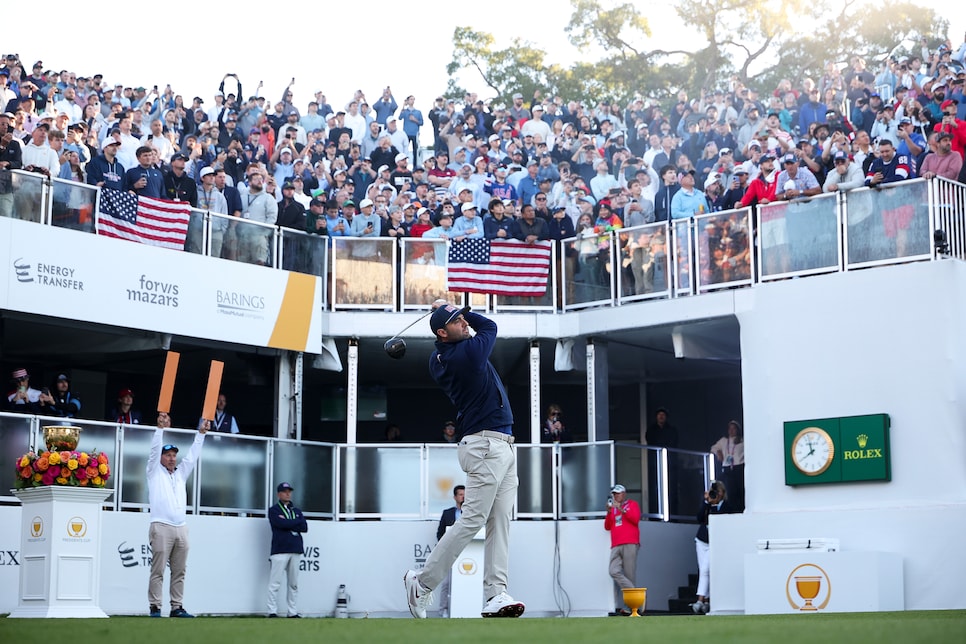
The Canadians quieted the crowd, a sentence that has rarely applied to team golf and now has been written twice in two days at the Presidents Cup. Nick Taylor played silencer Friday, and on Saturday afternoon his pitch to six feet in foursomes gave Corey Conners the chance to do the same. Conners, God bless him, is a perennially poor putter, one reason he entered Friday with a 2-8-0 record for his career in this event. But the six-footer never left its line, and when it went down the only noise at came from the International players and wives gathered beside the green. The American team, but especially the fans surrounding the hole and hanging over the first-tee amphitheater, looked on in woozy resignation as the unthinkable moved to the edge of reality.
RELATED: Why world No.1 Scottie Scheffler was benched for Saturday foursomes
The silence was earned, even if the manner of getting there followed no script. Perhaps that explains the strange mood around Medinah Country Club Saturday evening. Golf finally has what it has spent three decades demanding from the Presidents Cup—a real contest, with the Internationals carrying a three-point lead, 10½-7½, into Sunday—and almost no one seems sure what the heck to make of it.
For years, decades really, the Presidents Cup has been defined for what it lacked, an International team capable of putting up a fight. The refrain has been familiar for some time, but not urgent. For this event to survive—and make no mistake, with new PGA Tour leadership guided by whether fans actually care, its future is hardly assured—the Internationals desperately, absolutely needed to win to give any semblance that this match can matter.
Michael Reaves
Through three days, they have done that. Si Woo Kim and Tom Kim have supplied the voltage that was the foundation of any International miracle. Ryan Fox has shown his triumph at Royal Birkdale was no four-day fluke. Taylor, a 38-year-old Presidents Cup rookie, has strengthened his claim as no one being better when everything is on the line. Geoff Ogilvy has pushed the right buttons while building upon the culture Ernie Els, Trevor Immelman and Mike Weir created from nothing. The Internationals arrived at Medinah as heavy underdogs, but from the opening session they have carried themselves as equals. Whatever happens Sunday cannot take that away.
But—and you knew there would be a “but”—it would be dishonest to call that the prevailing story here on the grounds. The International surge has been overshadowed by questions, concerns and mounting disbelief over what exactly is happening to the Americans.
MORE: FULL GOLF DIGEST PRESIDENTS CUP COVERAGE HERE
Yes, the Internationals are good players; conversely, the other 51 weeks of the golf calendar tell us they do not belong in the same class as this U.S. team. The Americans have standouts in Scottie Scheffler, Cameron Young and Wyndham Clark, backed by eight of the top 11 players in the Official World Golf Ranking. They left home J.J. Spaun, who would be the highest-ranked player on the International team, which has only Si Woo Kim inside the top 20. The Internationals brought relative unknowns such as Nico Echavarria and Ryo Hisatsune; Taylor had one top-10 finish on tour all year; and Christiaan Bezuidenhout may lose his PGA Tour card this fall. There is a reason oddsmakers saw this as a mismatch.
The American players are ultimately responsible for golfing their balls, so start there. Justin Thomas carried Jackson Koivun in the opening session, then struggled Friday and Saturday (only Echavarria had a worse strokes-gained figure through three days). Xander Schauffele entered the week having earned 10 points in 14 Presidents Cup matches. His first win did not arrive until Saturday evening, against an exhausted pairing of Kims playing their fourth consecutive session. Russell Henley has been among the most dependable players in professional golf, yet for the second straight team event he has looked lost. He and Jacob Bridgeman were 3 up on Taylor and Conners Saturday afternoon and still found a way to lose.
And then there is Scottie Scheffler. The four-time major champion bristles at any suggestion of a weakness, whether it concerns his putting, his slow starts or, especially, his record in team events. He is 2-1 this week, which looks respectable if you haven’t watched him play. Scheffler has been so ordinary that captain Brandt Snedeker sat the World No. 1 for Saturday foursomes. The gamble backfired when Sam Burns and Wyndham Clark were routed, turning a debatable decision into an indefensible one in hindsight. Still, Snedeker did not invent the dilemma: Scheffler is 1-8-1 in foursomes and made only two birdies with his own ball this week. He can reject the premise all he wants, but the best player since Tiger Woods has yet to impose himself on these matches like one.
James Gilbert
However, much of the blame belongs to Snedeker. It began Thursday, when he said he wanted the crowd to be “savages.” It was an astonishing choice of words after the atmosphere at Bethpage Black, and the American team’s failure to condemn or contain it, embarrassed the team and country and game. During a television interview on Saturday, Snedeker could not remember whom he had paired with Chris Gotterup. He sent the wildly inconsistent Justin Thomas out in foursomes. He sat Bridgeman in four-ball despite Bridgeman ranking among the tour’s top five in birdie average, ensuring that by the time the rookie reaches singles Sunday, he will have played barely half the shots Medinah demands.
On Saturday night, Snedeker acknowledged the fact that he’s made mistakes this week that may cost his team in the long run. “I tried to work my tail off to put these guys in the best situation possible, and I don’t think I’ve done a very good job this week to be where we are right now,” Snedeker said in a stunning act of admission. “They look to me to put them in the best position where they’re comfortable. I hold myself to a high standard. I don’t think I’ve done the best job for them in that room.”
Snedeker complained earlier in the week that for the second straight year the Americans didn’t get the course set-up they wanted, a blame that is solely on them. Then came Friday afternoon and the familiar surrender of responsibility of “They just putted better” to explain his team being swept in foursomes. It is the tired refrain of American Ryder and Presidents Cup captains, reducing defeat to the whims of the greens rather than confronting their own decisions. It also diminishes the opponent, treating superior play as little more than good fortune.
MORE: FULL GOLF DIGEST PRESIDENTS CUP COVERAGE HERE
Perhaps most vexing, the Americans continue to ignore what the numbers tell them, arranging partnerships around friendship, familiarity and whatever feels right in the team room. That approach can survive in fourball, where individual brilliance can cover a poor fit. Foursomes is less forgiving, for it demands an understanding of whose tee shots leave a partner comfortable, whose misses complement the other’s strengths and which personalities can withstand the strain of being responsible for someone else’s mistake. Little about the American pairings suggests that degree of study, instead appearing to begin and end with asking who enjoys playing together, as if chemistry away from the course guarantees compatibility on it. At some point, instinct becomes negligence. Since 2023, the Americans are now 8-26 in alternate shot, a record too dreadful and too sustained to be dismissed by the other team putting better.
The overriding conclusion from Bethpage last fall was that the machinery behind Team USA was fundamentally broken. Medinah has made that judgment harder to dismiss. The Ryder Cup and Presidents Cup are different competitions run by different organizations, but the dysfunction looks awfully familiar with pairings based on comfort, captains learning on the job and lessons forgotten as soon as the next man takes the radio. Every year brings a new philosophy, a new support staff and a new set of instincts, leaving American team golf to repeatedly rediscover problems it should have solved long ago. What it needs is a permanent structure overseeing both teams—one that preserves information, studies what works and gives captains a foundation instead of a blank sheet of paper. It needs to be bigger than one man. Until then, the operation will remain captive to the preferences of whoever happens to be in charge that week.
It feels unfair to spend more time explaining why the Americans are losing than why the Internationals are winning. Sports culture already has a grubby habit of treating one side’s success as evidence of the other’s collapse. It also runs against everything people claimed to want from the Presidents Cup: tension, consequence and an International team capable of pushing back. Yet the imagined version of that revival came through International strength. No one pictured the Americans assisting with their own incompetence. Perhaps that explains the quiet around Medinah on Saturday evening. The crowd finally received the contest it had been promised, only to discover it did not care for how it arrived.