
In the context of team match-play golf events like the Ryder Cup and the upcoming Presidents Cup, “loading the boat” means sending your best players out at the beginning of the lineup, and it’s mostly used in reference to a final singles session. Over time, collective team-golf strategy has evolved to a place where it’s now accepted that a team should always load the boat, whether it’s behind, in front or locked in a tight match. The reason can be described in one word: momentum. But it goes a little deeper, because built into the concept of loading the boat is the conviction—unverifiable, but strongly held—that early momentum dictates later results.
Let’s try to illustrate this. If you’re playing in the back of the lineup—say, in match No. 10 of 12—and you see that your team is winning or losing the matches ahead, that’s going to affect your play. Singles matches are not played in a vacuum, which means, in turn, that all matches are not created equal. If you know the other team will load the boat, you can’t just hold your best players back to play the other team’s worst, because ceding that early momentum is going to make everything that comes afterward more difficult (see Angela Stanford and the 2026 U.S. Solheim Cup team). Once you hand the initiative to the other team (and its fans), you might not recover.
If you’re trailing big, like the Americans in Brookline at the 1999 Ryder Cup or the Europeans in the 2012 Ryder Cup at Medinah, the only way to mount a comeback is to seize the momentum early. In fact, history shows that comebacks like those only happen when there’s a massive surge from the start of the day. Conversely, if you’re up big, you desperately want to stop the other side from having momentum, and the only way to do that is to throw your best players at the enemy’s best and head off their momentum at the pass. Same goes if you’re in a close match entering Sunday singles—the team that grabs the early points has a distinct advantage.
There’s also a practical consideration, which is that the Cup may be clinched before the ninth, 10th, 11th or 12th matches finish, but it will never be over in the first four. Do you want your best players stuck in the back of the lineup playing matches that don’t count?
Jason Aquino of Scouts Consulting, who worked with several U.S. Ryder Cup and Presidents Cup teams in the last decade, is a believer in front-loading, for the same reason that almost every captain has come to adopt it as scripture—momentum is real, and it can affect later matches. To him, there’s also a psychological component, in that backloading comes from fear and insecurity about how the day will go, and the kind of matchup you want deciding the cup. That comparatively negative mindset must be avoided, and he summarized the situation bluntly:
“It’s about shooting your shot,” he said. “ If the Cup is over with your best players still on the golf course, you have committed captaincy malpractice.”
I have two favorite loading-the-boat moments in Ryder Cup history that help illustrate the point. One came in 1983, the first competitive Ryder Cup of the modern era (“Team Europe” became a thing in 1979 after decades of American dominance and the emergence of continental stars like Seve Ballesteros made expansion necessary, but its first two attempts were disasters). Tony Jacklin, the George Washington figure of Team Europe, was in his first captaincy, and circumstances forced him to get inventive in a number of logistical and strategic ways. At that point in history, the unwritten rule was that the best players on each team would play at the end of the lineup, as indeed Jacklin and the American captain, Jack Nicklaus, had done in 1969, the year of the famous concession at Royal Birkdale. But in 1983, tied 8-8 in singles and facing a more talented American side on paper, Jacklin saw a chance to throw a wrench in the works. He put three of his best players, Ballesteros, Nick Faldo and Bernhard Langer, in the top three spots.
It was probably the first loading of the boat in Ryder Cup history, and when Nicklaus saw what Jacklin had done, he was so shocked that he actually said, “You can’t do that!” If he’d been holding a glass, you can imagine it would have dropped from his hands and shattered on the ground.
In fact, according to Aquino, the two seminal Ryder Cups that began to cement belief in boat-loading in a permanent way came back to back, in 1999 and 2002. In 1999, the U.S. trailed Europe 10-6 at Brookline, loaded the boat and pulled off an incredible comeback largely because Mark James threw his lambs to the early slaughter and held off his bigger names until it was too late. (An interesting note is that Crenshaw originally intended to backload before his players talked him out of it.) At the next Cup, in 2002 at The Belfry, the match was tied 8-8 going into singles, and it was Europe who threw its big guns out first while the U.S. held Tiger Woods, Phil Mickelson and Davis Love III back for the final three spots, thinking a close match could come down to the best players. Instead, Europe took 4½ points in the first six matches, Love could only manage a half point, and Mickelson lost. With Woods still on the course in the 12th spot, the Cup was decided in Europe’s favor.
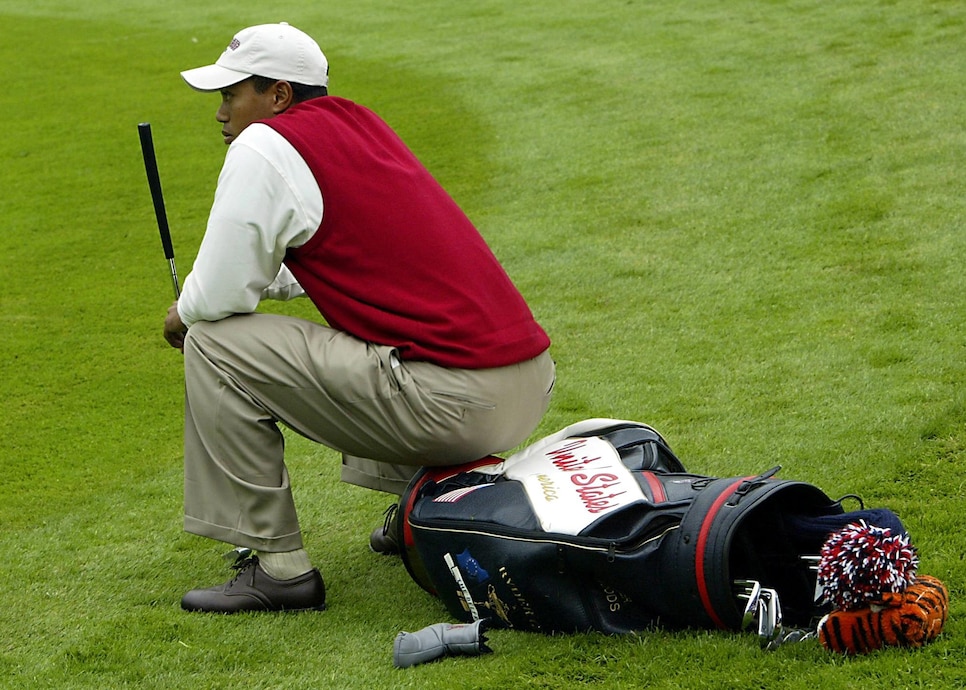
While leaving Tiger Woods in the 12th match of Sunday singles seems reasonable if the 2002 Ryder Cup came down to the wire, the way things played out, his match didn’t matter in the final outcome, Europe winning at The Belfry.
JEFF HAYNES
Paul McGinley, the successful European captain at the 2014 Ryder Cup, confirmed that the 2002 Cup, on the heels of the Brookline disaster, is when Europe became convinced of loading the boat as a strategy, and of course that was carried through at Medinah ten years later. He did caution, though, that it could be score-dependent; at Bethpage, Europe’s Saturday lead of 11½-4½ was so large that they thought it would be wiser to spread the wealth, at least slightly. Do the results of that day, when the Americans mounted a serious comeback, cement the theory that loading the boat is always preferable? That’s a matter for debate, and for his part, McGinley believes the comeback was due to a drop-off in performance, not the lineup order.
It probably says something about the pace of American progress compared to its European counterparts that by the time of my other favorite loading-the-boat story, in 2012, the Americans still hadn’t learned the lesson. That year, Love did an excellent job as captain for two days, but on Saturday night, he had no concept that he needed to load the boat, and didn’t. That mistake, plus a torrent of bad luck on Sunday, led to the Miracle at Medinah, the most devastating comeback in Ryder Cup history.
When it was all over on Sunday night, Love had a moment alone with Darren Clarke, and Clarke couldn’t resist asking the question: “You know we’re going to load the boat,” he said. “Why weren’t you loading the boat?”
Love was devastated, and in later interviews he would call it the biggest mistake of his career.
“It still crushes me,” Love told me a few years later. “Not for me, but for the guys we put in a position not to succeed. We left them hanging … certainly Bubba and Webb. Bubba and Webb going first was just a complete air ball. And we should’ve sent Tiger Woods out first, just like we send the big guns out first since then. We learned a lot from it, but it’s a tough lesson.”
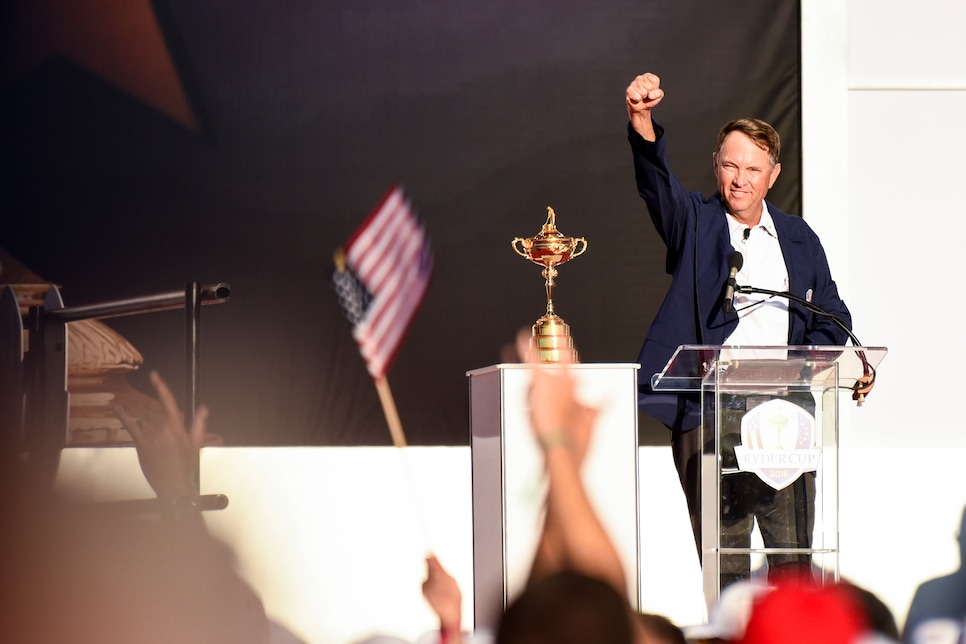
Davis Love III learned from his mistake on Sunday of the 2012 Ryder Cup, frontloading his lineup in 2016 to help the U.S. win at Hazeltine National.
Keyur Khamar
As fate would have it, Love and Clarke met again in 2016 at Hazeltine National, and yet again Love captained his team to a big Saturday afternoon lead. This time, he knew better, loaded the boat, and watched his team cruise to a win.
“We had Patrick Reed and Jordan [Spieth] wanting to go in a specific slot,” Love remembered of that year. “They said, ‘We want to play 3-4 because that way we’ll get Rory McIlroy.’ We said ‘No, you’re going first. Sorry.’ And sure enough, Patrick Reed got Rory McIlroy first. I didn’t have a plan that Saturday night in Chicago, and I’ll always be disappointed in myself for that. But it made Hazeltine even sweeter, those guys pulling it off and getting a win on home soil.”
Why did it take America so long, comparatively, to embrace loading the boat? Why would someone like Love, who played in two Cups (1999 and 2002) where he saw its efficacy firsthand, not be ready to deploy it as captain a decade later in Medinah?
Aquino has a theory—there’s a cultural explanation underlying it all.
“”I think there’s this desire as Americans where, we want the ball, right?” he said. “You think of the football metaphor, it’s crunch time, and when everything is on the line, what position do we want to be in? We want the ball, and what’s the analogous situation in the Ryder Cup? It’s down in the order. ‘I want the Ryder Cup to come down to my match.’ It’s a very natural American feeling. And a separate but related idea is, there’s some insecurity about letting the fate of the Ryder Cup hang in the balance with your weaker players.”
On the European side, though, playing the role of underdog for so many years produced a very different outlook. Players like McGinley, Phillip Price and Jamie Donaldson—far from their most decorated tour pros of the modern era—have all been Ryder Cup heroes.
“The Europeans who have holed the winning putts talk about the opportunity ‘falling’ to them,” Aquino said. “This is my language, not theirs, but I think they look at it more like a relay race, and in fact, it’s an honor to be up front, and whoever leads off in a European Ryder Cup, that’s a very special position to them. It’s sacrosanct, but it also creates opportunities for the bottom of the order.”
He pointed to a quote from Sam Torrance, the winning European captain in 2002, that illustrates the difference between the American insecurity around leaving weaker players at the bottom and the European tendency to see it as an opportunity. The operating concept is that the big names will do their job up top and create the chance for something special at the bottom. When speaking of Europe’s long tradition of minor figures emerging on Sundays to hole the winning putt, Torrance said, “out of the shadows come heroes.”
Torrance would know. He never won a major, but he hit a 22-foot putt on Sunday in 1985 to secure the winning point in Europe’s first Ryder Cup win.
Aquino discussed a couple variants within the boat-loading genre, from the “offset front load,” where you might sacrifice the top spot to a certain player before boat-loading (as Bernhard Langer did with a big lead in 2004, letting rookie Paul Casey face Tiger before sending out his studs), to a front load with one or two “circuit breakers” in key positions down the lineup kept back to stop any budding disasters. This strategy, however, requires good team depth, otherwise you end up not loading the boat at all.
On the eve of the 2026 Presidents Cup, it’s also worth looking at how strategy differs in the matches between the U.S. and the International team. The format here is that captains make match-ups one-by-one in front of each other, rather than the system of blind lineup submissions used at the Ryder Cup, Solheim Cup and Walker Cup. Is it better here to forget the notion of boat-loading and simply try to eke out advantages match by match? Or should a captain consider the lineup from a broader perspective and try to get his players in the front regardless of what the other captain does? According to Aquino, while the process lets you play with match-ups, it’s still important to keep on the bigger picture and load the boat.
“You’re playing with fire when you try to play one-on-one match-ups too finely,” he said.
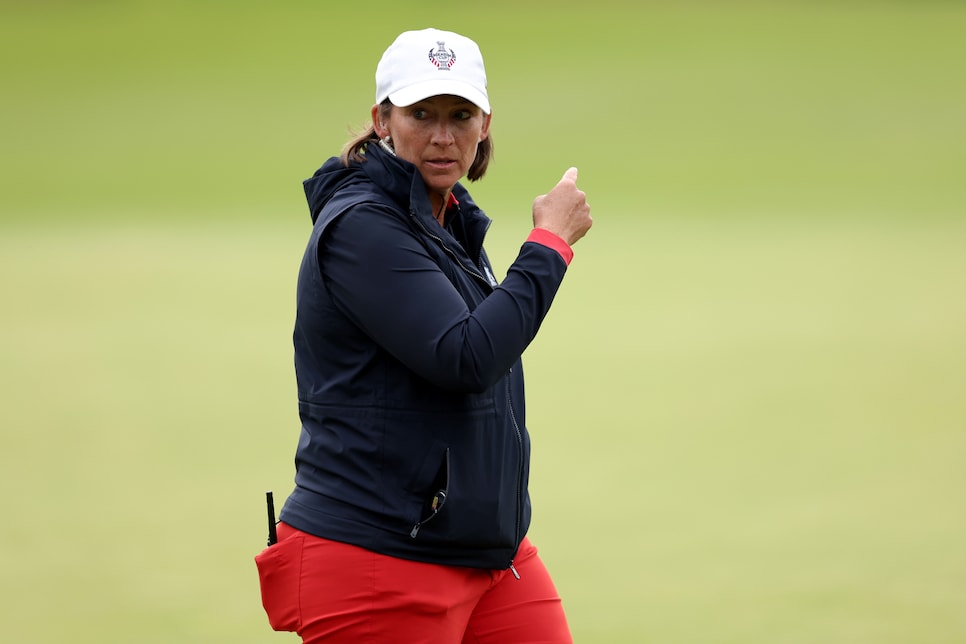
Angela Stanford didn’t pick up on the front-loading lessons of past team captains, and saw the 2026 U.S. Solheim Cup team suffer a close 15-13 loss earlier this month.
Naomi Baker
You can bet Brandt Snedeker and Geoff Ogilvy will both heed the lesson as the Presidents Cup goes to Medinah. In the 43 years since Jacklin first went rogue and brought the strategy of loading the boat into team golf, thought has evolved to the point where it’s standard practice … almost. And I say “almost” because of what happened with Stanford at last week’s Solheim Cup. Tied with Europe at 8-8, Stanford somehow had not internalized the lesson and put two of her worst players in the first three spots on Sunday in the Netherlands. The U.S. lost both matches, and the Cup, 15-13. While there are a bevy of factors that go into a narrow loss like that, the fact that Stanford either didn’t know or didn’t subscribe to the load-the-boat concept seems unforgivable … especially considering the last American Solheim Cup captain, Stacy Lewis, definitely took the concept to heart.
Loading the boat will not always work, of course. Your best players can still lose to their best players, or even to their worst. It’s not a cure-all or a guarantee. But decades of anecdotal and statistical evidence show that momentum is both real and contagious. If you’re not doing everything you can to either harness or defuse it, you’re not giving yourself the best possible chance to win. Load the boat, or watch it sink.
This article was originally published on golfdigest.com