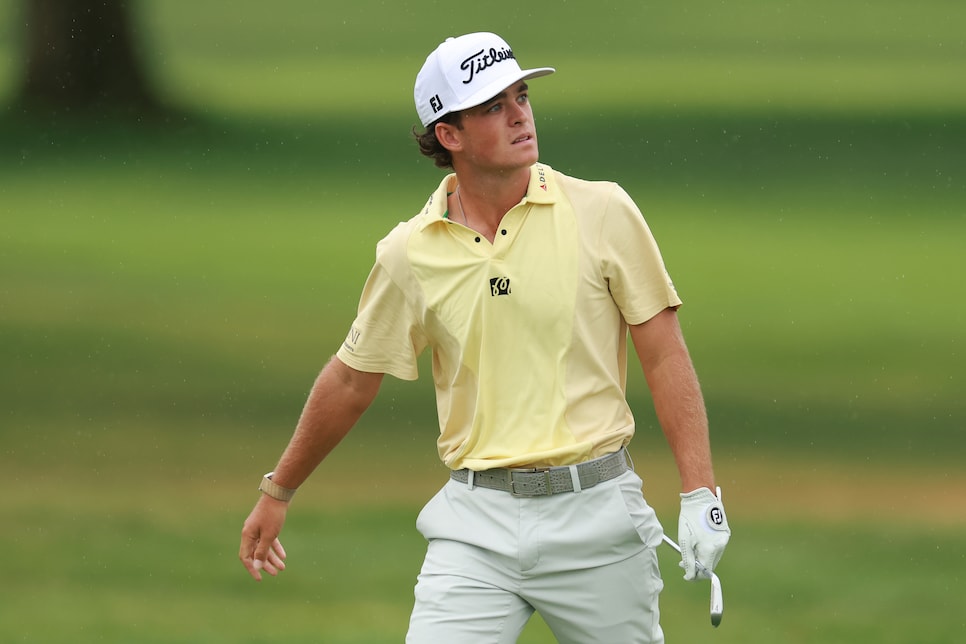
The debate about including rookie Jackson Koivun on this year’s Presidents Cup team often centered on a false dichotomy: Either you pick him as preparation for future competitions, like the Adare Manor Ryder Cup next fall, or you take someone with “experience” who can help you immediately.
This, of course, was always wrong. Koivun is a superstar in waiting and has done nothing but win in stroke play formats for his entire life, right up until the moment this summer when he won the 3M Open in his third ever professional start on the PGA Tour. But it’s another part of his resume that should have excited U.S. captain Brandt Snedeker even more—the 6-1 record in NCAA match play, which included two victories in Auburn’s national championship matches, and a 3-1 record in his only Walker Cup.
It’s reminiscent of Patrick Reed, who went 6-0 in college, also winning two titles. Koivun is a better all-around player than Reed, but they share the same mano-a-mano pedigree, and remember what happened when Reed made his Ryder Cup debut at Gleneagles? In an otherwise dismal showing for the Americans, he went 3-0-1 and earned the nickname Captain America. In three Ryder Cups, he never lost a singles or foursomes match. With Koivun, you get someone with those same match play plus the stroke play pedigree of a generational talent.
Gregory Shamus
The point is, a guy like this is sufficiently talented, and sufficiently competitive in a match play format, that he’s an asset to a Presidents Cup or Ryder Cup team immediately. He doesn’t need seasoning, and the normal rules don’t apply. It’s true that it will be beneficial to get Koivun some reps and some familiarity with the locker room culture before he (presumably) faces an away Ryder Cup crowd in Ireland. But this isn’t just about the future—you want him now to help beat an International team that could be tougher than many expect.
As Joel Beall wrote after Koivun’s win in Minnesota, “the tour will tell you, and not quietly, that the Presidents Cup is not an audition. It has its own case for existing on its own terms, and every year someone tries to shrink it down to a proving ground, the people running it bristle.” The good news here is, nobody has to bristle. No, Koivun isn’t anywhere near the top 20 of the Presidents Cup standings, since he just turned pro this summer and only played one major (as an amateur), but he’s making it on the merits nevertheless. To paraphrase Beall again, the stats show that he’s the best amateur in the last 15 years, and already has a better professional resume than Ludvig Aberg had when Luke Donald took a chance on him in Italy.
Koivun represents the best of both worlds—the chance to blood a star in preparation for a career of these competitions, and the chance to reap immediate rewards from his great talent. There was a version of this article waiting to be written that excoriated the Americans for excluding him, and it’s a massive sigh of relief that it will never see the light of day. To pick someone like J.J. Spaun or Ben Griffin ahead of him would demonstrate the same lack of imagination that has plagued the American team, off and on, for decades. There is no intelligent argument against his inclusion.

David Berding
In truth, you don’t even need to pit Koivun against any other potential pick, and I’d argue that to do so actually misses the point. One way or another, they needed to make room, and if they wanted Griffin or Spaun or Akshay Bhatia or Ryan Gerard or anyone else on, it had to come at somebody else’s expense. Koivun is already that valuable. It’s true that we don’t know the shape of Koivun’s future yet, and we’ve all seen big prospects go bust, but everything we’ve seen so far tells a story of a guy in the Spieth mold, who has major championships in his future. And now that he’s the second-youngest Presidents Cup player in history after Spieth, he has the chance to show what he can do.
(And by the way, when Fred Couples picked Spieth in 2013 after just one PGA Tour victory, Spieth won two matches and then earned 2.5 points in Gleneagles.)
On the selection show Tuesday, Snedeker was not especially illuminating on the thought that went into selecting Koivun, and as always with these increasingly hyper-secretive competitions, we’re left to do a lot of guessing about team strategy. But even without the fly-on-the-wall perspective—I would be especially eager to know what influence Jim Furyk had on these picks—I think we can safely say that this represents a step forward in American thinking when it comes to team competitions. Maybe the Presidents Cup is perceived as lower risk in the grand scheme, but it still feels like the majority of past American captains would have found a reason not to pick someone so new to the professional game. The fact that they looked past convention and found their way to the smart move is, hopefully, a great sign that in the aftermath of the Bethpage nightmare, a more broad-minded approach has taken root.
This article was originally published on golfdigest.com