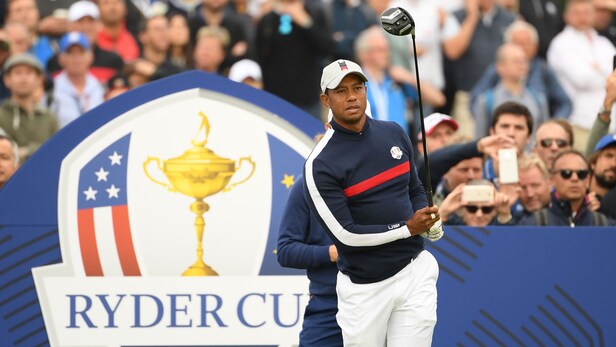
Pete Bevacqua is the George H.W. Bush of sports leadership. He held every important executive title until finally getting the dream job he always wanted. Caddie, high school president, walk-on punter under Lou Holtz at Notre Dame, Georgetown law, managing director of the U.S. Open, represented athletes at CAA, CEO of the PGA of America, chairman of NBC Sports, and now leads one of the country’s great athletic departments at Notre Dame. We’ve been friends and colleagues for 20 years, and among our best accomplishments was creating the Golf Digest U.S. Open Challenge for everyday golfers and celebrities trying to break 100 on the weekend before the Open on NBC (2008-10). Now at arm’s length from golf, he puts aside his former titles and simply answers some important questions as a thoughtful observer.
Golf Digest: People often say golf has never been healthier. Television ratings are solid, participation is booming and business has rarely been stronger. We’ve tried to ‘grow the game’ for decades now; it seems to be happening. Yet almost every week the sport seems to be fighting with itself. Is golf actually healthy—or simply wealthy?
Recreational golf is quite healthy and enjoying significant and steady growth. Many people were introduced to the game during COVID as golf was a fun, healthy way to get outdoors and interact with people in a safe manner. Then, of course, there’s professional golf—the golf that people tune in to watch on television, and that phrasing sounds a bit atavistic. I’m not convinced that form of golf is particularly healthy at the moment. It’s certainly “wealthy.”
When you worked inside governing bodies, every decision had institutional consequences. Now that you’re outside that world what do you believe the leaders of golf are worrying about that ordinary golfers couldn’t care less about?
In one word: distance. Recreational golfers have zero interest in reducing distance. No one wants to go backwards. Part of the fun and allure of golf is to go out there and get a rush of adrenaline from hitting a drive farther than you ever have on a hole or getting five more yards out of your 7-iron because you changed clubs, got fitted for a new shaft or made a swing change. I have yet to meet anyone who plays golf and is not on a constant pursuit to hit it farther. It’s the Holy Grail. There are several truisms in sports: people want to run faster, throw harder, jump higher and hit it farther. Now, I’m not saying increasing distance isn’t an issue. It is. But recreational golfers just don’t care about that.
Some might say you should be in the job, but nevertheless, CEO and commissioner Brian Rolapp inherited a PGA Tour that had already survived the LIV war but now faces a different challenge: making elite golf compelling enough for modern audiences. If you were advising him privately, what’s the first sacred cow you would tell him to slaughter?
I love the game and have loved it since I was 10 years old when my father dropped me off at Bedford Golf & Tennis to caddie. I enjoyed my time at the USGA and PGA of America. But my days working in the golf industry are 100 percent behind me. I wouldn’t advise Brian to slaughter a sacred cow. But I’d advise him to acquire two sacred cows. I believe the tour needs to sit down and strike a deal with the PGA of America to control the PGA Championship and the Ryder Cup, and I believe that would be in the best interests of both organizations if structured properly. Imagine if the NFL didn’t own and run the Super Bowl? It just wouldn’t work. The tour stands on the sidelines for the five events in the game that matter the most: the Masters, Ryder Cup, U.S. Open, British Open and the PGA Championship. I couldn’t stomach that if I ran the tour. That never made sense to me. Obviously, the Masters, U.S. Open and British Open are off the table but I believe there is a deal to be made for the others.
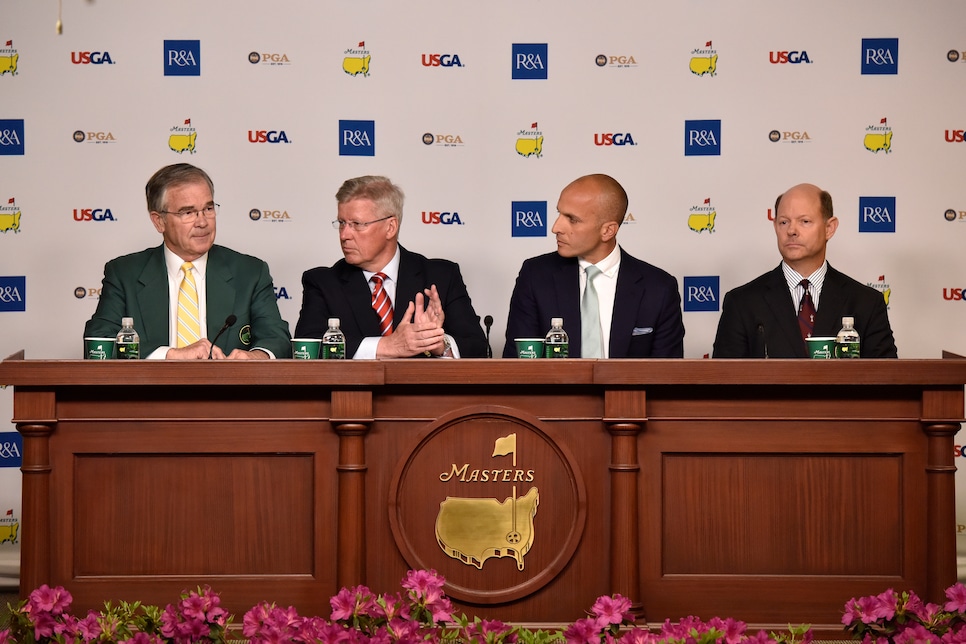
Chairman of Augusta National Golf Club Billy Payne, with R&A chief executive Martin Slumbers, Pete Bevacqua, then CEO of the PGA of the America, and the USGA CEO Mike Davis in April 2016. None of the four men hold the same position now.
Augusta National
Has professional golf become too respectful of its traditions? Or does the PGA Tour need more disruption than it is comfortable admitting?
Golf is built on traditions and those traditions are what make the game so timeless. Keep the traditions but disrupt the business—golf’s version of “leave the gun, take the cannoli.” I believe you can do both simultaneously. The event that relies on the traditions of the game has separated itself into a totally different stratosphere of success and relevance: the Masters. In my opinion, nothing comes close to the Masters. It is clearly the best and most important event in golf and one of, if not THE best event in sports. The individuals who oversee the Masters kept the traditions and continued to modify the business approach. That has led to an incomparable version of pure success.
What keeps me up at night is pro golf walking away from its charity and community roots. In your opinion, what’s the bigger danger: making too many changes or making too few?
I agree with you. Although it doesn’t keep me up at night. Winning a national championship in college football keeps me up at night these days! The connection between the professional game and charitable organizations in host areas is vital. I have a tremendous amount of respect for [former PGA Tour commissioner] Tim Finchem and one of the many things he did so brilliantly was to celebrate that connectivity. No one cares what a winner earns for a particular tournament but they do care about the impact that event had on a community. That connection creates loyalty and strong and enduring fan bases. Professional golf had such a wonderful advantage there and I, too, fear that it is fading.
If LIV Golf clearly seems to be fading away as an independent force, what should history conclude? Was it a failure or the catalyst that forced golf to modernize? I hate to think of Greg Norman and Phil Mickelson as heroes. What about you?
I never thought LIV Golf would succeed but, having said that, it has actually lasted longer than I thought it would. It just never worked for me—the names, the Triple AAA baseball-esque logos, the contrived team element to it all. I always felt like Tom Hanks in “Big” when he saw the building-to-robot transformer demonstration and said to the amusement of some: “I don’t get it.” It was a catalyst for change for sure and it forced the tour to respond. But the jury’s still out on whether those changes will be good. It changed the tour. I’m not sure it has modernized it.
I have known Greg for years. He is smart, aggressive and has always been nothing but wonderful to me. Same for Phil. I haven’t spoken to Phil in years but Phil has always been inquisitive and curious. Hero is a strong word. Helping ignite a golf league that looks to be on its last legs after only a few years doesn’t ring the bell in my opinion. There are players who have truly changed the game and, in that regard, are heroes. I would put the following on that list: Bobby Jones, Arnold Palmer, Jack Nicklaus and Tiger Woods. That’s certainly my golf Mount Rushmore.
Did traditional golf institutions underestimate how vulnerable they actually were before LIV arrived? Were you complicit?
There were variations of this concept in the ether for years and many of the leaders of these concepts came to meet with me when I was at the PGA of America. I was chairman of NBC Sports when we redid the tour deal and the specter of LIV was apparent. We discussed it internally and with the tour. Having said that, I think all were surprised by some of the big names who joined and how much money the PIF was willing to pour into it. And, of course, lose. I just don’t believe anyone felt that they would be willing to bankroll that type of loss for as long as they did. So, yes, I feel I was complicit—and twice—once at the PGA and once at NBC Sports.
The Ryder Cup has become golf’s greatest spectacle. After the crowd controversies surrounding the 2025 matches, many people wondered whether passion had crossed into performance. Maybe it’s too big for a club pro organization to handle, and I think you even thought about selling it to the PGA Tour when you had the chance. Has the PGA of America lost control of its own event?
I love Bethpage State Park and some of my very best golf memories occurred on the Black Course in the late 80s with my father and my friends. When I arrived at the PGA of America, one of my key priorities was to secure Bethpage as a site for the PGA Championship and the Ryder Cup. That was a passion project for me that also made all the business sense in the world. Several people came together to make that happen: Ted Bishop (then president of the PGA), Dave Catalano (ran the park), Charlie Robson (executive director of the Met PGA), Larry Schwartz (worked for then Governor Cuomo) and me. So, I was really saddened about the off-course behavior last fall. For me, one of the all-time low moments in golf was when Rory’s wife, Erica, was hit by a beer thrown by a fan. That was awful and wrong and ridiculous. I absolutely think the PGA could and should have done a better job responding to those incidents. You can’t stop all bad behavior when you amass crowds that size, but you have to deal with it and stop it as soon as it becomes apparent. Bethpage crossed the line. If that type of behavior continues, the event will be diminished and, eventually, ruined. As I said, the tour should acquire the Ryder Cup from the PGA of America. That time has come. And I believed that when I was at the PGA of America after the 2016 Ryder Cup at Hazeltine. I recall saying internally that if the Ryder Cup was a stock, Hazeltine was an all-time high and we should have sold it.
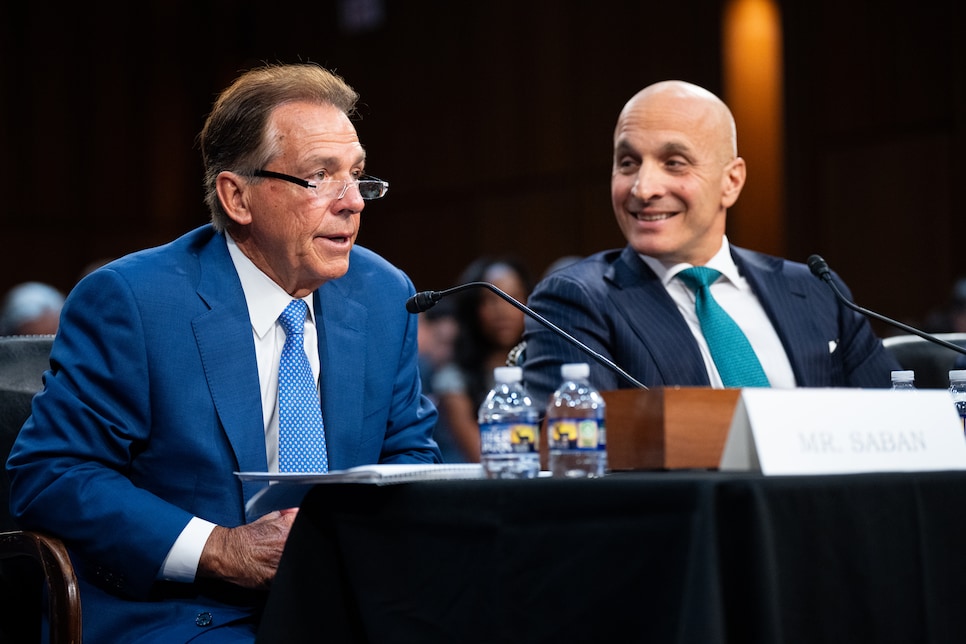
Former University of Alabama head football coach Nick Saban and Notre Dame director of athletics Pete Bevacqua testify during the Senate Commerce, Science & Transportation Committee hearing on “Protecting College Sports: supporting student athletes, restoring fair compensation, and saving the games fans love.” (June 2026)
Bill Clark
The PGA of America has also experienced significant executive turnover. When leadership changes repeatedly, what does that usually tell you—bad luck or deeper organizational issues?
PGA of America professionals are the backbone of golf in this country. They are on the front line fighting the fight and doing all they can to serve and grow the game. My love of golf was cultivated by two people: my father and Walt Ronan, the long-time head PGA professional at Bedford Golf & Tennis. I also believe being a PGA professional is one of the most eclectic jobs in the world. Those men and women are teachers, coaches, business leaders, amateur psychiatrists, best friends, confidants, rules officials, team builders, etc.
I believe that there are two fundamental issues that need to be addressed. The first is that you can’t change the leader of an organization every two years and not expect turnover, lack of efficiency and lack of effectiveness. The president and he or she—one she, by the way, in over 100 years, a remarkable woman in Suzy Whaley—has a two-year term. That doesn’t work and it’s not a model that can coexist with a fully functional, professional staff. The PGA needs to take notice of the changes the USGA has made with more autonomy given to their CEO, Mike Whan. The second area is the time commitment that elected officers make during their tenures as secretary, vice president and president. They’ll spend over 200 days a year on PGA officer business in a voluntary capacity. That puts them in a precarious position back at their clubs and places of business. It’s just not healthy or sustainable and, I believe, it’s why many of the very best PGA professionals in the country just can’t possibly run for office—people like Bob Ford who, as I have said before, is the Gary Cooper of PGA professionals.
The USGA spent years defending the golf ball rollback as essential for the game’s future before substantially retreating. Is there a lesson here about leadership? From your perch now in academia, what have you learned? Can governing bodies admit they were wrong or did this simply demonstrate that they lacked the political capital to finish what they started?
The deck is stacked against them. I have yet to meet a person on the “outside” who wants this to happen. As I have said, no one wants to go backwards or make a sport less exciting or less fun. Adam Silver is not raising the basket two feet to make dunking harder. Pitchers throw faster and faster. The record for the mile gets shattered. A 4.2 40-yard dash gets more commonplace. Point guards in the NBA get taller. Kickers in the NFL routinely make 55-plus yard field goals. You combine better fitness (thank you Tiger), better equipment, precise fittings and people generally getting bigger, faster, stronger and living longer and that little ol’ golf ball is going to fly farther. As the motto at Chicago Golf Club (one of my favorite courses) states: “Far and Sure.” It doesn’t read, “How about a little shorter?” It’s just the nature of things. No one wants to slow down, get older, hit it shorter. It’s just a fight that’s not meant to be won.
Does golf have too many governing bodies or too few leaders?
Golf leaders are well intentioned and doing all they can to help the game. But there are too many cooks in the kitchen. The best run sports have a commissioner: the NFL, NBA, MLB and the NHL. Golf as a recreational sport has a great advantage with the various organizations doing their part. However, as a professional sport, I think you need one person who can say unequivocally, “the buck stops here.” Golf is not set up or positioned for that and that won’t change anytime soon.
I see your point, but golf is different from other sports in that everyday participation far outweighs the professional game. Golf is just messier by nature and the system of checks and balances have served us well. I’d tell the commissioner to embrace it. On a similar subject, the R&A found itself defending rules interpretations involving Bryson DeChambeau during the Open Championship. Do golf’s governing bodies sometimes confuse protecting the Rules with protecting public confidence in the Rules?
The Bryson moment was a bit of a dog’s breakfast in my opinion. I agree with Scottie Scheffler. I don’t believe Bryson was trying to do anything illicit. Golf is a sport of inches. I just tend to believe that unless there is clear and convincing evidence to the contrary, you have to give the benefit of the doubt to the player, especially a seasoned professional like Bryson. Bryson is many things to many people, but I have never envisioned him as anyone who would circumvent the rules of the game. Now, his reaction was over the top and his threat of leaving the championship was petulant at best. I would have penalized him for those histrionics but not for the actual breach that he was charged with.
Media coverage increasingly seems to cast Rory McIlroy and Bryson DeChambeau as competing symbols of what golf should become. True?
I don’t see Rory and Bryson as competing symbols or as versions of good and evil in the game today. I don’t pit Rory’s Luke against Bryson’s Darth Vader. Frankly, I think they’re both exceptionally talented and good for the game as they drive fan interest and engagement. I have gotten to know Rory quite well over the years and I happen to think he’s the best thing professional golf has going for it. I have never seen anyone strike a golf ball better than he and he is a true champion in many ways. I think the world of him and am always interested in what he has to say. He is thoughtful, smart and candid. Golf needs Rory McIroy. I have never met or had any type of interaction with Bryson. I enjoy watching him play and get a kick out of his approach to the game, including his take on equipment and his weight training a few years back. Golf needs personalities and characters not automatons from some insipid mold. Golf needs more Trevinos, Chi Chis and Ray Floyds. And golf needs Rory AND Bryson. I’d just much rather sit down and have a nice dinner with Rory.
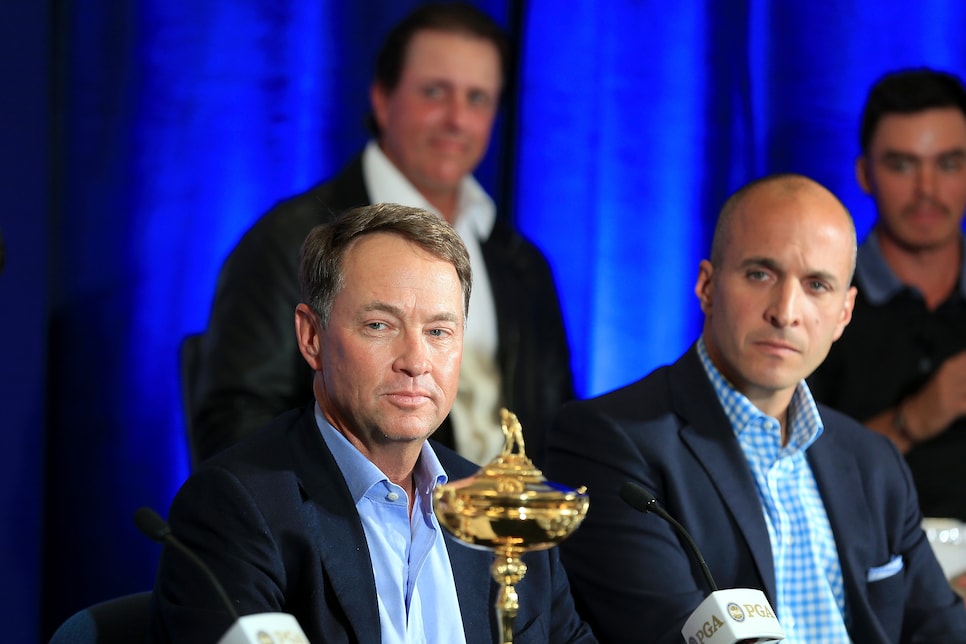
Davis Love III sits beside Pete Bevacqua during Love’s announcement as the 2016 United States Ryder Cup team captain in February 2015.
David Cannon
Personally, I think you give Rory a little too much credit, but you know him way better than I do and have a personal relationship. I was struck by the carefully conceived word he used in describing Bryson when he said “performative”—certainly true, but true of all these guys who construct their own public images. It reminded me of the phrase Phil used a couple of years ago about the PGA Tour administration when he was describing himself: obnoxious greed. The world including golf would be a better place if we all stepped back a little from greed and technology and a bit more toward humility and gratefulness about what we already have.
Well, to your point, Jerry, that is probably something we all need to do. Our head football coach, Marcus Freeman, made a great comment about living in and appreciating the moment: “Be grateful for what you have or you’ll lose it.” I believe one of the keys to a happy life is to be thankful and appreciative of the blessings you have. Hey, I am not Pollyanna in my view of the world. We all have our crosses to bear but I always try to remind myself of what I ought to be grateful for starting with my wife and three kids and the fact that I can show up to work each day to a place that I truly love. If you’re Rory or Phil or any one of the world’s best players, you have to construct an image and I believe that image acts as a needed barrier to protect their personal lives and their families; it serves as a shield of sorts. Even Superman went home at night after saving the world, took off his cape and had a beer.
Speaking of golf’s superstars, after a century of paragons of sportsmanship in golf—from Bobby Jones and Ben Hogan to Arnold Palmer and Jack Nicklaus—we have witnessed questionable conduct by the game’s modern superstars: from Greg Norman to Tiger Woods to Phil Mickelson. How hurtful is this to the game or is it just the consequences of knowing more about our heroes in a world laid naked by social media and a larger audience. Are we all to be forgiven as human?
I think it is very much the latter. There is no hiding from the glare and gaze of the sports fan. There is no letup, no intermission, no place to hide. I never met Bobby Jones or Ben Hogan, unfortunately. I had one of the most memorable conversations in my life with Arnold Palmer during an outing at Merion where we were both sidelined with injuries so we passed the time talking at the bar. He told endless stories about his father and I just enjoyed that moment so very much. I have gotten to know Jack quite well over the years and he is one of the kindest, nicest people I have ever met. I spent quite a bit of time with him during my tenure as the CEO of the PGA of America and once played a round with him on a late afternoon at the Bears Club, just the two of us. My father passed away in 1997, and I remember thinking to myself how much I wish I could have called him and told him about the round. He would have been floored. Greg, Phil, Tiger—they have done an awful lot for the game over the last 40 years or so. We all make mistakes and we all need forgiveness.
Slow play has become almost universally condemned. Yet year after year nothing meaningful changes. Major League Baseball fixed its problem. Should it really take professional threesomes to play 18 holes in six hours? If you had complete authority—one decision—what would you do tomorrow morning to speed up professional golf?
Slow play is a killer. It makes some events and tournaments unwatchable. I hate it. I hate playing with slow players. I can’t stand watching slow play, it is soul-crushing. I would put a shot clock on players, immediately. One warning and then you start getting dinged a stroke for each violation. I’m fortunate to be a member at Seminole. The legendary Jimmy Dunne has a saying that governs our pace of play: “Play Fast. If You’re Playing Poorly, Play Faster.” There is no excuse for slow play and the better player you are, the faster you ought to play.
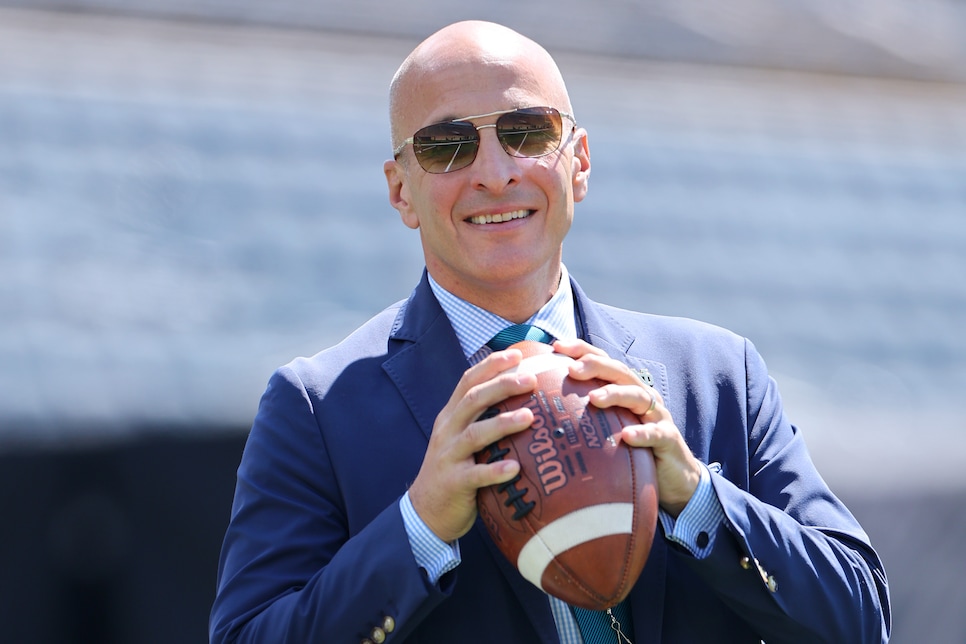
Michael Reaves
You’ve been around private clubs your whole life, even belong to some of the best. I’d venture to say a green coat belongs in your locker. But private clubs have become extraordinary financial assets. Memberships are traded almost like luxury real estate. Has golf accidentally created a system where exclusivity has become more valuable than community?
I spent my youth working at a great little private club. We were not members. I worked there from the summer after fifth grade through the summer after my first year of law school—caddie, caddie master, kid who ran the golf shop. I learned an awful lot about the inner workings of private clubs, and a lot about people. Great clubs with great cultures absolutely do NOT treat memberships like real estate. Clubs that just look for a big check and an express lane to the first tee will never be great clubs. A great club has to have a great golf course, a great PGA professional, and a great culture where people treat everyone on property with the utmost respect from the club president to the fifth-grade kid washing clubs in the sink that probably looks a lot like the 1983 version of yours truly. You want to really know what kind of person someone is? Ask his or her caddie how that person treated him or her for the last few hours. That’s better than any psychological profile I have ever seen.
Given golf’s great egalitarian heritage of coming from the shepherds and caddies of Scotland, can it continue calling itself an inclusive game while its most desirable clubs become financially unreachable for nearly everyone?
Golf needs to be more inclusive and bring more women and minorities into the game. And the good news is that the leaders in the game know that and are taking steps to make the game more welcoming. Many things are unreachable for financial reasons: certain properties, restaurants, the best cars, great vacation spots, etc. That is the way of the world. Golf has an abundance of affordable spots to play. Are some of the best courses and memberships expensive? No doubt, but there are plenty of affordable options in this country on wonderful venues for people to play. I view golf as a very democratic sport and one that is doing quite a bit to become more and more democratic.
One of the pros I admire most is Jordan Spieth, and he’s been outspoken about the dangers of gambling. Is he wrong in questioning whether gambling ultimately is more likely to increase fan engagement or undermine public trust?
I agree wholeheartedly with Jordan. I am very concerned about the impact of gambling and the fact that it has become ubiquitous. It can absolutely have a negative impact on the integrity of sports across the board, including intercollegiate athletics. I believe sports betting increases fan engagement AND potentially undermines the public trust. The consequences for athletes who engage in it in regard to their form of competitive must be severe and swift.
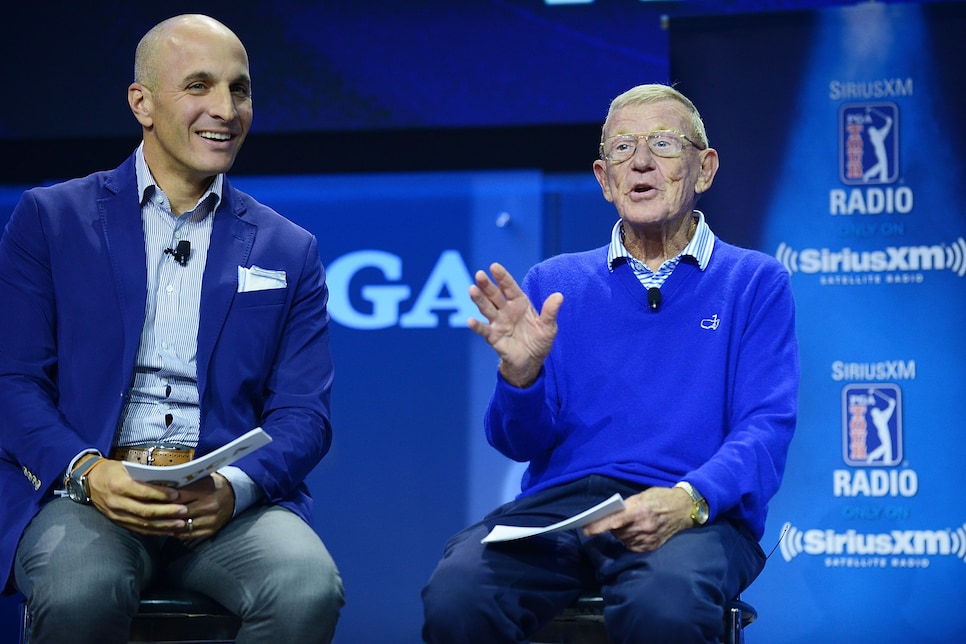
Pete Bevacqua and former Notre Dame football coach Lou Holtz at the PGA Merchandise Show in January 2018.
Gerardo Mora
OK, the existential question of our time: You’ve overseen sports television. I just heard about an AI commentator being added to the New Mexico Open coverage. Now AI threatens journalism itself. What’s more likely to disappear first—sportswriters or sports executives? Will AI just replace journalism or contribute to the disappearing line between truth and fabrication?
Well, AI will probably replace both sportswriters and sports executives or at least drastically alter our perception of what it means to be a sportswriter or sports executive. It appears the be an unstoppable force. We can adapt to it or treat it like the creature in “Alien” knowing that eventually it’s going to take over the ship. But the good news is, it will never replace the Tigers, Jacks, Arnolds and Rorys of the next generation. Rejecting AI is like screaming the earth is flat. I have no intention of being a Luddite when it comes to AI. Gotta get on the train because it has left the station.
You’ve worked inside organizations where every sentence becomes tomorrow’s headline. Looking back—what truth about golf do you believe insiders privately acknowledge, but almost never say publicly? Mine would be that golf is and always will be a minor sport. It’s a fact that the National Dog Show on Thanksgiving has a larger TV audience than the Masters Tournament on Sunday and always will.
I would agree with you, but that’s OK. Golf doesn’t have to be the NFL. And, quite frankly, it will never be the NFL. But, to your question, I would say it’s the constant refrain of “grow the game.” I must have said that over a thousand times when I was the CEO of the PGA of America. And, as CEO, I very much wanted to grow the game. But let’s be honest, nothing is better than going out to the first tee with a friend or two, looking around and saying, “hey, this is great, we have the course to ourselves!” If you really love playing golf, it’s a lot like fishing … you don’t tell too many people about your favorite spot.
Suppose we have this conversation again in 10 years. What’s the headline you hope we’re writing? And what’s the headline you fear we’ll be writing?
Hope: “Notre Dame Wins its 10th National Championship in a Row!” Fear: “Pete Bevacqua, in contention for the U.S. Senior Open as an amateur, gets penalized for slow play.”
This article was originally published on golfdigest.com