
On Saturday night at the Ryder Cup, the captains will have to make the most important decision of the week – who to play at the bottom of the singles draw. If the matches come down to the end, you do not necessarily want your best players in the final spots; you want clutch players for when the heavens shatter and the earth gives way beneath their feet.
Tour pros might say otherwise, but in their hearts, they fear the bottom like the Normandy beaches on D-Day. Silence breaks like thunder in the team room when everybody’s head is bowed. Some might talk boldly, but, Oh, captain, my captain, take anyone, not me, is what they’re thinking.
At the 1995 Ryder Cup at Oak Hill, with the Europeans trailing 9-7, Seve Ballesteros shouted to captain Bernard Gallacher, “Put me down the bottom!” This was laughable on the face of it. Ballesteros was gasping on the last vapours of his career with an aching back and a balky driver. He had been playing so badly that Gallacher left him out of the foursomes on Friday and Saturday. For the previous 16 years, Seve had been the soul of Europe, and he wanted one more chance to play the deciding match. It was crazy. He couldn’t break 80.
In a brilliant move, Gallacher’s strategy instantly came together as he replied, “No, Seve. You will not play at the end. We want you to play first! You will lead us!”
Often, the key singles match is third from the end on Sunday when the winning point is played; in this draw was the classic decider, Bernhard Langer vs Corey Pavin, both high-pressure players.
Seve’s draw was Tom Lehman in the opening match. Lehman had the unimpressive look, as Dan Jenkins said, of “a girls’ high school basketball coach”, but Lehman was a killer at the top of his game, contending in every major the next year and winning the Open Championship. “Seve’s game is a
horror movie,” Jenkins wrote.
Seve’s manager, Roddy Carr, had dinner with the renowned teacher John Jacobs on Saturday night and asked him to give Seve a lesson. Seve and John weren’t speaking because of an old grudge. (As European Ryder Cup captain in 1981, Jacobs was part of the three-man committee that barred Seve from playing because he had taken appearance fees. Actually, Jacobs had voted in favour of Seve; it was Neil Coles and Langer who cast their ballots against him.) Jacobs told Carr: “Play nomination with him, no standard shots.” He wanted him to forget mechanics and instead visualise and play like Seve the artist.
The next morning, Roddy found Seve, a lonely figure on the practice tee with a white pyramid of balls beside him. “What do you want, Roddy?” Seve asked suspiciously.
“Hit me a low cut, Seve,” Roddy said. Then he said, “Hit a high hook.” After 10 minutes of nominating every shot, Roddy says his parting words were: “Now play like that, Seve. Make up every shot as you go along today.” Meanwhile, Lehman’s teammates were warning him about Seve’s gamesmanship. “Never make eye contact,” they told him.
On the first tee, Lehman was staring at the American flag with “horse blinkers” when Seve purposely dropped his glove and reached low to catch Tom’s eye. “It’s like a bolt of lightning goes through Lehman’s body – game on,” said Roddy. Seve did not hit a single fairway the first nine holes and only saw Lehman on tees and greens. Seve drove it 30 yards offline at the first, hacked it up the fairway, and made a one-putt bogey to lose the hole, 1 down. On the second, he drove it 20 yards right into heavy rough, slashed his second shot behind a bunker and then holed a pitch to a short-sided flag for birdie – even. On the fourth, a par 5, Ballesteros hit a tree and his drive went only 92 yards, but then hit two 3-woods to save par.
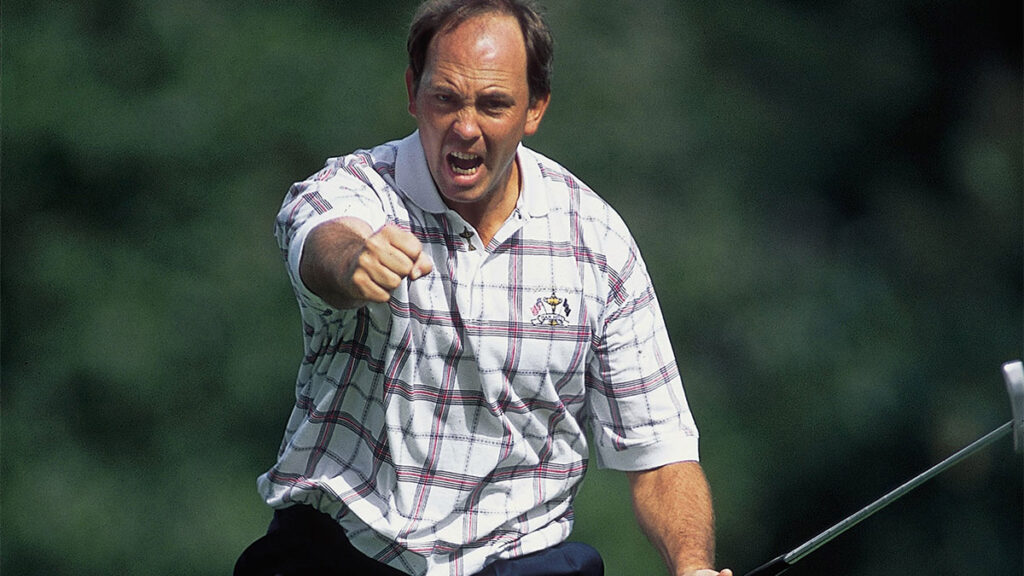
Seve drove it deep into the woods at the fifth. Lehman’s brother Jim was standing beside Seve and his caddie who were discussing the shot. It was out of the rough, over water and through trees. They were talking about a gap in the branches for Seve to hit his ball through. Jim Lehman saw no gap. Seve hit it through the trees onto the green again to save par and score another half. “He is magical to watch, man,” said Dave Marr on the telecast. Johnny Miller responded, “It’s tough to play somebody who is playing all over the lot and tying you or maybe even beating you – you just start shaking your head.” At the sixth, Seve holed a 20-footer for another half. Howard Clark, playing in the second match, said, “Jake LaMotta from ‘Raging Bull’. He won’t go down. Seve won’t go down!” Word was spreading around the course. The Europeans were energised.
On seven, Seve missed the green again in the deep stuff. He hacked a wedge to 12 feet. “How many more times can you go to the well?” whispered Paul Azinger on the telecast. Seve poured it right in the middle – still even. On eight, he pitched over a bunker for par and hit the lip, but it wouldn’t go in, 1 down. Gallacher approached Seve on the 10th tee and asked him why he was smiling. “I should be 9 down,” Seve said. On the 10th he missed the green again but got it up and down from a long bunker shot, making a 15-footer to tie.
Chills went up the spine of the whole of Europe. “We can’t let Seve down,” they said. “Do it for Seve!” I was walking the course with Jenkins, who never walked the course, but he had to see what Seve was doing.
At one point Lehman lagged a putt to within a foot, and tapped it in. Seve went apoplectic. Lehman had played out of turn! Seve called a rules official and demanded that Tom replace his marker. After some debate, he did. “I want to use his ball as my line,” Seve said, knowing exactly what he was doing.
On he fought. “Braveheart,” the Euros were calling him (the movie was released that May). Seve started losing holes, but the damage was done. The US team had slipped, and Gallacher’s players were gaining momentum. On the 15th hole, again Seve got it up and down, but finally Seve fell, 4&3. By then it was too late for the home side. Heartened by their leader, the Europeans won five out of six consecutive matches. Pavin beat Langer 3&2, and so rookie Philip Walton scored the winning point against veteran Jay Haas in the penultimate match. Europe took the Ryder Cup, 14½ to 13½.
“It’s the greatest nine holes I’ve ever seen,” Lehman told me recently. “Every hole, Azinger was walking with our group and says to me, ‘Seve’s got no lie. He’s dead,’ and Seve gets it up and down. If I had been playing me and hit it where he did, I’d have lost 10&8.”
Seve didn’t play in another Ryder Cup. He died of brain cancer in 2011 at age 54, heralded as Europe’s Arnold Palmer. It was Seve who put the Europeans on his back and reversed American domination with a 12-9-1 team record since his first event in 1979. Across all those heroic seasons, the greatest match Seve ever won was that singles match he lost 30 years ago.
Photography by Montana Pritchard, David Cannon/Getty Images