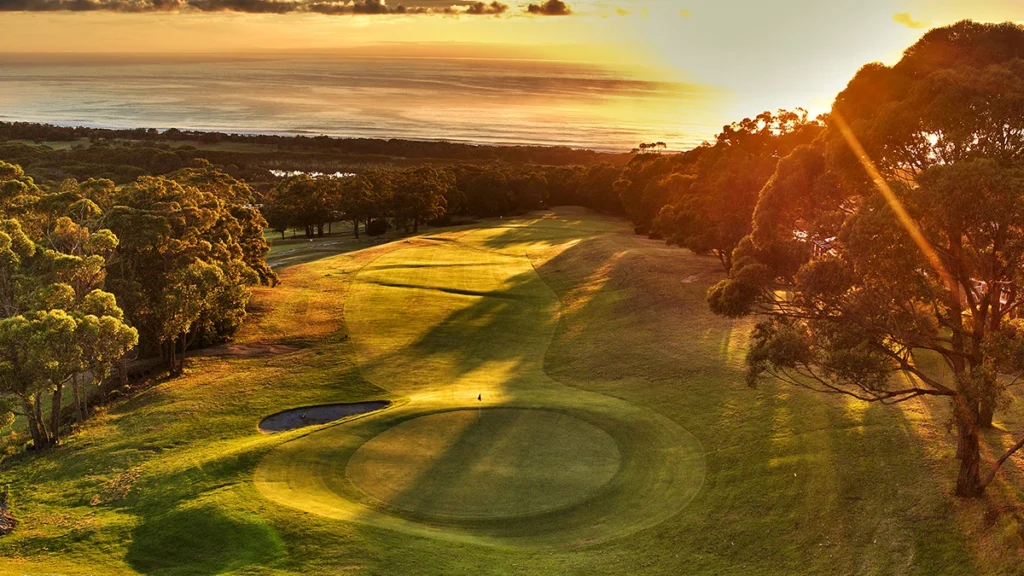
I got to spend a month in St. Andrews this summer, which is heaven on earth for a golfer. The turf is firm and running. The links keep company with the tide. And if there’s nae wind, there’s nae goff. The highlight for me were the rounds at Elie Links, where the game has been played since 1589 and a submarine periscope from the HMS Excalibur is used by the starter to observe play over the mounds on the first hole. My caddie Mike Dougal was not only a member of what’s known as “The Golf House, Elie,” but its past captain, which is the American equivalent of club president.
Golf Digest ranks Elie (pronounced EE-lee) as No. 29 among the great courses of Scotland, and as with a lot of clubs in Britain and Ireland it’s not uncommon for caddies to be members of the club. Some even require it. (Another caddie I had, Brian McSkimming, a retired salesman, was the past captain at Ladybank, ranked No. 34.) The notion of members, especially captains, carrying your bag and reading putts for you is so foreign in America; it’s like having Jimmy Dunne caddie for you at Seminole or Billy Payne at Augusta National. Or maybe Bill Clinton doing guided tours of the White House.
Dougal’s grandfather bought a seaside cottage in Elie in 1938 and his father became captain of the club 1967-’69. After retiring from an international career as a chartered accountant, Mike, now 68, returned to the family home and captained the club 2013-’15. “I thought I could add a bit more than line and distance for visitors,” says the 6-handicapper. “Caddieing is good exercise for senior members. We get to meet interesting people and share our knowledge of the course and local history.” Dougal pointed out a darkened cave on the cliffs where legend has it Macduff hid from Macbeth and was saved by a ship of nuns, eventually to kill Macbeth and restore the rightful king Duncan to the throne. Or the time George and Barbara Bush played Elie, and Barbara complained so bitterly about the on-course outhouse that it was knocked down and replaced the next year. My wife’s caddie Jim Mathieson was a scholar of the Scottish poet Robert Burns, so we were also treated to “the best laid plans of mice and men.”
Marty Carr, one of the leading golf travel agents in Europe, says it’s a growing trend since Covid, as the game’s popularity has increased and pushed up caddie demand for tourists. “There’s an all-hands-on-deck sense across Ireland especially,” he says. “The money is good and members are encouraged. It’s not unusual at places like Tralee, Ballybunion, Lahinch and Rosses Point.”
At Ardglass Golf Club, hugging the northeast coast of Ireland, all 75 of the caddies are members. “We’ve even had golfers join the club just to caddie,” says director of golf Paul Vaughan. “It creates an experience for our visitors, from the moment they get off the bus till they return. Caddies are ambassadors. They don’t treat it like a job. It’s more of a hobby that you happen to get paid for. (Caddies typically work as singles, as opposed to carrying two bags as they do in the U.S., and earn a base rate of about $100 plus a $50 tip per round.)
“If you get a caddie at Ardglass, he could just as easily be a student or a bricklayer, an accountant or an architect—we even have a meteorologist. They enjoy being outdoors, showing their pride in the club. The thing about golf is, when you’re on the course, it doesn’t matter what your job is or how much money you have; you’re a golfer and the game relates to everyone.”
I was telling this to David Kohler, owner of the Old Course Hotel, and he said three of his closest friends in life were caddies and named them—”Walter, Andy and Wes.” Obviously, what’s different in Ireland and Scotland is that clubs have a culture that welcomes outside play. Caddies aren’t toting for fellow members, but for guests. “The system over here is uniquely balanced,” says Phillip Allen, who oversees Marine and Lawn Golf Hotels, based in London. “Visitors pay $500 a round and locals pay $500 a year to play the same courses. You might think it doesn’t make sense, but it works, and everybody’s happy.”
British and Irish golf has been increasingly focused on U.S. travel because Americans seem less price sensitive than Asians and Europeans. Americans tend to buy all-inclusive packages for the week, paying about $10,000 for a buddies trip that includes hotel, golf, meals and ground transportation, so they don’t know or care how much they’re paying for individual rounds.
At the same time, golf remains amazingly affordable for locals, which isn’t always the case in the U.S. The American game has enjoyed a booming economy, but inflation as well as rising expectations threaten access for the next generation. Links golf is more modest, the clubhouses less grand, the menus smaller, the greens a wee bit slower, the pace of play faster. We might learn something from where it all began. Golf has a history of including butchers, bakers, candlestick makers and bankers. Not just bankers. My favorite caddie was the one who gathered his players on the first tee, looked into their eyes and said, “Gentlemen, we’re not here to have fun today–we’re here to play goff!” Of course, he meant it the other way around.
I don’t know how to fix the American problem, but maybe if every golfer spent a month in St. Andrews, we’d come back with the answer.
This article was originally published on golfdigest.com