
It’s one of golf’s most common myths: all putts break towards a lake or river and away from a mountain. Without much thought, it seems logical that if a golf course is sloped predominantly in one direction, then the vast majority of its putting surfaces will break in that direction. And in some cases, it’s even true. Often, however, it’s more urban legend than reality. We’ve written about this misconception before (here and here), but the mindset remains a prevailing one.
RELATED: Putting – Hannah Green goes to ‘Tempo Town’
If any course would put this idea to the test, it’s The Olympic Club’s Lake course, where the world’s best amateur golfers are competing this week in the US Amateur. The clubhouse sits on the top of a hill with the course situated on a steep hillside, all leading down to nearby Lake Merced. Drop a flood’s worth of water on the top of the property and it’s cascading to the lake immediately. Surely all putts must move in that direction, as well?
For sure it’s an idea, like all putts breaking towards Rae’s Creek at Augusta National, that predominates during everyday play at Olympic. Yet numerous players who have successfully navigated the greens to advance to matchplay and the round of 64 aren’t buying it.
RELATED: This tour-inspired 10-30 practice routine improved my putting in one week. I have proof
“It’s not something that I’ve paid much attention to,” says Caleb Bond, a rising senior at Michigan State University.
“I haven’t noticed anything too crazy,” says Tom Fischer, who helped lead Ole Miss to the semi-finals in the 2025 NCAA Championship and finished the strokeplay portion of the US Amateur at one-over, in a tie for 23rd.
Alabama rising sophomore William Jennings put it more bluntly: “I haven’t really thought about it at all.”

Luke Poulter says that the “valley effect” at Olympic Club doesn’t always hold true. [Photo: Tom Dulat/R&A]
Luke Poulter, son of Ian and currently ranked 28th in the World Amateur Golf Ranking, more closely gets to the truth of the green-reading concept. “With the valley effect, it does do it on some putts, but not every one,” he says, “so I just feel what I see and trust that.”
Ralph Bauer, a green-reading expert who coaches numerous players on the PGA Tour, explains that the concept is really just an optical illusion. “Gravity is a force that pulls objects towards the centre of the Earth and has nothing to do with lakes, landforms, creeks, etc.”
The illusion is typically created on hilly courses with large-scale slopes, like at Olympic Club or Augusta National. A green that appears flat when compared to the large slope surrounding it may in fact still be tilted slightly in the same direction as the predominant slope of the property. To exaggerate this concept, imagine a slope tilted 45 degrees in one direction with a green cut into the side of the slope, but the green is tilted only five degrees. The illusion will cause the green to look completely flat, but putts will still break.

Photo: Stephen Szurlej
The par-3 eighth hole [above] at Olympic’s Lake course is a great example of this. Walking up to the green set against a hard slope, it looks quite flat.

But as you can see from Stracka Line’s green map, nearly every putt breaks left, towards Lake Merced. What’s more, the slope is quite severe, 3 to 5 percent in some places.
Examples like this create the confirmation bias that fuels the myth. Putts look flat, but they break towards a landform; it’s why the “everything breaks to the lake” myth is repeated here.
The issue is, there are many examples where this isn’t the case. Take the third hole [below], cut into the hill near the top of the property. Everything around it slopes down and to the right, towards the lake, and yet there are many putts on the front of the green that break in another direction. Architects often intentionally create these subtle slopes in greens that work in a different direction from the predominant slope of the property to create deception.

Photo: Kirk Rice
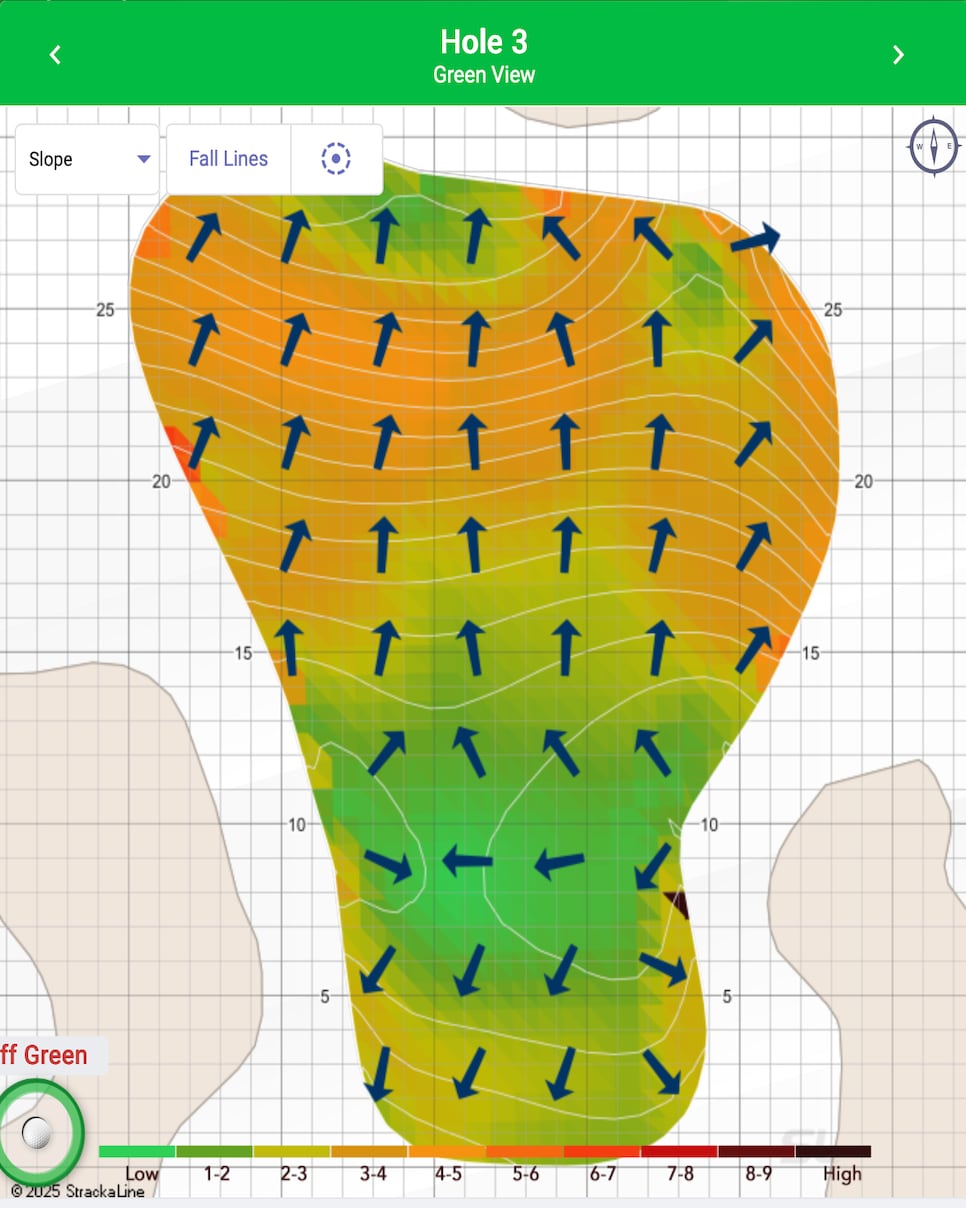
Examples like the third have become even more common on the Lake course since Gil Hanse and Jim Wagner completed their recent restoration of the original Willie Watson design. Hanse and Wagner expanded the greens by 35 percent, creating larger pockets and thumbs on the edges where putts may move in a different direction from the prevailing slope.
So where does that leave players who, knowing this illusion, are trying to determine when their eyes are being tricked and when putts really are breaking towards the lake? Bauer points to Tiger Woods, who would often put both hands to his hat to block out any vision outside of the line of his putt. “Tiger did a good job of blocking out distractions and optical illusions with this simple technique,” Bauer says.

Photo: Montana Pritchard/PGA of America
By doing this and focusing intensely on the exact line of your putt – and nothing more – players won’t see the surrounding slopes that cause the illusions. While players aren’t necessarily using Tiger’s hat technique at Olympic, they are following Bauer’s advice by only focusing on the green itself when reading their putts – not the surrounding hills and slopes.
“The ball reacts to the slope of the ground, not distant objects,” Bauer says.