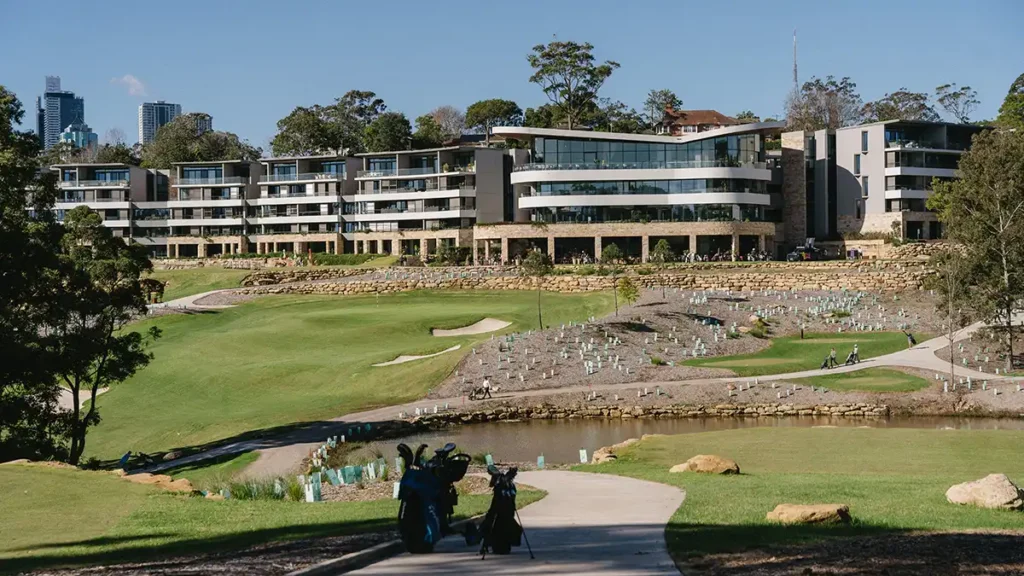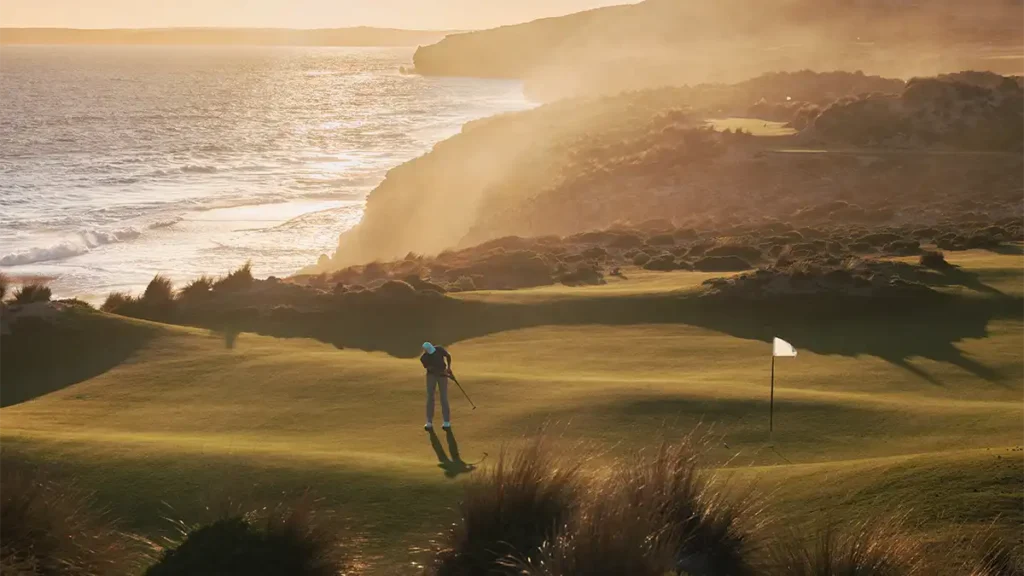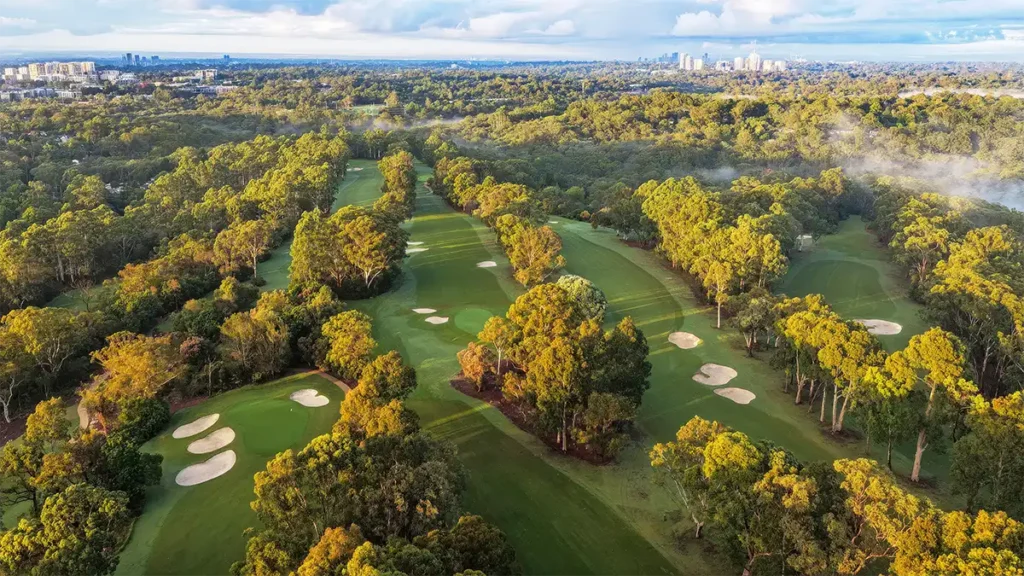
Graham Marsh, a winner of 70 titles across five different tours, talks all things golf, including his impressive course-design portfolio and life off the fairways.
Graham Marsh looked to have pinched the 1983 Open Championship at Royal Birkdale before Mother Nature conspired against him. Safely in the clubhouse after a sparkling 64 to close – even Arnold Palmer told the West Australian to “stick around. That might just be good enough [to win]” – the winds he’d battled on the final day strangely abated to allow the leaders to nudge past Marsh’s 72-hole aggregate of 277. It wound up being his closest call with a major, alongside a sixth-place finish at The Open in 1975.
Of course, Marsh was anything but a flash in the pan. He won 70 times in a truly global career before successfully turning his hand to course design. Now 82 years old, the spritely octogenarian remains armed with a slew of indelible memories. During an extensive interview inside the clubhouse at Royal Melbourne Golf Club, Marsh regaled us with more than a few.
Australian Golf Digest: You were born in Kalgoorlie. How long did you live there?
Graham Marsh: Not very long. My father was in the Air Force. I was a war child, January of ’44, and then the Air Force was at Pearce Air Force Base. He had met my mother and she was working in Kalgoorlie. Anyway, they went to Kalgoorlie and lived there for a while.
Tell me about your time spent as a maths teacher.
At the age of about 15 or 16, I had really made up my mind that I wanted to be a professional golfer. It’s a young age to decide that, of course. But I had two aunties who were both primary-school teachers and I had a mother who had her own hairdressing business. And they said, “We’ll do everything we can to support you,” as did our father, Ken. But he said, “You’ve got to get an education because that’s a risky business.”
There wasn’t a lot of money that we were playing for then. Even on the Australian tour, they were playing for $20,000, $30,000. That’s all. So anyway, remembering, “You’ve got to get an education,” I got through the Leaving [Certificate], went to university and thought, No, I’m not going to spend four years here. That’s too much out of my life for this. But then they were taking people into a teacher’s college. So I went to teacher’s college, and they were offering a two-year course where you could qualify to become a teacher. So I did it. I thought, Well, that’ll be good. Because I knew my aunts always had about eight or 10 weeks holiday. I thought, Well, at least I’ve got a job. I’ve got a qualification. Now I can do that and I can play a lot of golf in those eight, 10 weeks. Which I did. But then I got really antsy because I got to the final in the 1967 Australian Amateur Championship at Royal Perth against another guy from Western Australia, who I played interstate golf with – one of the nicest men you’d ever meet – John Muller.
Norman von Nida came over and coached us and he said, “Western Australia, you can win this.” Because we never won diddly squat in a teams championship, in men’s teams. We’d won a junior championship – we won the one down in Hobart – so we had the makings of a pretty good side. He came over and coached us. And I told him, “Look, I’d love to turn pro.” He said, “If you win the Australian Amateur Championship, you ring me and you’ll play as a professional.” Well, I lost in the final, 1 down. Anyway, I still rang ‘The Von’ and he says, “It doesn’t matter,” and that, “You’ve done enough to prove that you can get it.”
Back then, the PGA states all had their own little rules. South Australia, Western Australia, they were all sort of colloquial little PGAs, and in many ways, very protective of their own lot. So Von put my name forward and they rejected it and said, “No, no, you can’t.” If you weren’t from New South Wales or Victoria, you didn’t have a chance. And so he went in and ripped the daylights out of them. But back then, the rule was, if you wanted to become a professional from being an amateur, you had to play a year on the tour at your own expense, to show them that you could play. What the hell? It didn’t make sense.
When I got in the first year, we formed the PGA Tour of Australia and New Zealand. First meeting, that was the first item on the agenda – that’s gone. We got rid of it. So they were significant, tough times when you’ve come out of something like that and you’ve got to go and play. I played in tournaments. I was finishing in the top 10. Wills Masters at Manly and the Queensland Open I did pretty well, and in a couple of others. So my record was good enough to get through.
I should know this, but was your brother Rod older or younger than you?
Younger. He was about four years younger than I was, and sadly passed away a few years ago (in 2022). So tragically, in many ways, because he was actually very fit and played golf four or five times a week. Never had any major illness in his life, other than limbs that he hurt. But there were a lot of people during COVID – of course, call it conspiracy or whatever it is – but putting them on those bloody drugs, a lot of people died of a heart attack during that time. I don’t know whether that was the case, whether it was or wasn’t. He was a remarkable guy.
That’s an impressive set of sporting genes in the family, considering what the two of you achieved.
Well, our dad played off a 5 handicap. I think he finally got down to about 4. And he played local cricket and was picked in combined teams that would then play some of the bigger cities, but he never got to do anything at state level. My mother didn’t have a sporting bone in her body, but she did play golf for our sake and for the kids. It was quite an interesting life. But he was a proud man because he had two sons, one that was competing internationally and winning international tournaments and another one that was at the peak of cricket in the country. He was a proud man. You’re like that if you’re a parent, you like to see your kids achieve.
You’ve played all over the world. Was that important for you to do or is that just how it transpired?
Once I made the decision [to turn pro], I had a very clear vision and I had observed the sport over time. If you’re a young boxer, you don’t go out and try to fight Joe Frazier or Muhammad Ali on your first fight. You’ve got to be ready to do those things. Now I’d seen players from New South Wales – like Bruce Crampton and Bruce Devlin – go to America and do extremely well. But I was also familiar with the fact that Peter Thomson steered away from America. Kel Nagle played there and lost that US Open to Gary Player, but he also did very well internationally. “Five Times” did great in becoming a five-time British Open winner and he won hundreds of tournaments. And Gary Player, while he did play a lot of golf in America, also believed that golf was an international sport.
So I was driven by both sides of that. I was also driven by the fact that I had two young kids in a very good high school, and I didn’t want to take them out of there and just go and relocate in America for the sake of taking a chance over there. And it would have been a chance. But the underlying reason I did that was I felt like I had to prove myself. If I couldn’t win in Asia, I couldn’t win in South-East Asia and I couldn’t win in Japan. If I couldn’t win in Australia and I couldn’t win in Europe, I had no right to be playing in America, because America was the crème de la crème. So that was a driving factor for me.
When I did go to America in ’77, I figured I was going to make a bit of an effort. I had to go and qualify, and qualified with Jack Newton. We both went down to Brownsville to qualify, and we both did. Bob Shearer was also playing. I enjoyed playing in America, but to be honest with you, it wasn’t the perfect scene for me because I was always a fader of the ball, having grown up on the small ball, 1.62 versus the 1.68. And to be honest, when you fade the big ball, unless you’re extremely powerful, you lose too much distance on soft fairways. In the wind, the ball would get away from you. A drawer got that extra 20, 30 yards. And of course, there were a tremendous number of long hitters on the tour back then.
The first year, I did win at Hilton Head, which was a narrow and shorter course. I won there, was Rookie of the Year and I finished 17th on the moneylist, only playing about 17 or 18 tournaments. So it proved to me that I could do it. But then the PGA Tour back then – and it still has a similar thing today – if you play the US tour, you’ve got to get a special release if you want to play anywhere else. Now, it’s pretty hard to argue against that because if you want to play there and take advantage of the tour, then they want your support. I wasn’t angry about that, but by the same token, one of the problems was that I was earning much more money than these guys by playing the Japanese tour. So I had to make a very calculated decision. What is right for me? What’s right for my family? I made the decision to play internationally, and I don’t regret that decision because I had quite a lot of success. In fact, the highest success rate I had on any tour in the world was the European Tour. I won more tournaments [based on] the number of appearances that I made there than on any other tour. So I vindicated my own decision, if you like, in my own mind.
I left the door open, because I couldn’t get back there fast enough when I was 50. But even after all that, I still had to go and qualify for the senior tour. But then winning the US Senior Open and winning the Tradition, winning those two majors there, that was a sweet arrangement for me because I always wanted to play there and always wanted to win a major.
I didn’t get to play as many majors in America, but I did have some very strong finishes in the British Open, twice within two shots. And I didn’t really start competing as a professional until I was 25. All those guys I was playing with over there all came out of college golf and so forth, and they were 21, 22. They played all these golf courses, they were all mates, and it’s what it was.
The only place I haven’t played is in South America. Having said that, I did play senior events in Puerto Rico and some of those places, but not Argentina or Chile or any of those places. So I would call myself an international player, for sure.
Towards the end of my career, that’s when they started doing the world ranking. If that had been a little earlier, it would have given me a better position with the American tour, as it does for some of them today. But still, it’s a shifting world out there, with a lot of money.
I’ll never forget, one of the things that stimulated me was: you can make a lot of money playing golf. I’d get the Golf Digest magazines down in Perth. They were six weeks behind. I’d always land there and that was the first thing that I would buy. And I’d look at the money that was in the United States. In a fantastic year, they’d bring in $108,000.
It’s extraordinary by comparison.
It’s crazy, isn’t it? Extraordinary. But that’s progress. But that means professional golf has progressed, which is good. Nothing wrong with that. I don’t think they have a better time now than we did, but that’s not the point. The point is that golf, for it to become truly great, it has to have international flavor. And that’s what it does now, which I think is a wonderful thing.
Japan clearly agreed with you as well.
Well, it agreed with my game because if you’ve been to Japan and you know the golf courses there, most of them are built on the tops of mountains and along the edges of every hole, there’s those little, ugly, white [out-of-bounds] stakes. The first rule is: keep it in play.
They had small greens. They always had two greens at the end of the fairway. They had the summer and the winter green, but they were small. That also suited me as I was a good iron player. So keeping it on the fairway, getting it on the green, making enough putts, that was good. And it was a lot of fun.
We had a lot of good Americans come in that period. I played in the first Dunlop Phoenix tournament. The third one was the first time I ever saw Sam Snead play. Beautiful golf swing. The best golf swing I’ve ever seen, actually. I never saw Ben Hogan hit a golf ball, which was a disappointment, but I saw Tommy Bolt and some of the real characters of the game.
Japan grew. At that time, it was almost double the size of the European Tour in terms of prizemoney. Thomson gave me very good advice back then. He said, “This tour is going to grow. These guys are fanatical about golf.” And furthermore, back in that time, the ’70s and ’80s, Japan had a booming economy. It’s not so great now, but back then it was. They didn’t carry the debt they carry now. So it was very, very good advice. I was probably going backwards and forwards from Perth about every two weeks to play in Japan. I’d play two or three tournaments and then come back. I was never going to be able to do that with a family if I was living in America. That was impossible. Even by today’s standard, even if you’ve got your own jet, that’s almost impossible.
Of course, there was no social media or anything like that. When you were playing in Japan, there’d be a half-column-inch in The Western Australian or something, “Marsh wins Tokyo or Sapporo.” There was never the publicity that an overseas player gets if they win there today. But times have changed.
I’m looking at the European Tour. Now when I was going over there, we always had about eight or 10 players playing the European Tour, like the Shearers, the Newtons, the Thomsons and Nagles. You name it, we had them. Then there was David Graham and myself, and then others in that group.
Now they struggle on that DP World Tour – you can’t find an Australian name these days. It’s thin on the ground, comparatively speaking. And there’s everyone saying, “Oh, we want to go to the Korn Ferry Tour. We want to do this. We want to do that.” But if golf is going to be truly international, it needs to continue to promote the international scene. And that’s why, when we had the Australian PGA Championship at Royal Pines, that’s when they first did the [co-sanctioning] arrangement with the DP World Tour. Well, that was great. We got some good players there that year. We had Sergio [Garcia] come out, we had [Ian] Poulter, then we had some good American players come out and play it. That was good.
But Australia’s very spoilt in golf because if you think about it, people ask, “Why was [the Australian Open] the fifth-largest tournament in the world? Why was it the ‘fifth major’?” Well, the answer was very simple. When Dunlop Slazenger were here, every year they’d bring out Jack Nicklaus, Arnold Palmer and Gary Player. The Big Three – that’s who golf was at that time. And so they played in these Opens, and it was huge. But I haven’t seen too many tournaments like that since. Of course there’s the Presidents Cup. And they had the Australian Masters when Tiger came and played. That was huge. But other Australian Opens have failed to meet that test or haven’t been successful in reaching that level of notoriety. I think [last year’s Open was] a bit of a turning point for Australian golf. This is a good formula for them. And it’s almost like Rory McIlroy versus the rest, isn’t it? But not in a bad way. It was always Nicklaus versus the rest when he came here. And Nicklaus, Player and Palmer versus the rest.
I’ve never been dissatisfied with the decisions I made. Of course, you always ponder the other side of the coin, what would have happened if I’d gone to America? Nicklaus tried to talk me into it a couple of times. “When are you going to get rid of all this stuff? Come over and play with us on this leg of the tour.” Which I eventually did. And he was very kind towards me, as were many of the other American players there. But I’m not resentful of any decision I made. I think I’ve got to separate the failures in life, and as long as you make the decision, you’ve got to be happy with it.

Tell me about the majors. You had six top-10s, and as you said earlier, a couple of brushes with victory at The Open. Do you consider 1983 at Birkdale to have been your best chance?
I actually had a reasonable chance at Carnoustie, the year Tom Watson won his first – when Watson and Jack Newton played their 18-hole playoff. I was right up there after the second round. I shot 67, which beat the lowest score in a British Open [at Carnoustie]. That was held by Ben Hogan, when he won there [in 1953]. [Editor’s note: Newton would shoot 65 the next day.] I was within two shots of that playoff. It was a packed field, but I shot three or four-under on the back nine to get myself into that position, so I wasn’t really in genuine contention.
Birkdale was a different story because I was well behind. We went out that morning, and there was a guy who used to come and caddie for me in the British Open every year – a good friend of mine, our families were good friends – Don Watts. We teed off, and I was eight shots back, and I just played the round of my life. I mean, the flag at the clubhouse wasn’t this way [gestures a flag hanging limp], the flag on the clubhouse was going that way [gestures a flag taut with wind]. It was all over the place. I never hit better shots or played better in my entire life. I shot 64.
I went into the clubhouse and Arnold Palmer was sitting in the locker room, as he was four or five groups in front of me. He had met Don, and he asked, “How did he go?” And Don said, “He shot 64.” And Arnold said, “Now what did he shoot on the back nine?” Don said, “No, he shot 64.” And Arnold said, “Tell him he’d better stick around. That might just be good enough.”
So the day went on, and as it so often does in the British Isles, depending on when the tide turns, it can be whispering in the morning or blowing a gale in the morning, but as the afternoon goes on, it goes down and you get those beautiful, soft evenings. Well, it did ease, and it eased by a lot. I was the leader in the clubhouse for more than three hours until the leaders made the turn. Then gradually the wind eased a bit and they also made a couple of putts. Watson hit two great shots into the last to win by one. Hale Irwin and Andy Bean were second and I was fourth. It was funny, but it was what happens.
Look, I started out in my life as a professional golfer, and because I was a teacher, I always set my soul to golf. I said, “I want to win 50 golf tournaments. I want to win a major and I want a million dollars in prizemoney.” Because that was the golden number back then. If you won a million dollars in prizemoney, you’d made it. Even if you didn’t win the tournament, you’d still made it. The 50 tournaments was surpassed. A million dollars, I was winning a million dollars a year on the bloody senior tour. US dollars, by the way.
I just didn’t win that major. I finished ninth in the Masters one year and I finished seventh in the PGA one year. My game was better suited for things like The Open – not Augusta so much because I was this way [gestures a fade] and Augusta’s that way [gestures a draw]. But they played a lot of great courses – like Oakmont, for example – in the PGA Championship, which were tight. But in my mind, I’m comfortable with the fact that I would have had a lot of good finishes in those events if I’d stayed there. But there was a trade-off. You can’t have everything. You’ve got to make decisions, and it’s what it was. You can reflect on these things, but I reflect positively, not negatively.
Amid all this, how did your course-design career begin?
I was playing in the Victorian Open in Melbourne, and some friends of mine in Japan, a professional golfer, actually – a guy called Fujio Ishii – I got a call from him, and he said, “There’s a guy in Japan who’s the biggest single developer of condominiums in Tokyo. He’s building 10,000 condominiums a year and he wants to come to Australia. He’s been there several times; he comes down and scuba dives on the Barrier Reef,” he said. “He wants to build a golf course here.”
There was a developer, an engineer that had the piece of land for it, so he bought the land. Fujio came to me and said, “He wants your name on the golf course.” Because he was planning on a lot of Japanese people there.
I said to Don, “Look, I have an interest in golf-course architecture, but I really don’t have an interest in somebody else doing the job and putting my name on it. I don’t see that as being credible.” He said, “Well, it depends on how much money they pay you.” I said, “Yeah, I know that, but it’s not credible. You can’t be the designer if you haven’t designed it.”
In a wise manner, because Don was first CEO of Bond University – he got the Curtin University established in Western Australia, changing from the Western Australia Institute of Technology to become Curtin University – and he said, “Well, Graham, you can win as many golf tournaments as you want, and your name will be on some [trophies] and be on others, but your name will be forgotten. So build a golf course that lasts for 50 years. That’s somewhat of a legacy.” And I stopped and thought about it. I thought, Yeah, he’s probably right.
Look at Alister MacKenzie. They remember Royal Melbourne, don’t they? Look at Cypress Point, they remember Mackenzie there. And look at some of the work that Tom Doak or some of those others have done. You build something and people come and play – you’ve created a legacy. So that’s when I decided to get serious about it. But I was determined that I would be in charge of it, and I would also be partly responsible. Not totally, because I needed a partner to be able to bring it together when I wasn’t there. So that’s how I got into it. And I’m very happy I made that decision. That was one I never regretted in any shape or form, because we’ve designed more than 60 golf courses now, and I think in every country that I’ve done one, we’ve been in the top 10 or 15 places [in the rankings]. So that’s a nice achievement.
Did your philosophy on golf course design change during your architectural career? Or were you set on what you preferred?
The problem that the industry had – and still has today – is that it’s driven by real-estate developers. Unless you’ve got a real-estate developer who really understands golf and wants it there as the golf course and the real estate just sits on the sideline over there that you might make a few bob on. But if you get involved with companies like the major real-estate players in the world, they’re not interested in the golf at all, they’re only interested in that real estate. Because every block built up against the golf course, there’s 20 percent more value than the block behind it. So, yes, I was interested in it, but my greatest joy came from dealing with core golf, pure golf sites, which is where all the great golf courses are built. And they’re built as core golf courses. You don’t see many great residential golf courses.
You take the Top 100 in the world. What have they got in common? Great pieces of land – first thing that comes to mind. Look at this, think of any of these Sandbelt courses, great pieces of land. You look at courses in America, like Cypress, Pebble – you can go to every state in America – look at the places that have those top golf courses: great pieces of land.
Second thing is, they have a great owner. An owner who had a vision and wanted the best he could get on that piece of land. It was a nice canvas to be going to somebody with and saying, “I want the best. Just get it done for me.” Which means that there was enough land that, as the ball and the game changed, they could actually meet that standard and still stay competitive with the great golf courses.
The third thing is, you need a good architect. Then you need a good construction company. Because you can get an architect with a bunch of plans, you can give a construction company a good set of plans, but my goodness, if you don’t monitor them, you’re going to get three different results. Because they’ll put their interpretation on it.
The missing link, of course, is the maintenance. If it’s not maintained well, it doesn’t matter, it can never be great.
There are five components, in my book, 20 percent to each one. And you don’t have to fail by much in any one of those to be not at the highest level. So that was my underlying principle.
In hindsight, the one thing I do regret is we took on too many residential projects. But that was because the office was up in Queensland and we were dealing in floodplains. “The Melbourne mafia” here with their guys, they’re all working on the Sandbelt – they lived here. And there’s nothing wrong with that. I don’t begrudge that at all, but it’s understandable that they work on most of these courses here. But if they had to do the documentation that we did to get some of those golf courses we built in Queensland, they couldn’t have done it. Because that was largely where design and engineering cross. To be able to get a result, knowing it will work for that site.
People forget that in Queensland, all the golf courses, every one that was built, there’s a retention base. It’s meant to flood. It’s supposed to go under. So once you recognise that, you can only get your tees at a certain level and you can only get your landing areas at a certain level. They allow you that much at the green so you can try to get your bunkers out of the floodplain, so they don’t cost you. Because the most important part of the golf hole is the green, and it’s the most expensive part. If that goes under every time [it rains], it’s not even viable to build a golf course. Nobody can afford it. So you work to those parameters, which is not the parameters you want to be working to if you want a great golf course.
I’ve had some really good sites, too. I think Links Kennedy Bay is a marvellous site. Being a public golf course, it was ever going to turn into a great project, but if it had the right owner, it could easily be. Because they were very stringent on what they were doing. We got some good results, but you can see how those things work – your hands are tied. But having said that, that’s the route I chose, and we did have some good sites. The ones where we had good sites, we actually got a very good result. But sadly, even if they weren’t [dependent on] real estate, some of them were still chopped up for real estate because they saw the land as being too valuable. Paradise Palms would be a perfect example. That was a pretty good golf course.
It was a great golf course. It was a sad loss.
It was a sad loss to the game. And then the other one, which was a purely residential golf course, and it was a tight golf course, was North Lakes in Brisbane. That was a pretty good place to play golf, because you had the creek down there and so forth, you had to manage yourself around that. It was chopped up for land again. So for a golf course to be successful, it must be done for the right reason. And if you think about all the golf courses, going back in the history of the game and the ones that started it, were done in Scotland or they were done in Ireland or anywhere else in the British Isles. You think about when they went to America to do them, they were done for the right reason. They were done for golfers. They weren’t done for real-estate developers. That’s what they wanted. They wanted a unique place for their members to gather and play on a great golf course.
That’s a key distinction, isn’t it?
Yes. It’s a huge difference. I’ve always said the greatest golf country in the world, for architects and for courses, is the United States. I mean, what is it? Twenty thousand of them now, or 21,000? Something in that order. But you’ve got the greatest variety. You’ve got links golf courses, you’ve got your Augusta Nationals, you’ve got your parkland courses, you’ve got your desert golf courses, you’ve got the highlands, the Carolina courses and so forth. There isn’t a variety of golf in America that hasn’t been developed.
Having said that, a lot of that is real estate too, but the great ones don’t have a lot of real estate around them. Then you say, “Which would be the next best country in the world to develop golf courses?” Well, given our population here, given our coastline, given the climatic advantages that we have, there’s no greater country in the world to develop golf courses than Australia. We’ve got the most magnificent sites here. Water’s an issue, but a solvable one. And so there is a great future for golf-course architecture in this country.
It’s a bit like picking a favourite child, but is there any course you’ve designed that’s given you the most satisfaction?
I’d say there’s probably two, but they’re both the same golf course.
We did a course in Sutton Bay in South Dakota. The first course, when we did it, that was all our bums on a seat on a four-wheel drive. We were picking out 18-hole routes, out and back. When it opened – and I’ve still got clippings at home – Golf Digest rated it best new private golf course in America. And we finished 17th in the rankings. So that was an achievement for me, that we found all the natural golf sites. We just moved the minimal amount; we went to the right pieces of the land.
I’ll never forget saying to the guy that was the president who financed us, I said, “Mate, there’s big slips around here in some areas. We need a geotech [report] done here.” He said, “Oh, we don’t need it. We’ve got the farmer here, old Mac Sutton. He’s over here. He’s told us that he’s run cattle on this property for 50 years and he’s never seen slips.” Well, guess what? Within two years of opening that golf course, the slips started to appear. And partly it was because it was built on this horrible soil that had been brought down in the Ice Age, reached the Missouri River and didn’t get any further than that. What happens when you get ice coming down, it brings all the s–t. It’s all carted down. We had boulders there that were as tall as this room. You’d never move them.
So we didn’t do it. And then once they put the irrigation in, the soil turns into a ‘gumbo’, and it’s oily and soft. Well, you put water on that, what have you got? Then you get these big rocks in different parts, and we’ve got slips on that golf course now that would be 15 feet. Just a wall, high as a ceiling or more. And the lands just fell like that.
We had to make a decision. There was a piece of land up the top on a mesa that we used to get to the 10th, but there was maybe two metres of fall over the entire site. So we built a links golf course up there, pure links – the other one was not pure links. But it had these big fairways like you see at Royal Melbourne, because they were all natural.
It had to be fully engineered. Everything had to be drained because you couldn’t get the water off. So at that stage, I got the state engineer of South Dakota and said, “Right, you tell me how close I can get to the edge before the bloody hole falls down where that other golf course is.” What frightened the hell out of me was, he said, “You’re on the right track.” He said, “Because we built roads crossing the Missouri River on the material where the Ice Age was. The Missouri River in some places is only about 100 metres wide, but we have to go back seven miles before we can be assured that we can get the footings right to be able to get over that piece of water.” I said, “Well, I wish I’d known that five years ago.”
So what happened was he took me around – he became quite a good friend, Tommy – and he showed me. I said, “Look, this is where I want to put it, 30 feet.” He said, “Yep. I can guarantee if you’re 30 feet away from that edge, you’ll be good.”
It’s a pretty spectacular golf course. It really proved to me that you can manufacture golf courses and you don’t always have to have the perfect site. If you’ve got good engineering, it can be done.
We also never taxed the members. We built that golf course, the members – I’m an investor – but there were 17 there and we raised the money amongst us. And ever since that golf course has gone in there, the members have come up and said, “Thanks. We were 45 or 50 when we joined here. By the time we got to 65, that was a hard course to walk and move around. You’ve given us this links golf course, beautifully undulating. It’s given us another 15 years of being a member here.” So it turned out to be a fantastic decision because we kept our membership mates, which is nice. So from an achievement point of view, that would be one of the best, for sure.
What about in Australia? Is there one design here that is closest to your heart?
There are two. The remodelling at Royal Pines was a bit of a master achievement too, because that’s a pretty good test of golf. [The fields at the Australian PGA Championships held there] didn’t chew that place up. And that’s an acid test at some point, when you get a world-class field playing on it. I’ll never forget when Cam Smith won his second PGA Championship there, I went and slipped into his press conference and sat around until the end – he didn’t know I was there – and he said, “Now I finally understand what Graham Marsh was trying to do. It is a positional golf course and you’ve got to manage your way around.”
That’s what you should be doing. Golf’s a mind game. That’s why Royal Melbourne is so great because if you don’t manage your way around here, you can come to grief in a heartbeat.
And the other one, I’ve always thought it was a great yet terribly difficult site, is Bingara Gorge. That’s underrated, that golf course.
The nine holes that have been in play there for about 10 years are fabulous. And I know they’re waiting for that bridge to be built so you can do the other side, but I’m with you – the nine that’s done is brilliant.
I have a lot of hope for that golf course. But again, the real estate is a long way away from the golf course. For the most part, anyway. Lendlease being the developer that they are, they were squeezing everything out of there. But they couldn’t actually squeeze it all out because there are Aboriginal sites. They couldn’t get down to the gorge, so they had to stay away, and then they had to have a certain boundary, and they couldn’t touch some of that area because of the Aboriginal regulations.
I still believe in the long term, if we could get the right person, Kennedy Bay could be a very good golf course if we could get the right owners in there. I hate to say that, but I have hope for that golf course. There are not many links golf courses like that in Australia. I don’t consider Barnbougle a links golf course – not in a classic sense. I can’t talk about… I’ve only seen pictures of 7 Mile Beach, but that could be?
It’s closer to a links.
Closer? I think that would be a fair comment. I think Kennedy Bay is a classic links layout – great changes in wind, the par 5s you’ll reach some days, par 5s you have no chance of reaching. You’ve got some good par 3s there. It looks pretty straightforward because of the width of the fairways, until you find the bunkers. But it is a links golf course that the average guy can play, which is always nice. And that’s the ultimate test. Because the guy that I followed more than anybody else in my golf design and the one that probably had the most influence on my thinking was MacKenzie.
It’s the old cliché: the greatest golf hole in the world is the one that gives the greatest amount of pleasure to the greatest number of players. Well, guess what? If you’ve got 18 of them, you’ve probably got the best golf course in the world. So if you’ve got that as an underlying principle…
I never let my own play ever get into anything I did when I was locating bunkers or anything. It was all about numbers, it was all about the type of land you were getting, it was all about what sort of grass we were going to have there, how long it was going to play, what you could do with it. But before I even sent the plans out, we’d look at the golf course and I’d ask the team, “Right, on a scale of 1 to 10, how good is this golf hole?” They’d say, “Oh, it’s probably only a 7.5.” “Well, let’s make it an 8.5,” or, “Let’s make it a 9.” In my own mind, I was going through how I would think a rater might approach it. We know any rating system is flawed, but you have to have it. I’m not against it. It’s there. It’s rigorous, and it should be. But there’s probably too much weight given to the history of the game… And that’s fair game, because at the end of the day, that’s what people want. They want to be a member of a golf club that’s seen to have great acceptance. And that’s perfectly OK.
I was always a fan of Paradise Palms. I never heard anybody come back and say, “Well, that’s a sh–ty golf course.” Never.
Terrey Hills is a very good members golf course, and it’ll get better. But a lot of those courses were done 30 years ago. Well, the game’s changed in 30 years. If you’re not current and you’re just piling them out… But we’ve got to be careful in the game that we don’t finish up all doing the same thing. Because that’s the tragedy. I think Kalgoorlie is a very good golf course for that market. And I never hear anybody come back and say, “I didn’t like that.” Because the contrast and everything is – it’s probably the one golf course in this country that is a true desert golf course. Thommo and Wolveridge did the Alice Springs course, but I don’t think it’s got the same impact. We just scraped the dirt [at Kalgoorlie] and got it right. We’ve got a very good superintendent there now, and he’s got a few ideas to help them in the tournament (this month’s WA PGA Championship).
This is a long way around to tell you that Sutton Bay is probably my favourite golf club – because of the disappointment of the first course and the challenges of the second one, and then still being able to maintain a position in the top 50. I just feel that was a worthy achievement.
One thing we’ve glossed over was your US Senior Open win. You’re still the only Australian to have won it.
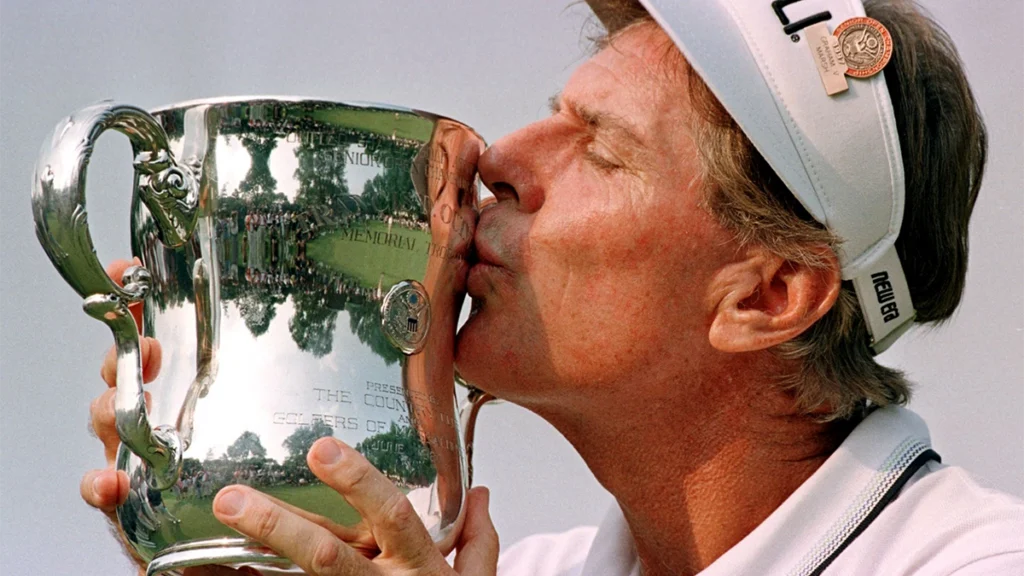
It meant a heck of a lot because I was able to win a major competing against many of the same guys that I competed against on the regular tour. So you have a window of when you can do that, between 50 and 57, 58, 60. Once you get over 60, the number of people who win tournaments over 60, the numbers are down.
That was very, very satisfying. And it was on a very good golf course in Olympia Fields. The senior tour was sent there as a test by the USGA [ahead of the 2003 US Open]. That was originally a 72-hole golf course, believe it or not. They chopped up 36 of it for housing, but they still had 36 left and they wanted to see [if it was suitable for a US Open] because there’s a bit of history with that place, in terms of how golf was developed, as people got there by train. So we were there as a test case because they planned to have the US Open there a few years after we were there. And they did, and Jim Furyk won it over Stephen Leaney.
That US Senior Open was a very important thing because I never won a [regular] major. I’d had a reasonable record in the US Open, but not great because I think I only played in a couple of them. But getting that one on a very good golf course and against a really good field… Floyd, Nicklaus, Irwin. So that was great fun.
I’d finished runner-up – I lost by a shot – at Pinehurst No.2 three years earlier when the South African guy, Simon Hobday, won. And I was in the bloody lead. We get to the 17th hole there at No.2 and we were tied. Hobday hits the most horrific bloody shank off into the pine trees. Somehow, from about 50 metres, he masterfully struggles it onto the green and holes it for 3. I hit it in there about 15 feet from the hole, didn’t make it. And we came up the last, it’s an uphill par 4 to the clubhouse. Hit good drives. And Jim Albus was the other one. So there was three of us tied now, going up the last. Albus missed the green. I was between a 6-iron and a 5-iron, and I thought, No, I won’t try to press it. I’ll hit the 5-iron. I hit the 5-iron and it eased off, it went down the slope over there. And I didn’t get it up and down. So Hobday hit it on the green. Albus didn’t get it up and down – we gave it to him. He makes 4 and we both made 5.
But then when we came to the 18th hole at Olympia Fields, which was our 18th hole – I don’t know if it was the same 18th hole when Furyk won the US Open – but it was a good, strong par 4, slightly downhill and up to the elevated green. I thought about laying up, but I just said to myself, “No, f–k it. This is a chance. I’ve got to do it.” I took driver and smashed it down there. Then it was a toss-up between an 8-iron and a 7-iron. And I had a flashback. I said, “Don’t make the same mistake again. Hit the other one, make a good swing at it. Don’t try to steer it up there.” So I hit it up there about 15 feet, took par and won.
It’s funny how those memories come back and just hit you, sometimes at critical times. They say it helps to not have a memory in golf because you can always remember the bad things you do. But on the other hand, they say that you only want to remember the good things. Well, both of those work, to be truthful, if anyone is really being honest with themselves. Let’s forget the double-bogey here and let’s get on with life. Sometimes when you’re playing really well, all you want to do is remember the good stuff, and that’s what you should do. But that’s why golf’s 90 percent above the shoulders.
What are you doing to keep active now that you’re in your 80s?
I’m still obviously doing some stuff, but one of the greatest enjoyments of my life is being nominated as an honorary member at Royal Melbourne. I couldn’t think of any place in Australia that I would be happier. There’s a marvellous membership here. Everybody talks about it. When I was chairman of the PGA Tour of Australia and we had five Mayne Nickless Australian PGA Championships here, they were good years for the PGA. I’ll tell you what, of all the clubs we ever went to in Australia, this was by far the most hospitable. They almost feel like they’ve got an obligation to do it, but they do it with pride and enjoyment.
Photographs by Getty images/Tony Duffy/South China Morning post/craig jones/vincent laforet