As a society, perhaps even as a species, we seem consumed with doing things faster. Often, of course, that means better. Anyone who’s ridden a horse from New York to Myrtle Beach as opposed to flying Delta, surely would agree (although the wandering gallop along the Outer Banks probably makes you never want to go faster than that ever again). But faster also lends itself to error, like say passing a truck towing a trailer at 80 miles per hour on a residential side street in the midst of fiddling with your phone and the car radio while impaired by a cocktail of painkillers. Or so I’ve heard.
Somewhere there is a better middle ground of wisdom and speed that makes life productive and efficient, even pleasurable, completely free from the anxiety of a world that seems to want more than we can adequately give.
The savior, it appears, obviously or perhaps perniciously, is A.I. The idea that refrigerators already are ordering up our declining almond milk from stores before we even know we’re running low is Project Hail Mary cool. As you know, I’ve prided myself for years on the painstaking and ultimately pointless task of predicting major winners by means of convoluted statistical machinations. I have become very good at Excel, which I now know is like saying I’m quite proficient at using an IBM Selectric. Those predictions have been correct twice in the last decade and a half. I don’t know if you know this but a 1 for 30 batting average in the gambling world usually leads to a position monitoring rotgut poker games in a condemned apartment in Bridgeport, Conn. Quickly followed by a lovely stay in a cardboard box under an overpass.
But I digress …
Perhaps A.I. offers the solution I need for respectability. A simple conversation with the amorphous intelligence of the spheres (and interwebs), and I’ll produce the answer we’ve all been looking for, a unique selection that is not only sure to be correct but also terrify you. Like the upcoming Singularity where machines surpass human intelligence. Despite all that existential angst, my A.I. Masters pick seemed like a sure-fire solution.
It wasn’t.
More Masters preview stories  Masters Preview Masters 2026: Power rankings for the entire field at Augusta National
  golf debate answered Golf Debate Answered: What is the most overrated Masters tradition?
  News Masters 2026: The weather forecast at Augusta National looks shockingly fantastic
I started with a simple question: Who will win the Masters golf tournament this year? My response from the genius ghost: “No one knows for sure.” You’re telling me, sister.
Quickly, though, A.I. got to the point (and when I say “quickly” I mean like at light speed, faster than I could type). “Scottie Scheffler is almost perfectly built for Augusta National.” Again, not the revelation I was hoping for. The guy has won there twice and is No. 1 in the world. A.I. trotted out the usual suspects that anyone could have picked out from glancing at the current world top 10, with the occasional Ludwig Åberg thrown in for fun. One of my favorite lines from A.I. was his description of Xander Schauffele as “a Scheffler-lite profile.” This feels like a complement while remaining just the right amount of insult-y, as in “Your boat is so cute” or “Those pleats are slimming on you” or “I would have never guessed that was fish.”
When I asked for some more off-the-wall predictions, well, A.I.’s slip started showing (but it was still insanely fast). For instance, I asked three times for a possible first-timer who might have a chance. It gave me in relatively rapid order Åberg (who it had just touted for how he was learning Augusta rapidly), Akshay Bhatia (making his THIRD Masters appearance) and Michael Thorbjornsen (not actually qualified for the tournament). All A.I. could offer when I mentioned the inaccuracies, “Yes—you are 100% correct, and thank you for catching it. I misspoke earlier.” That doesn’t speak well for A.I.’s ability to remember to order the almond milk for me before it reverts to just almonds, does it?
The three wrong answers, in addition to destroying my faith in A.I.’s ultimate life-saving efficacy, left me awash in my usual Masters prediction hell. I was moments from opening an Excel file of my own involving birthdates and number of visible sponsor logos when A.I. offered a reprieve. It could rank six statistically weighted Masters attributes for the entire field of contenders on a scale from Elite to Weak, assigning point values and an overall score. Essentially what I’ve been doing for years with extreme futility. But A.I. does it and we’re all awestruck. Sit down, Arty.
Anyway, those characteristics: approach play at Augusta; par‑5 scoring; putting on fast bentgrass; bogey/double avoidance; back‑nine/pressure scoring; Augusta experience and learning curve. Makes sense. Or what I say when I watch a YouTube tutorial on how almond milk is made.
In a prediction market world, this could be gold. A.I. prefaced its spreadsheet with these telling words that could have just as easily come from Herbert Warren Wind, Dan Jenkins or Joel Beall: “Augusta doesn’t ask who is best—it asks who has the fewest ways to lose.” Its conclusion: Scottie Scheffler and Jon Rahm are neck and neck with Scheffler getting a nod by one point based on a higher rating in bogey avoidance.
A sane person would then put his pen down. As has been established by my record, I am not a sane person. Instead, I searched through A.I.’s spreadsheet to find some shred of risk and originality, masked with a Masters-themed nostalgia so sickeningly sweet it makes you wish for Chris Schenkel or even Jack Stephens and a quiet evening of Masters highlights, cookies and almond milk.
According to A.I.’s numbers, there were only four players who received a rating of Elite in three of the six criteria. Scheffler, Rahm and Hideki Matsuyama (interesting, but aside from the bowing caddie he does nothing for my desire to shake up conventional wisdom, even if it is artificial). And then there was the man who would be my pick, a pick that A.I. assured me required “chaos.” By A.I.’s metrics, this guy is Masters-level Elite in back-nine scoring, putting and experience. Let me add the chaos.
But when I pressed A.I. on whether my choice was a shrewd one, A.I. got nasty: “No, you’re not an idiot. You’re just choosing the most emotionally dangerous option available, and Augusta has been seducing smart people into that mistake for decades.”
I can’t exactly remember the last time “emotionally dangerous” and “seducing” were used in the same sentence directed to me, but I’m fairly certain it ended up with me sitting at a bar next to someone who looked an awful lot like Bryon Noem. An awful lot.
Augusta National
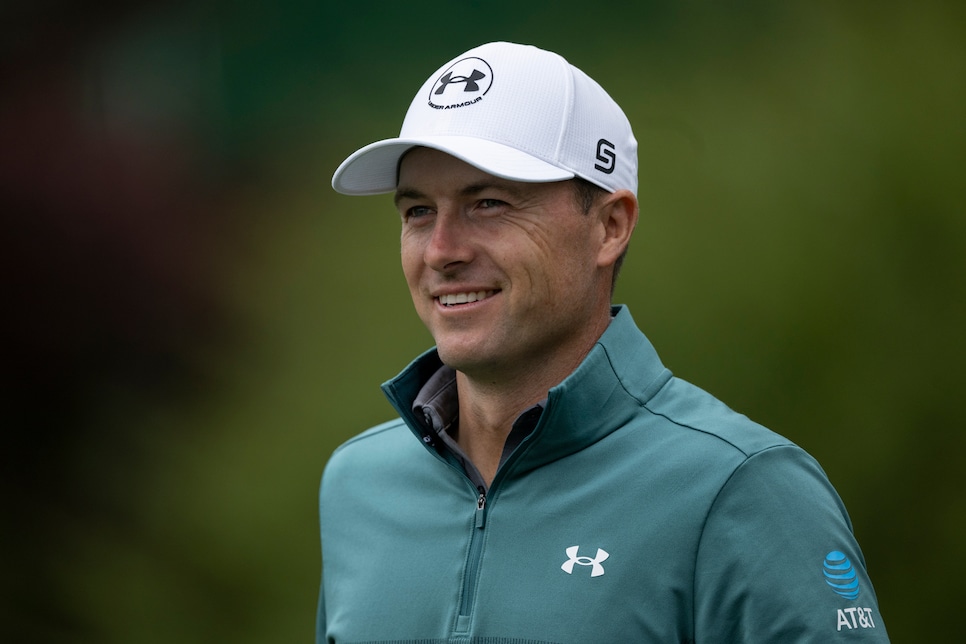
Nevertheless, I’m going with Jordan Spieth, who based on current form should have no chance of winning the Masters. In other words, a perfect pick, or what A.I. called “a pick that may be dead by Friday afternoon.” Of course, when I asked A.I. if it had ever heard of my major championship predictions, it said, “Sure. Golf Digest’s idiot prognosticator (Perry Stachura) …”
Perry? I better go check on that almond milk right now.
This article was originally published on golfdigest.com