That Lou Graham won any tournaments on the PGA Tour—and there were six total victories, including the 1975 U.S. Open—was a testament to his considerable skill. Because back in his era, there weren’t equipment trucks on-site at every event, and players couldn’t go through clubs like sticks of gum.
When, after he’d gotten on a hot streak in 1979 by winning three events in the span of 11 weeks, Graham sheepishly admitted that the new clubs he’d put into play that year were a factor. He had used his previous sticks for 17 years.
“The 9-iron was so worn that the bottom scoring line wasn’t there anymore,” Graham told Golf Digest after the magazine named him Comeback Player of the Year in 1979. “No matter how good an iron shot I hit it seemed I couldn’t get the ball close to the hole. … I couldn’t even the last time I hit a 5-iron, say, two feet from the hole, or a 7-iron right against the flag.”
That trio of wins to close the ’79 season would mark the end to a terrible slump Graham endured after his U.S. Open triumph, while also marking the last competitive peak in a career that saw the Tennessee native play for the U.S. on three consecutive Ryder Cup teams in the mid-1970s.
Graham died on Monday while in hospice care. He was 88.
Born in Nashville in 1938, Graham played college golf at Memphis State before being drafted into the U.S. Army. He was among those who served as honor guards at the Tomb of the Unknown Solider in Arlington National Cemetery, and he played on the Army golf team.
Graham joined the PGA Tour in 1964, but it’d be three years before he notched his first win at Hazeltine National in the Minnesota Golf Classic. Five more years passed before he got his second victory, in the Liggett Myers Open in Cary, N.C.
The dearth of wins may have been due to what many described as Graham having a conservative nature when it came to the game. “He’s absolutely colorless,” a tour source told the New York Times. “He never gambles for birdies. Always goes for the fat part of the green, where it’s safer.”
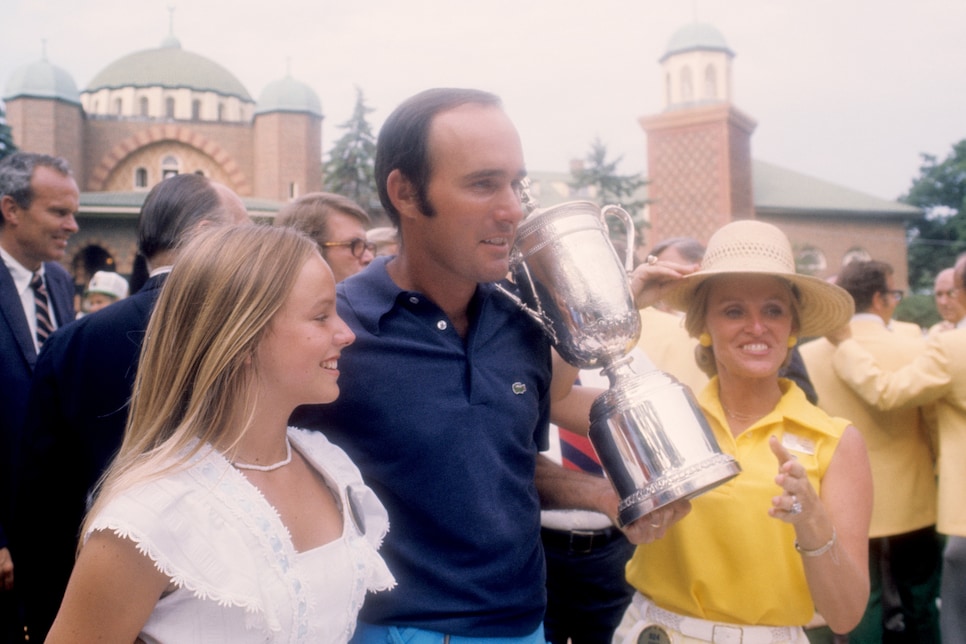
Lou Graham celebrates winning the U.S. Open with his wife Patsy (right) and daughter Louanne.
Heinz Kluetmeier
Which means Graham’s approach set up perfectly for a USGA championship, and he got about the blandest test he could hope for in 1975 at Medinah Country Club. Three over would be the best total score for 72 holes—shot by Graham and John Mahaffey—and in an 18-hole playoff on Monday, Graham prevailed by shooting even-par 71 to Mahaffey’s 73.
“I kept telling myself this is not the Open you’re playing,” Graham said in the aftermath. “It’s just another round of golf. I didn’t put pressure on myself. I put the Open out of my mind.”
Graham, who was 37 at the time, earned $40,000 for his victory, and that would seem like a king’s bounty when he later fell into a slump that lasted for four years. When Graham did finally win again in July of 1977 in Philadelphia, he’d only made $20,000 that year.
“I started asking myself, ‘Am I going to win a U.S. Open and never win another tournament?’” Graham told Golf Digest. “I was getting 40, 41 years old, and it was hurting me that I couldn’t win a tournament. It was upsetting. Every week I was trying as hard as I could to win. It was killing me to think that I might not win again.”
In a remarkable turnaround, more victories would come in quick fashion in Philadelphia, Sutton, Mass., and San Antonio.
Graham had rediscovered his self-belief.
“Winning that second tournament in Sutton was easier than winning in Philadelphia,” Graham said. “And winning the third down in San Antonio was a lot easier. The fact that I’d already won twice really made a difference. Winning tournaments definitely breeds winning—there’s no doubt about that.”
This article was originally published on golfdigest.com