How to maximise your viewing experience at this month’s BMW Australian PGA Championship.
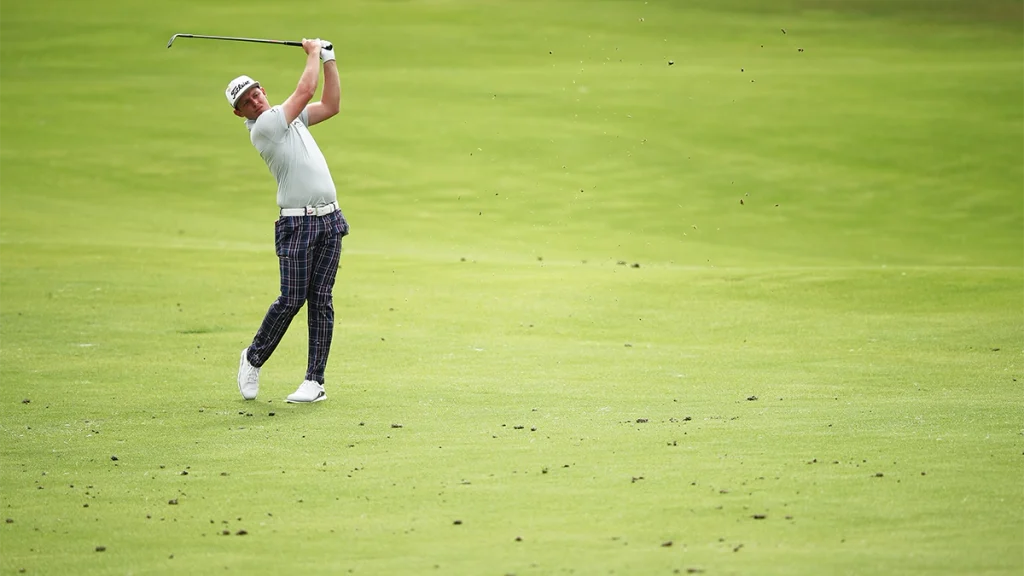
There’s a photo of a 25-year-old Cameron Smith playing the 2018 Australian Open at The Lakes Golf Club, about three years before adopting his trademark mullet haircut. Coiled at the top of his backswing, he’s about to strike a wedge for his second shot into the driveable, par-4 13th hole at The Lakes Golf Club.
The photo was sent to me by Mike Clayton, who helped redesign The Lakes – a private club nestled in the suburb of Eastlakes near Sydney Airport.
“Cameron chose to lay up on No.13 in all four rounds, and made birdie three times,” Clayton says via a text accompanying the photo. Smith eventually earned a T-10 result behind winner Abraham Ancer. Weeks later, Smith would claim his second Australian PGA title.
There will be plenty of 3s, 4s and 5s, some 6s and maybe worse when The Lakes stages the 2026 BMW Australian PGA Championship. The PGA’s previous host, Royal Queensland, is undergoing renovations given it is the Olympic course for the 2032 Brisbane Games. Tourism arm Destination NSW convinced the PGA of Australia to move the event away from Queensland and to New South Wales for the first time since 1998.
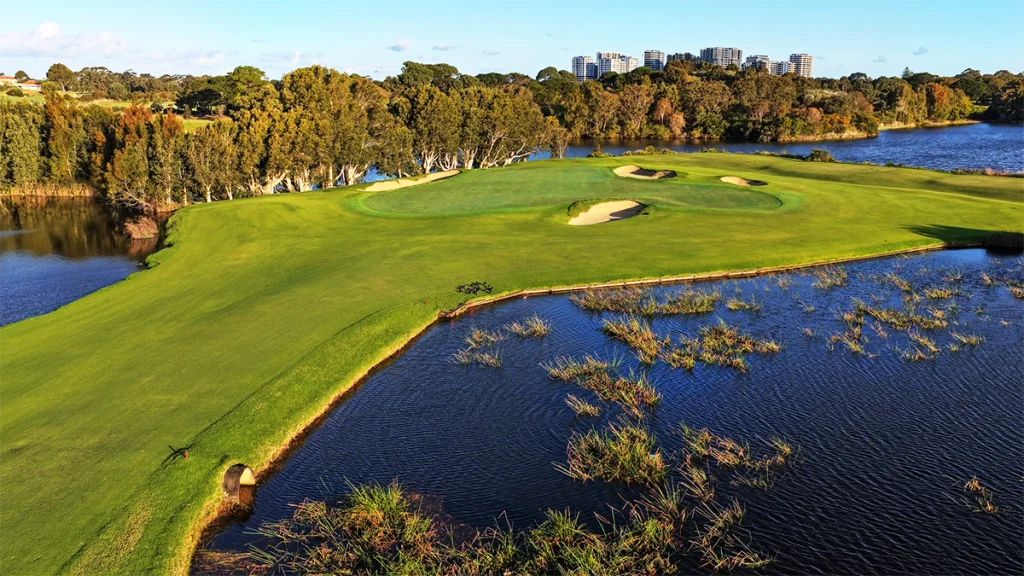
At The Lakes, perhaps the most dramatic corner of the property for fans to watch an entire hole will be that short yet devilish 13th. Standing near the ropeline at the tee will have punters enjoying listening to the player-caddie discussions as the decision-making process plays out. Go for the green or lay up? Many will attempt to drive the green. The hole measures 288 metres from the tips but falls steeply downhill and is often down breeze, meaning the pros will be caught between 3-wood to the front edge and driver to reach the back. There is a water hazard down the right that, for the ball-strikers of the Challenger PGA Tour of Australasia and the DP World Tour, shouldn’t be a concern.
That penalty area will only gently influence the pros who elect to lay up by forcing them to aim for the left side of the fairway. They will probably choose a 5 or 6-iron from the tee to leave the ball 50 to 70 metres short of the green.
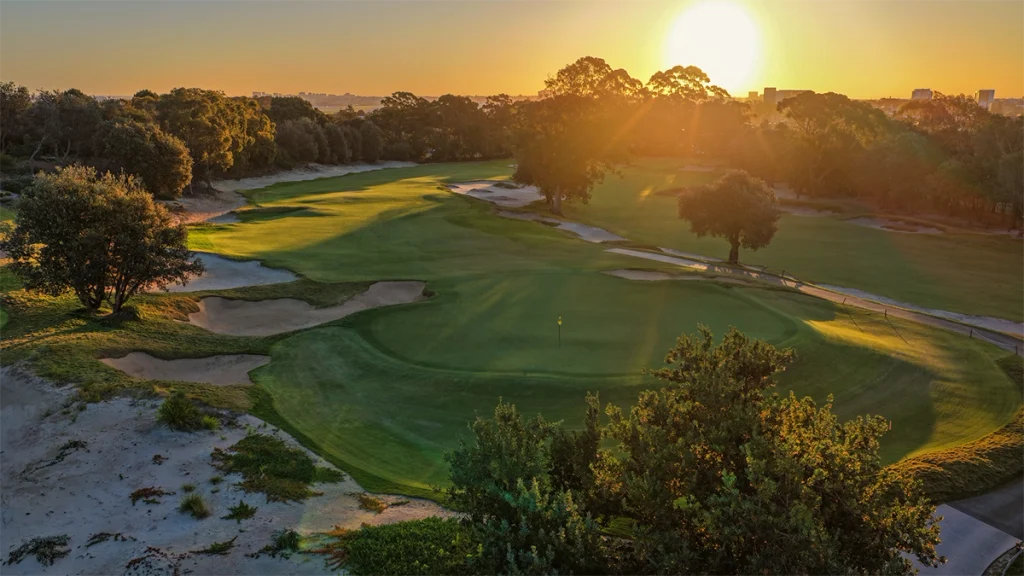
The green alone will be ‘box office’ to watch the pros show off their skills, or prove they are human. For this, fans may want to position themselves behind and to the right of the green, towards the 14th tee. The putting surface on 13 has a heart-shaped, turtleback form and slopes from back to front. Those contours, and more importantly the tilt, render spin control difficult yet crucial. The landing areas become miniscule. If a player fails to carry the water hazard from the tee, or misses the green with his second shot, big numbers become a possibility.
Some pros may not love the 13th, which is typically the hallmark of a good golf hole.
Other highlights of the back nine include the marvellous par-5 11th. Some golf fans may remember John Daly rinsing seven balls when going for the green at the 2011 Australian Open, before walking off the course and withdrawing. The tee shot is demanding, requiring either a draw that starts towards a fairway bunker and the enormous lake, or a fade that begins dangerously close to the out-of-bounds driving range. From there, a long iron to a tricky green or a layup to the left fairway are the options. Fans should stand as close as possible to the left side of the hole, after a series of fairway bunkers end, and watch both the second shots from a slight distance and the third shots from close range.
The Australian PGA has also selected the delightful par-3 15th as its ‘Party Hole’, which has become a feature of the tournament. There are elements of links golf in the way lower tee shots can be rewarded by running the ball onto the green, as well as its Redan-style putting surface. This area of the property is also great for watching the players coming down the par-5 14th, where a risky second shot is played completely over water to an enormous green. Viewing the rustic sand carry of the par-3 18th is also a treat, particularly from beside the clubhouse.
Personally for this writer, the front nine at The Lakes is where the course really shines. After a testing first hole, where a lake extends down the entire left side, players and fans cross through an underpass to a sprawling and hilly series of sandy paddocks. No.1 is classy, but holes two to nine are a visually striking battle of strategy, execution and imagination that play like an inland links. Sandy barrancas are a feature of every hole. After muscular par 4s at the second and third, a series of shorter par 4s begins and all demand smart golf or bold, aggressive shot-making. Fans positioned behind the fourth tee will marvel at the punch shots and stingers to the end of the fairway, and the risk-reward tee shot at the fifth. For that, my advice is to stand as close as the ropes will allow to the greenside bunkers at the fifth. You’ll see tee shots land, and the wedge shots from up close.
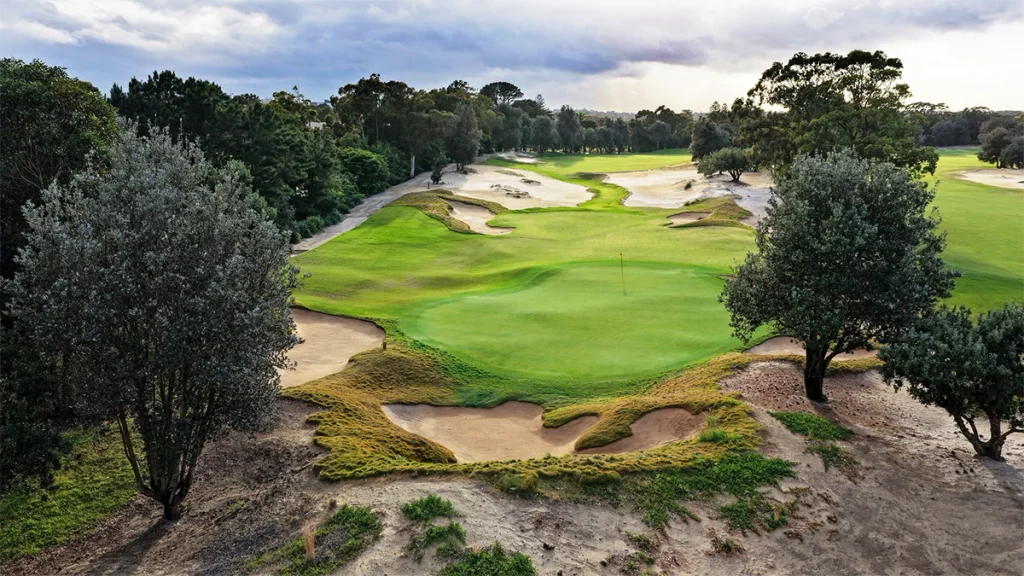
Then comes arguably the best stretch of holes at The Lakes. Stand behind the tee at the 312-metre, par-4 sixth, or up at the cart path to the left of the green, and watch the tour players go for the green with driver or lay up to the right. At the par-3 seventh, stand behind the green and watch players hit wedges and irons over a charming sandy barranca to a brutal, two-tiered green. This spot will also allow views of the downhill tee shot at the par-5 eighth.
Outside tournaments, the visual from the tee at the par-3 ninth is wonderful. There’s a sandy waste area between the left and middle tees and a sprawling fairway, which surrounds a lone pot bunker short of the middle of the green’s front edge. The view feels like a par 3 at a links course on the Open Championship rota, only with much deeper green kikuyu grass. Behind the green is a wonderful vantage point to watch the players hit wedges and short irons to a large green that has plenty of pin options.
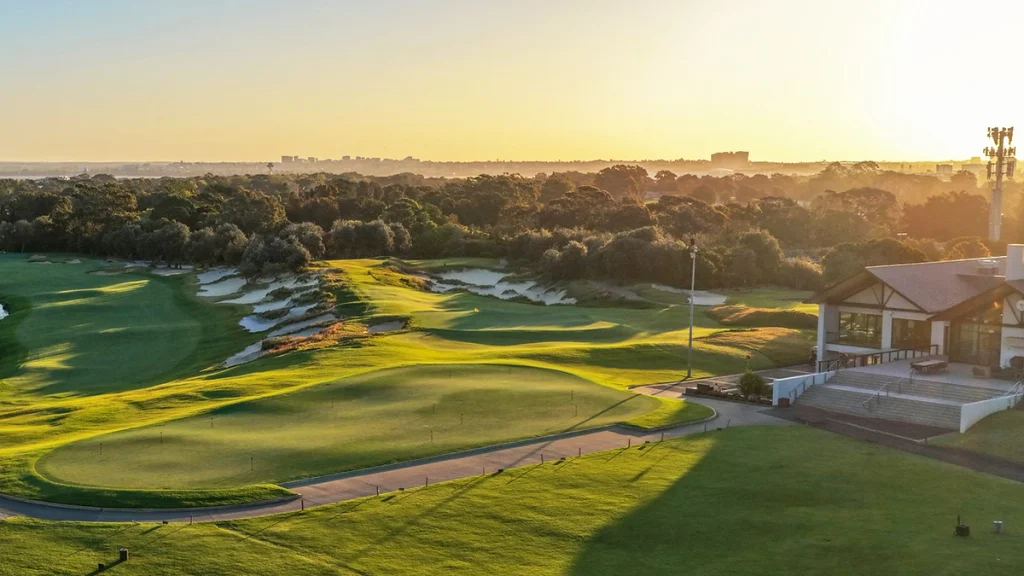
The Lakes is unique in tournament golf in that fans can see the entire practice facility from the clubhouse surrounds. Often, driving ranges and chipping greens are located a decent distance away. Here, it’s possible to see pros hit practice chips and pitches, putts and range balls, as well as tee shots in competition at the first and 10th holes, depending on the tees in use that day.
The Lakes Golf Club, founded in 1928, is approaching its centenary. In that span, a collection of legends of the game have hoisted trophies here, and not only from three Australian PGAs and eight Opens (most recently as Open co-host in 2023). Jack Nicklaus won the 1964 Australian Open and Greg Norman the 1980 Open, while Arnold Palmer was victorious at the 1963 Wills Masters. Gary Player (1961 Wills Classic) and Curtis Strange (1993 Holden Classic) have also won, while in 2011 Greg Chalmers held off a determined Tiger Woods (third place) and an elite field littered with Presidents Cup stars to claim his second Stonehaven Cup.
With the DP World Tour now co-sanctioning what is the first event of the 2026-2027 season, a stronger field will feature a host of decent European names, including some who will be looking for early Ryder Cup points ahead of the matches at Adare Manor next September. That’s in addition to the list of homegrown stars such as Smith, Min Woo Lee, Adam Scott, Lucas Herbert, Elvis Smylie and Matt Jones. International names such as Corey Conners and LIV golfers David Puig (the defending Australian PGA champion), Carlos Ortiz, Harold Varner III and Josele Ballester have been confirmed.
The past is rich at The Lakes and in the Australian PGA, but this edition is set to be one of the best yet.
Photographs by Gary Lisbon, getty images/Matt King