In an era of automation and fast production cycles, Mizuno is one of the few manufacturers in golf where craftsmanship genuinely matters.
The company has long been known for producing irons with a level of precision and feel that players trust instinctively, but very few people ever see how that reputation is earned. Access to the factory is limited, cameras are almost never allowed, and the full process is something of a guarded ritual in Japanese manufacturing culture.
A rare tour through Mizuno’s forging headquarters and its Technics custom-build facility in Japan provided a chance to watch the entire journey from raw metal to finished club. What becomes obvious straight away is that every part of Mizuno’s operation is built on a deep respect for skill, repetition and tradition. Nothing feels rushed. Nothing feels disposable. The product is the end result of people who take real pride in what they do.
The Forging Floor
The first step takes place at the forging factory where raw billets of steel are cut and prepared for shaping. Mizuno uses three primary forging strikes depending on the iron design. The first strike stamps a rough outline of the club. The hosel, neck and basic blade start to show their form. The second and third strikes sharpen the top line, the sole, the cavity and the face. At this stage the head begins to look more familiar.
Instead of leaning heavily on robotics, Mizuno still employs highly trained hammer technicians who govern the feel of the strike. Only two people in the entire operation are certified to do this job. Their skill is the result of years of training and thousands of repetitions. If they miss by even a fraction, the head is discarded and the process starts again. It is an approach that values consistency over speed.
The forged heads are then moved to the kiln for heat treatment. The temperature is intense, and the environment feels closer to a workshop than a factory. Once heated, any imperfections are buffed away by hand before the heads move into inspection.
Inspection Without Compromise
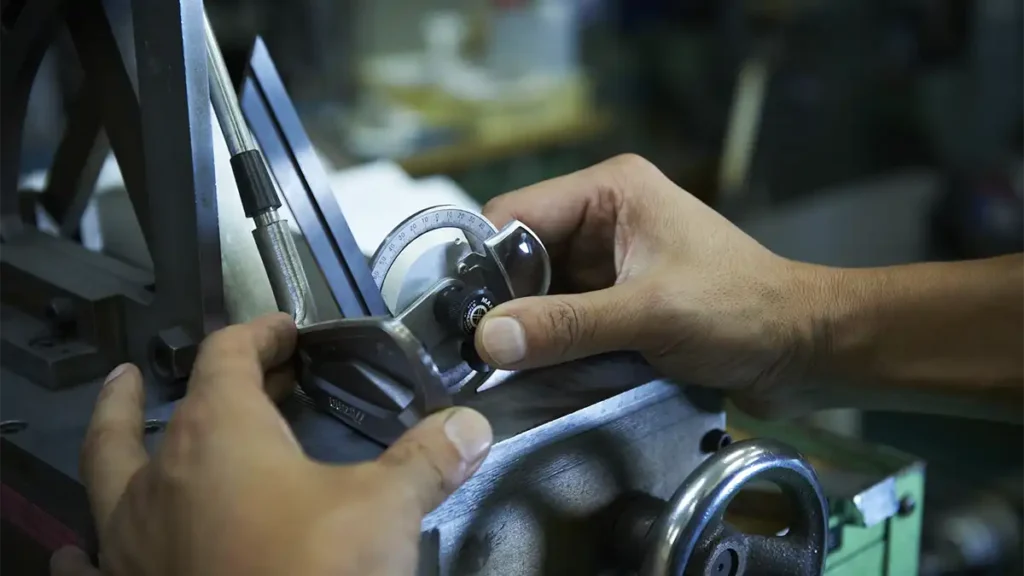
One of the most striking parts of the tour is the inspection room. Every single iron that leaves Mizuno is checked by hand. Not a sample, not a portion of the run. Every head. If anything looks off, even slightly, it is either reworked or rejected. This can include the tiniest surface blemish, a weight reading out of spec, or a subtle shift in offset. The attention to detail is remarkable and it shows how seriously Mizuno takes quality control.
It is slow, methodical work, but it is central to the feel that loyal Mizuno players talk about. The process protects the lineage of the product. The company refuses to take shortcuts at the point where customers will notice the difference most.

Inside Mizuno Technics
The tour then moves to Yoro and the Mizuno Technics facility. This is where shafts are installed, grips are applied and swing weights are dialled in. The process is surprisingly hands-on. Before any glue is added, technicians dry-fit each club to confirm swing weight. If the number is off even slightly the weight is adjusted inside the head.
The grip installation process is almost a performance. Tape goes on in a single smooth motion. The cut is precise. The grip solution is applied quickly and evenly. The grip is rolled on in a matter of seconds. These technicians complete in moments what would take most amateurs minutes.
Each finished club receives a unique barcode. Every ferrule is shaved by hand until it sits perfectly flush with the hosel. If the technician goes too far and scuffs the head, the club is rebuilt. There is no tolerance for imperfection.
The Meister Grinders
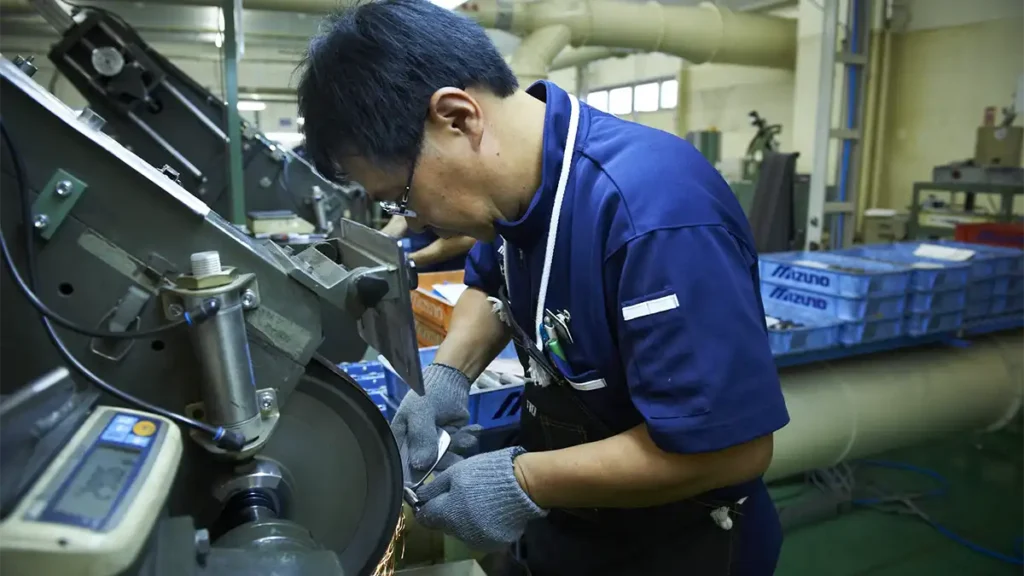
One of the the most fascinating parts of the visit is seeing the work of the Meister grinders. These are the artisans who shape soles, add or remove offset and refine blade lines for players who need precise specifications.
It takes roughly 15 years to reach this status. Many of the Meisters have worked on the clubs of major champions and elite professionals. They trust their hands more than any machine and watching them work makes it clear why.
Their touch is subtle. Every pass on the wheel is deliberate. Even in a noisy factory, you can sense how much concentration the role requires.
A Culture Rooted in Craft
Across both facilities, what really stands out is the culture. The workers move with a quiet confidence. There is no rush and no sense of chasing volume for the sake of it. Mizuno produces roughly 1,500 to 1,600 sets a day worldwide, with capacity reaching about 2,200 if absolutely necessary. By modern standards this is modest. But Mizuno has never built its identity around scale. It has built it around feel and craftsmanship.
The precision that comes off the factory floor is the result of humans who understand the weight of tradition and the expectation of golfers who choose Mizuno for a reason. When players describe a Mizuno iron as soft or pure, they are talking about something that has been earned through decades of repetition and care.
For those who value authenticity in their equipment, a tour of Mizuno reinforces what many already believe. These clubs are not just engineered. They are crafted. And the feel that golfers chase is forged long before a club ever reaches the first tee.
To experience the passion and craftsmanship that goes into your next set, book at one of our fitting days mizuno.com.au/pages/fitting or directly at our Mulgrave, VIC office mizuno.com.au/pages/mizuno-custom-fitting-experience