If a week is a long time in politics, football or whichever pursuit you’d like to inject into the time-honoured saying, don’t ever let it be said that a week is a short period in golf – or golf courses.
RELATED: Our ranking of Australia’s Top 100 Golf Courses for 2024-2025
Australia’s 1,600-odd golf courses might not always seem to be the source of significant news or change, but this past week or so would tell you otherwise. On the happy side, the stunning Links Kennedy Bay course re-opened for public play two Sundays ago, a long-awaited return of an old favourite near the coastline south of Perth.
Kennedy Bay continues a steam of major redesign projects reaching or nearing completion. The run began with Commonwealth Golf Club’s re-opening in March, a similar timeline to Perth’s Mount Lawley, which received such rave reviews at the WA Open last month, and the courses at both Royal Sydney and New South Wales.
The winter saw less activity on that front, but upcoming are the returns of Glenelg (latest renovation scheduled for completion on December 6), Huntingdale (set for a likely re-opening this summer), The National’s Long Island course and the ornate renovation of the Country Club Tasmania layout (both set for late 2026).
Throw in newcomers 7 Mile Beach in Hobart (which opens for play on December 4) and The Cliffs Kangaroo Island (spring 2026), and you have a phalanx of openings and re-openings to savour.
Yet this past week has been less about the golf courses themselves and more about management, administration, ownership and government.
Ever-present in the news is Sydney’s Moore Park Golf Course, where two weeks ago draft plans for the controversial $50 million halving of the inner-city layout were unveiled.
The saga goes on at Moore Park, with hope remaining that our governing bodies can persuade the NSW Government and Sydney Lord Mayor Clover Moore that neighbouring Centennial Park is a more than adequate space for citizens’ non-golf leisure activities.
In the same city and in a similar realm is Pymble Golf Club, which yesterday received the go-ahead to build residential towers on a peripheral section of its property (totalling just 3 percent of the club’s land). The North Shore Times reported the club navigated a rezoning battle with Ku-ring-gai Council before securing approval.
This is a rising concept, quite literally. Adapting or utilising clubhouse or carpark space to ‘go underground’ with parking facilities and ‘go up’ with a lucrative residential tower – where zoning allows it – is a growing trend. Oatlands Golf Club in Sydney’s north-west is using its existing clubhouse footprint to do exactly that, while Killara Golf Club has plans to use its upper carpark space for a future residential development.
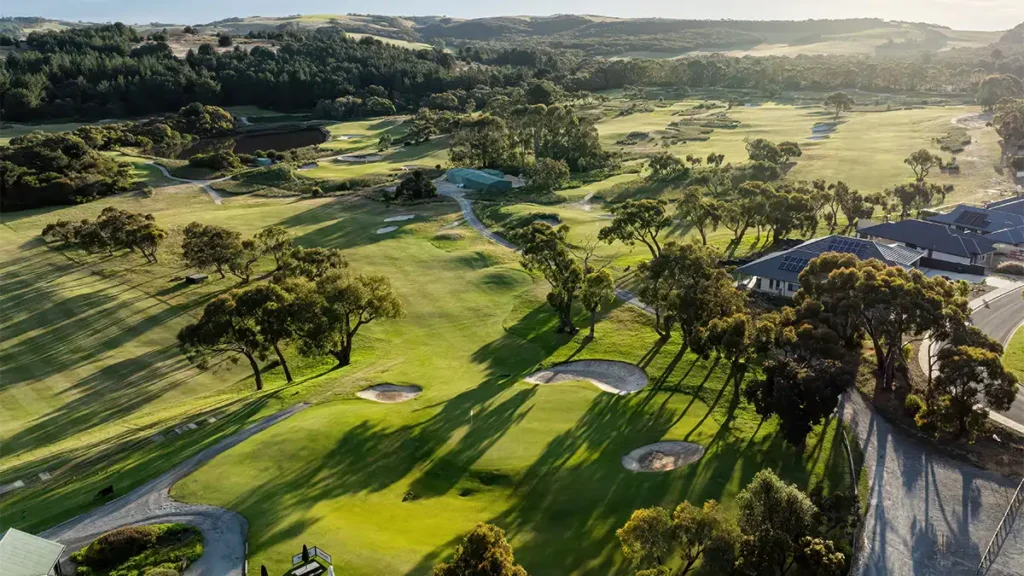
In Melbourne, a report last week suggests the billionaire Fox family is eyeing a purchase of the city’s ultra-private Capital Golf Club [above]. Crown – the new naming-rights sponsor of next month’s men’s Australian Open – is the current owner of Capital, with one real-estate website speculating about a price-tag well north of $100 million for the reclusive golf playground.
And just yesterday, Brisbane’s Courier-Mail reported that the company operating Kooralbyn Resort – the Gold Coast hinterland course with an already chequered management past – is now in the hands of administrators.
It’s never a positive sign when a course finds itself in this situation, particularly in a part of the country that has seen the closure of the Arundel Hills, Victoria Park and North Lakes courses in recent years, but it’s also part and parcel of the business world – if you can separate the golf aspect.
Which makes you wonder what next week might bring.