From cardiac arrests to heat stroke and snake bites, rapid response can change outcomes. Developed alongside frontline paramedics, InGolf and Utility’s Medical Response Vehicle is redefining emergency preparedness for golf clubs.
Golf clubs have spent years investing in the first two links of the cardiac arrest survival chain: training staff and members in CPR and ensuring defibrillators are readily accessible around clubhouses and on-course facilities.
The missing piece has always been what happens next.
How do you get paramedics to a patient quickly when that patient is lying hundreds of metres from the nearest road, on the far side of a golf course, across difficult terrain that a four-tonne ambulance simply cannot reach?
InGolf & Utility believes it has the answer.
The origins of the Medical Response Vehicle are grounded in real-world experience rather than theory. Following a tragic on-course medical incident at Cromer Golf Club, general manager Melissa Ellis began discussions with intensive care paramedic specialist and general manager of Shield Medical Training, Michael Covey, about the challenges of delivering emergency medical care across large golf properties.
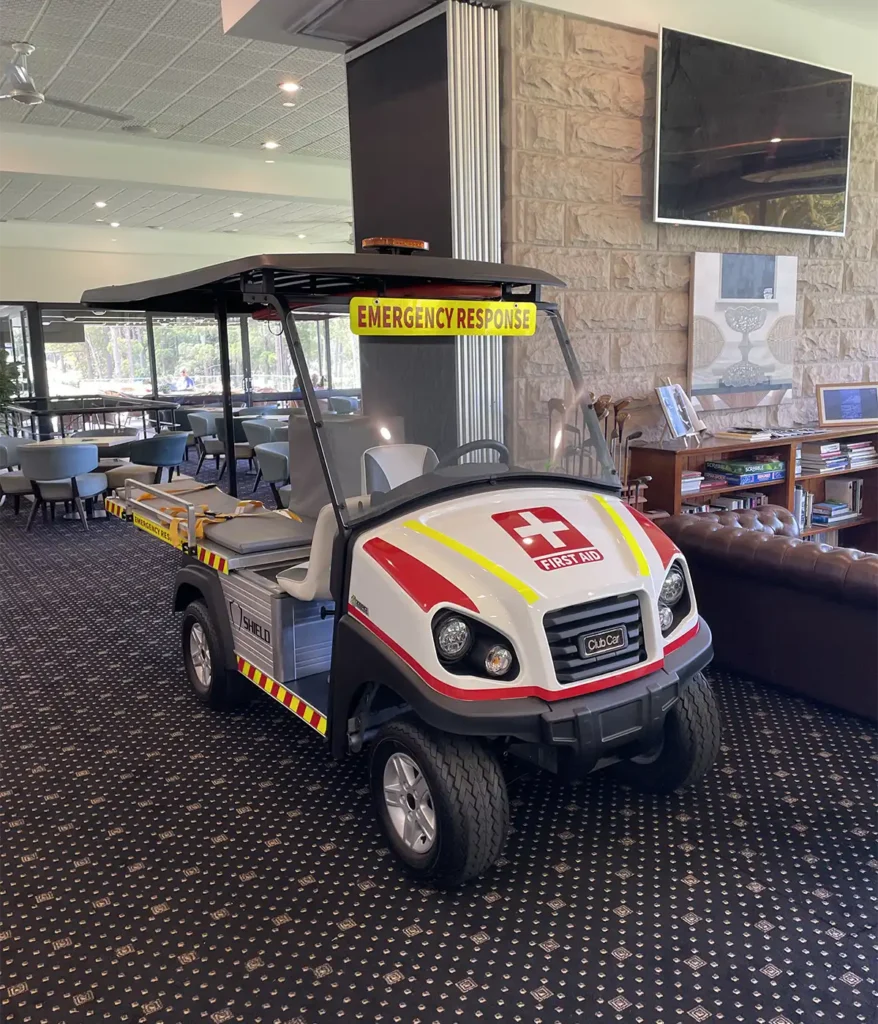
What followed was a shared determination to create a purpose-built medical response vehicle specifically designed for golf and resort environments. After 12 months of collaboration between Covey and InGolf & Utility local production team, the result is a vehicle engineered not for a specification sheet, but for the realities of frontline patient care — enabling faster access to patients, safer transfers and more effective treatment during those critical first minutes of a medical emergency. The new Medical Response Vehicle has been purpose-built to solve one of golf’s most significant and often overlooked operational challenges.
“Cardiac arrests on golf courses are a regular occurrence, and unfortunately, it can be a lottery as to the location of the patient and how quickly they can be moved,” Covey says.
“Golf courses cover large areas of often difficult terrain, and while they’re beautifully maintained, that can create challenges for emergency response. Ambulances weigh more than four tonnes and can quickly become bogged on soft ground, particularly after wet weather.”
The reality is that golf courses pose unique logistical challenges for emergency services. Patients can collapse hundreds of metres from an access road, in locations that require responders to carry equipment across fairways, through rough and over bridges before treatment can even begin.
For lower-acuity incidents, such as a broken arm or ankle, this can usually be managed without significant consequences.
Cardiac arrests are different.
“In the case of a cardiac arrest, where ongoing CPR is required, moving a patient safely and effectively becomes incredibly challenging,” Covey says.
“This vehicle has been designed to solve that problem. It gives paramedics the ability to reach a patient quickly, begin treatment immediately and transport them off the course and into an ambulance far more efficiently. Most importantly, the design allows the paramedic to continue vital CPR while moving the patient”
Built on the proven CA300 platform, the Medical Response Vehicle features a purpose-designed patient transport deck, spine board capability, dedicated attendant seating and space for critical medical equipment, allowing CPR and patient monitoring to continue while the patient is being moved.
That capability can prove critical.
“This really is the final piece of the puzzle in managing cardiac arrests on a golf course,” Covey says.
“The first steps are effective CPR from bystanders and fast access to defibrillators positioned around the course and clubhouse. The missing link has always been getting paramedics to the patient, and the patient to the ambulance, quickly and safely.”
“This vehicle closes that gap and completes the chain of survival for golfers experiencing a medical emergency.”
Importantly, cardiac incidents were only part of the design brief. Heat stroke, snake bites, falls, allergic reactions and trauma injuries are all realities for clubs operating across large outdoor environments.
“We’ve already seen the value of this type of response vehicle in action, with it being utilised within days of being introduced at Cromer Golf Club, and it may surprise some people, but it’s actually been out on the course almost weekly, which proves its purpose already”, Covey says.
For golf clubs investing millions into course improvements, clubhouse upgrades and member amenities, emergency preparedness is increasingly becoming another essential piece of infrastructure.
Because when a medical emergency occurs on a golf course, minutes matter.
And in many cases, those minutes can mean the difference between life and death.