
DIY-ing your own golf swing generally isn’t advised. Go find a good coach—you’ll be better for it.
Yet the reality is that if you’re at all curious about your own golf swing, you’ll probably, at some point, whip out the phone and record your swing. The next question is: What should you actually look for?
Well, you could do far worse than this set of checkpoints. It won’t tell you everything, but it will give you a good framework to improve one of the most important elements of every golf swing.
It’s all about body structure.
Here’s how it works.
Two angles, three checkpoints
The set of checkpoints comes from Andreas Kali, one of the top coaches in the world who teaches rising star Rasmus Neergaard-Petersen, among many others.

[Photo: Andrew Redington]
You can check this in one of two ways—or both if you’re feeling ambitious.
Face on
It’s pretty simple, really. We’ll use a video of Kali’s student Neergaard-Petersen to illustrate.
Take a video from this angle.
Your browser does not support the video tag.
When you go to look at it, pause it on the release position—AKA, when the club is parallel to the ground. You’re looking at three things:
- Hips
- Chest
- Head
The goal is:
- To make sure your hips are ahead of your chest
- Your chest is ahead of your head
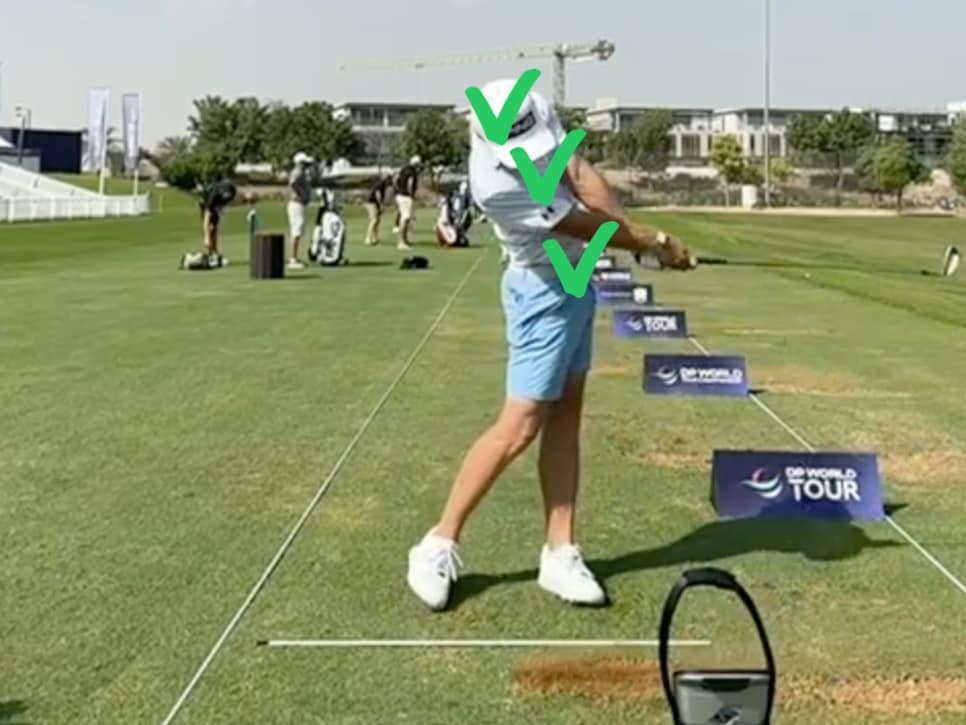
Often, amateur golfers get their head and chest ahead of their lower body at this point. Smothering the ball with this action is a sign the golfer just came over-the-top, among other things.
Down the line
You can use this same framework for a down-the-line look at your swing, too.
Your browser does not support the video tag.
You’re looking at the same three things (hips, chest, head) at the same position, but from this angle, the checkpoints are different:
- Your hips are to the left of your chest
- Your chest is to the left of your head

Again, lots of amateurs often lose this body structure through the ball. Their hips tuck under their head so it appears in a straight line from this angle. You may know this as early extension, which brings with it its own slate of problems.
These checkpoints can help with these things. It may not solve everything, but at worst it’ll give you something productive to look for.