
Max Brown, a senior on DePauw University’s golf team, didn’t think about playing college golf until his sophomore year in high school. That’s late by today’s standards, where many golfers start the process in middle school and are committed to a program by junior year.
From Spring Lake, Mich., Brown was the first person in his family to go to college. His parents, while supportive of his golf dream, were not knowledgeable of how college recruiting worked. Brown chuckles at his obliviousness when asked where he ranked among his national graduating class of golfers. “I wasn’t great.” He was fairly certain that Michigan State University, which he’d cheered on since childhood, wasn’t an option.
A friend suggested he reach out to a college golf advisor. Brown didn’t know such professionals existed, what they did or how they worked. While advisors to help golfers find the right college are relatively new, the business of advising high school students—and their parents—to gain an edge in college admissions has been thriving for decades. Tutoring for SAT prep and essay writing are table stakes; the big bucks are spent on creating so-called “spikey” kids who stand out as applicants whether they’re volunteering at animal shelters, performing with an orchestra or excelling in a sport.
In some respects, golf is playing catch up in the multi-million-dollar college advising business.
Brown got connected at a tournament with Michael Burcin, the former golf coach at the University of Wisconsin who now runs Under Par Consulting. They had a positive initial chat, and their advising relationship formally began when Brown flew to Charleston, S.C., to play golf with Burcin. After that meeting, Burcin knew what he had to work with. He started Brown on a program for improving his mechanics, course management and mental game, but more to the point, he gave Brown direction on how to evaluate various college golf programs and what to say when interacting with coaches.
“He helped me find DePauw and all these different schools,” says Brown, now majoring in business analytics. “He figures out what people’s priorities are. Mine was not to be a top golfer. I wanted to get a great education.”
The college golf consulting business is about helping a junior golfer find a spot on a team at a school where he or she can thrive. Most advisors charge anywhere from $2,500 to $10,000 a year, or sometimes more. Some advisors run showcase camps that cost from $300 to $1,800 to attend and meet top coaches. Others have created web-based programs to rank players and, ostensibly, get this data to coaches.
The demand is there. The membership of the American Junior Golf Association has more than doubled in the past decade. It has 11,400 members, and about 9,000 of those kids play at least one event a year, with some playing the maximum of five. Mark Oskarson, chief operating officer at the AJGA, says the organization has recognized the need to help connect players and coaches. The AJGA has created a site that allows players to input their rounds as well as their GPAs, standardized test scores, and areas and schools of interest—to which more than 1,300 college coaches have access.
Beyond increased participation in golf, systemic factors have boosted the usefulness of consultants. Many young golfers who could’ve played Division I in a past era now can’t because of shrinking team rosters. To comply with an NCAA settlement that offers more full scholarships but restricts the size of teams, as of the 2025-2026 academic year top golf programs have reduced rosters from 12 to nine players. In addition, the transfer portal lets coaches snap up players who have already proven themselves on the college stage. Whereas coaches used to offer scholarships to two or three high school players per year, now it’s common practice to take one from high school and one from the transfer portal.
This has been a boon for Ivy League and Division III programs. Rather than remaining a practice player at a power golf school, a very good but not great player can more seamlessly transfer to an elite academic school and get connected with alums who can help launch a career.
Most advisors charge anywhere from $2,500 to $10,000 a year, or sometimes more.
“Perfect grades are not the standout anymore,” says Richie Brazeau, a college golf advisor and owner of The College Golf Guide database. “Our job is to open these kids’ eyes to what’s out there. There are 295 men’s Division I teams and 250 women’s DI teams, but some of these DI programs are closer to a DIII [in golf competitiveness] than they are to Oklahoma State.”
John Brooks, who set up Red Numbers Golf in 2003 and is considered the dean of college golf advisors, says, “You start by being realistic with how competitive Duke, Vanderbilt, University of Virginia, Georgia Tech and Texas are. Then you realize players at Lehigh, Bucknell, Richmond and Georgetown are really good, too.”
Parents and golfers are often surprised to learn how few roster spots are available for juniors and seniors in high school.
“The top 150 golfers in each class are done or close to done sometimes two years before other kids in their class,” Burcin says. “Then you have the other 1,200 programs, with DII and DIII coaches recruiting kids in the top 400 in that class. These schools have access to kids they never thought they would.”
All of this has left parents scrambling for advice and advisors playing more of a therapeutic or psychological role to manage everyone’s expectations.
More From college golf  College Golf Why Gen Z is loving non-varsity golf
  Golf Digest Logo The 25 Greatest College Golf Courses in America
  Golf Digest Logo 10 of the best colleges for casual golfers The Advisors
The common thread of top advisors is having played or coached at a high level. Brooks won two NAIA titles at the University of North Florida in Jacksonville, Fla., as a player before coaching there for 13 years. He charges clients depending on what they want. His initial assessment costs $3,500, though that gets credited back if the student stays. An annual program costs $8,500. He offers an hourly rate of $375, with a retainer of $3,500. He has worked formally with the AJGA since 2006.
Richie Brazeau, who was not guaranteed his spot on Seton Hall’s golf team, finds it easy to relate to late bloomers. “I was not a very good player in high school,” he says. “I had to work hard to get on my college team.” He says he specializes in players who are “ranked 300 to 500 in their class.” His annual fee is $5,000, though he halves it for kids who start with him before 10th grade.
Burcin, who worked with Brown, started his career coaching at the University of South Carolina before spending a decade as the head coach at the University of Wisconsin. Not traveling during COVID-19 got him thinking of other things he could do in the game. He started Under Par Consulting and brought the perspective of a Big Ten coach to his advising. Most of the families he works with pay between $2,000 and $5,000 a year.
CJ Gatto played college golf at UNLV and as a professional won the 2010 Hong Kong PGA Championship. After playing for five years in Asia, he found a niche working with families in Asia who wanted to send their junior phenoms to the United States. In 2013, he brought a group of nine college coaches to China, including from Yale and Oregon.
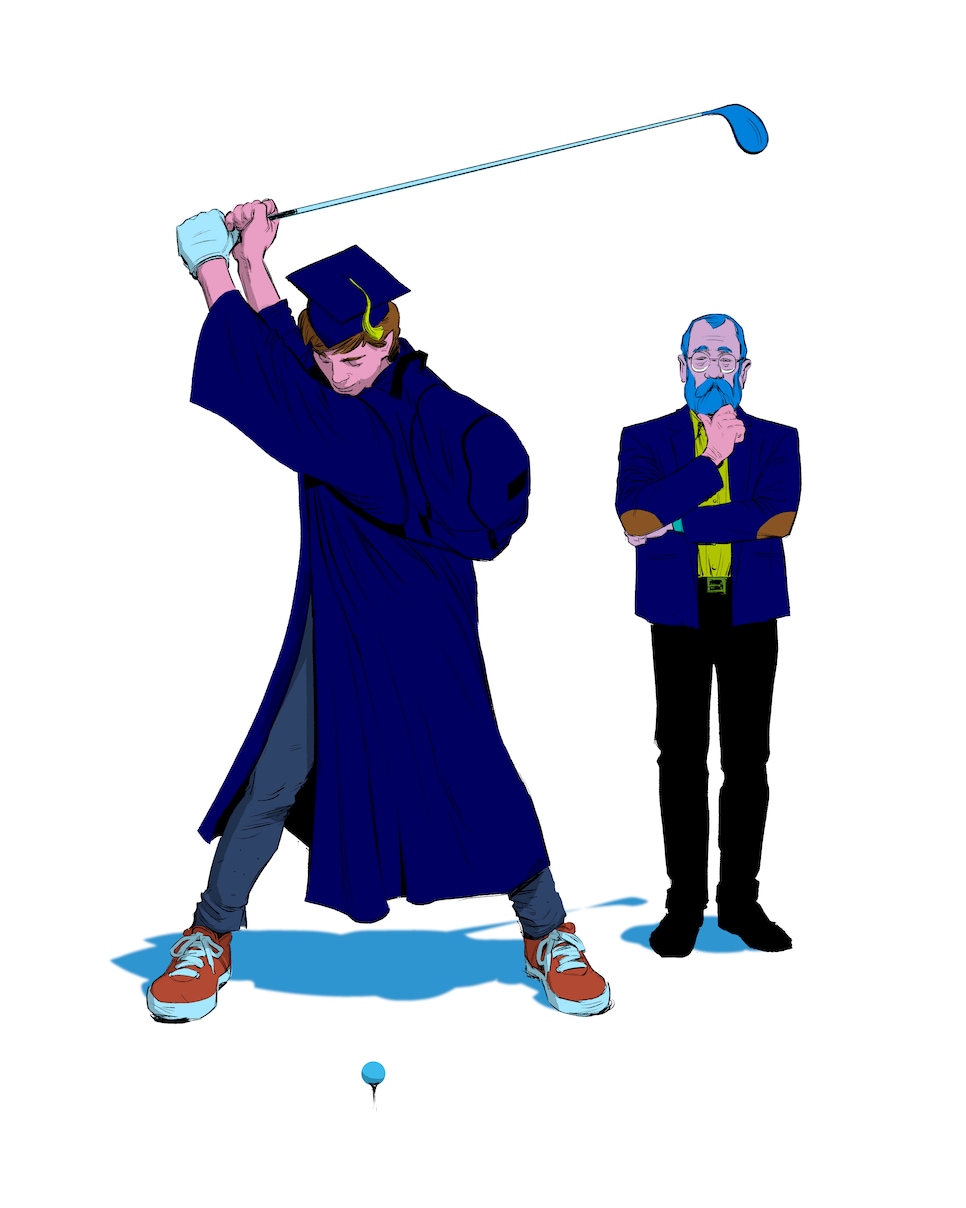
Frank Stockton
“Parents didn’t believe me that the term ‘student-athlete’ existed,” says Gatto, who runs American College Development Solutions and who regularly gains added perspective from his wife, Mimi Burke, the women’s head golf coach at Georgia Southern University.
Josh Jacobs has a different business model: showcase camps. Jacobs, who played golf at Emory University, is the founder of College Golf Experience (CGX). This company runs nearly 100 camps per year, primarily in the United States but also in Japan, Mexico and Canada. Jacobs says the ratio of players to coaches is never more than eight-to-one, and smaller at the Top 25 camps. CGX offers one-day camps for players looking to stay in state, as well as camps focused on Ivy League, NESCAC and top Division III programs. Some multi-day camps aim to put a golfer through the paces of what it’s like playing at an elite program. There’s even a camp for last-minute hopefuls to Division II and Division III schools.
“The coach really gets to know the player but also the family,” Jacobs says. “These types of camps are very prevalent in other sports for the recruiting process, but they weren’t in golf. When I told parents what I was doing, no one had a good grasp on the do’s and don’ts. There was a lack of education.”
The Kids
Unless you’re playing at the absolute top level, in the rarefied air of, say, Asterisk Talley, who just won the U.S. Women’s Amateur and is committed to Stanford, or Miles Russell, who made the cut at the U.S. Open and is headed to Florida State, it can be hard for a junior player to know where his or her game exactly stacks up. There are several ranking systems, like Junior Golf Scoreboard, The Universal Golf Ranking and the Rolex AJGA Rankings. Being the best in your state is relative as even small states produce outsize talent. Ben James, who grew up in central Connecticut, played at the University of Virginia and is now on the PGA Tour.
A central truth advisors stress to kids is that they don’t have to be among the absolute best to find a spot on a college golf team.
“Everyone can play college golf,” Burcin says. “Kids who shoot in the 80s can play college golf and get such a life-changing experience. Too often kids get into thinking they should play at those schools that they see playing football on Saturdays.”
This was briefly the case with Brown. Now going into his final year at DePauw, Brown plays in the No. 1 spot for his team. Last spring, he earned player-of-the-week honors in the North Coast Athletic Conference. His low competitive round is 65.
“My college golf career’s gone a lot better than high school did, for sure,” he says. “One of the big things Michael told me is, ‘You want to be traveling and with the team as much as you can. Don’t try to go to a Michigan State just because you might get on the roster. You want to go and play and have a great experience.’”
Jake Lopes, who also worked with Burcin, started his journey much earlier. Attending Gonzaga College High School, the prestigious all-boys school in Washington, D.C., he got into the Optimist International Junior Golf Championship when he was 13, the same summer he became a scratch player and got serious.
It can be hard for a junior player to know where his or her game exactly stacks up.
“My dad needed help scheduling. It felt like a second job to him. Mike helped a lot with that. After my freshman year he told me what to send to coaches and when to send it and what tournaments to play in.” That helped Lopes maximize his time and his family’s financial commitment.
Lopes’ priority was to stay in the mid-Atlantic region. As a plus-4 handicap, his choices varied from small private colleges to big state universities. Going into his junior year, he was focused on getting a scholarship.
“I played really well all that summer—I was shooting under par weekly,” he says. “After all my events, Mike was making sure I was sending the right things to coaches. He didn’t want me to send schedule updates. He told me the right things to say and what to ask, like how many roster spots they’re taking, what they do for qualifying, how they practice, what their workout schedule is, how they see me in their program.”
Emilee Ferguson, who is playing at DIII Sewanee in Tennessee this year, knew she wanted to play college golf when she was in seventh grade—well before she was competing. Her father is a golf course superintendent in Connecticut, and she fell in love with the game going with him to the Travelers Championship.
She took the leap and enrolled at the Golf Performance Center in Ridgefield, Conn., a golf boarding school 30 minutes from her home that also accepts day students. She worked on her strategy and mental game while playing only a local tournament schedule—mostly events run by the Connecticut State Golf Association and Metropolitan Golf Association.
She committed to Sewanee during Thanksgiving of her senior year and now enters as a 3-handicap. “When I stepped on campus at Sewanee, it was just so beautiful,” she says.
The Parents
What parents don’t think their son or daughter is the best golfer out there? It’s natural, but problems arise when the love and support for their child’s achievements reach pathological proportions. As such, advisors are often reigning in the parents who are paying them.
“There are plenty of parents who think Nick Saban is going to fly in on the helicopter and watch the second half of the game and come over for dinner,” Brazeau jokes. “Unless you’re a top, top prospect, that is not going to happen. You have to go find it, not just the schools but the coaches. You have to beat the door down.” All advisors agree on empowering kids to take the lead. “The kids are pretty smart,” Brazeau says. “They’re going to figure it out. It’s the parents you have to talk to. You’re not going to Yale with a 3.1 GPA, and you’re just decent at golf.”

Frank Stockton
Parents who don’t step back can be a hindrance to the process and even damage their child’s likelihood of getting recruited. “If you’re the most talented player in the world, but you have a dad or a mom who is impossible to deal with, coaches are going to pass,” says Spencer Graham, a golf coach and founder of the Junior Golf Performance Academy in Naples, Fla.
“I remember [Burcin] saying, ‘Make sure your parents don’t reach out,’” Brown says. “It was, ‘This is how you email them. This is how you keep the conversation going.’ It was everything you can think of, which was great.”
Parents who push kids too early are at best wasting time and money, and at worst putting undue pressure on young student-athletes. “A family who has a ninth or 10th grader fully committed to the process, playing a lot of tournaments, wanting to play college golf, that’s the right time to look for an advisor,” Brooks says. “I would bet that two-thirds of the work I do is counseling parents. I’m trying to help them understand reality.”
The Coaches
Even when a junior golfer qualifies for the biggest events, that’s not a guarantee of scholarship offers.
“Qualifying for the Amateur or the Open is more of a crap shoot—you could have just had a great day,” says Ryan Potter, the associate head coach for the women’s golf team at Wake Forest University. “If they then shoot 85-85, they’ve got a long way to go. If they shoot 72-74, then there’s something to work with.”
Potter says the Wake program isn’t often looking beyond the top 30 players in a class, so it doesn’t rely on advisors to fill out its rosters. Instead, he says, advisors can help recruits—and potential transfers through the portal—understand the role golf can play in admission. Read: Your scoring average is not going to carry you over the line at a school like Wake if you don’t have the grades to get in on your own.
“If there are three equally qualified candidates, maybe golf is the tiebreaker,” Brooks says. “It’s not like a team sport where the coach can get you in. Most golfers recruited at elite academic schools need to be close to getting in on their own.”
‘We try to identify the priority set—max out academics, playing time or scholarship money.’
—Richie Brazeau
Graham, the golf coach in Naples, pushes back on the need for advisors at all. “It’s really on the family and on the coach,” he says, noting he’s helped 150 players get recruited to DI programs. “That’s enough of a team. These families are paying so much already. I get frustrated when someone says we hired this service to get our kid noticed.”
Many advisors don’t disagree but point to a different goal. “The swing coach just wants to make the player better,” Brazeau says. “They don’t want to tell them you can’t do this. Our job is to say, ‘Here are 30 to 40 schools. This is where you can play. This is where you fit.’”
The advisors see golf as part of a bigger package, not the sole goal that a swing coach might consider it to be. “We try to identify the priority set—max out academics or max out playing time or max out scholarship money,” Brazeau says. “The most scholarship money may not be the best golf school you could play at, but you’ll get the money, and you’ll play on the team.”
The Portal
Depending on your point of view, the transfer portal is ruining college golf recruiting or making it more efficient. It has certainly changed how college coaches look at high school players. Unless a golfer has played an elite national schedule and qualified for USGA championships, questions will linger about how that player will adapt to college golf.
This situation is where advisors can manage expectations and craft a strategy if players don’t get into their top choice out of high school. “Most kids thinking they’re going to go to an SEC school have another thing coming,” Gatto says. “Those coaches are often recruiting from other DI schools. If I’m an SEC coach, why would I ever recruit a junior golfer unless he’s some amazing golfer who makes the round of eight at the U.S. Junior Amateur?”
Gatto cites the successful example of Miles Eubanks, who walked on at the College of Charleston, played well and transferred this summer to the University of Alabama.
One way the portal is problematic is when players enter thinking they’re going to reap name, image and likeness money. One coach at a top school who asked not to be named says the golf program gets inundated with portal kids thinking they’re going to get $100,000 from the school. “There are maybe half a dozen college golfers worth that,” this coach says. “The portal has inflated most players’ sense of value.”
Solo Sport
However students get to college golf, the core principles haven’t changed.
“If you’d asked me 35 years ago what’s important in recruiting, I would have said, ‘Make great grades and shoot low scores in tournaments,’” Brooks says. “Today, I’d also say, ‘Make great grades and shoot low scores in tournaments.’ It’s just that the number of people playing has increased drastically. The number of coaches recruiting has increased drastically. It’s a far more competitive space, but it’s the same basic formula that leads to success.”
Should aspiring college golfers still consider going it alone?
“All the time, I tell people you don’t need to hire a college golf advisor to get recruited for college golf,” Brooks says. “It’s just that the number of decisions you need to make in a year—tournaments, coaches, classes, SAT prep, colleges to target, etc.—consume the dinner table. That’s what I try to help people navigate. But hiring me doesn’t change you as a golfer or a student.”
This article was originally published on golfdigest.com