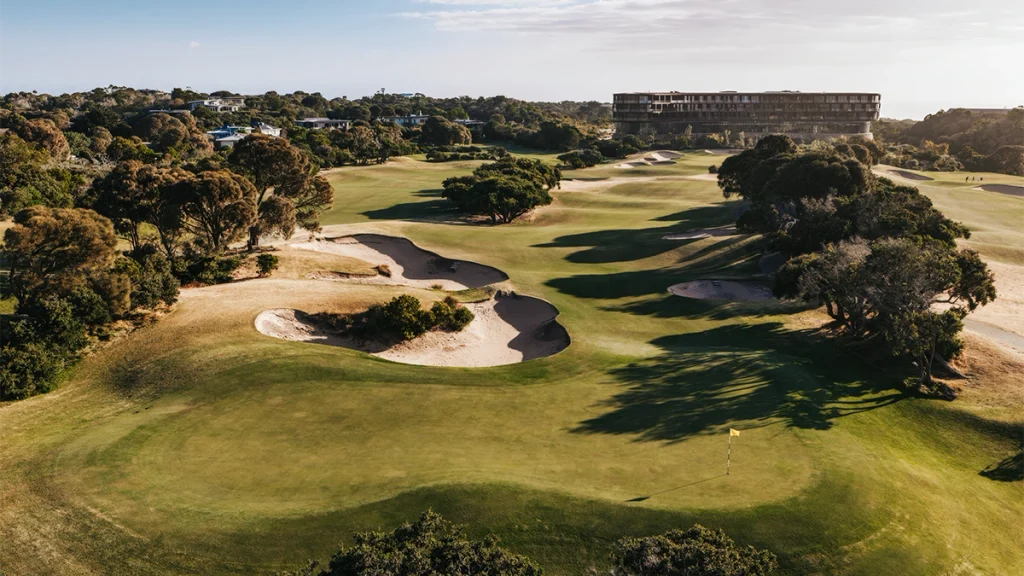
As the 2026 PGA Championship plays out at Aronomink, we’ll be watching the best players in the world take on a classic Donald Ross design. Like many Ross courses, Aronomink features crowned—also known as turtleback—greens. These greens, whose highest points are in the center, can be difficult to navigate. Because of the design, the ball runs away from the center of the green, towards the perimeter. This can make chipping it close difficult. If you find yourself on a Ross course, here are a few things you can do to successfully handle those tricky greens.
“Turtleback greens place a premium on distance control,” Sara Dickson, a Golf Digest Best Young Teacher out of Wilderness C.C. in Florida, says. “Because the edges of these greens tend to slope away, a chip that comes up just short may roll back toward you, while one that carries too far may run off the other side. Around these greens, success is often less about hitting a perfect-looking shot and more about controlling how far the ball travels.”
Dickson recommends what she calls “The Goldilocks Drill” to train distance control.
“Start by hitting one chip intentionally too far. Then hit one intentionally too short. Finally, hit one that feels just right. By experiencing both extremes, your brain begins to calibrate the difference between too much, too little, and the motion needed for the correct distance,” Dickson says. “Once your body has felt both ends of the spectrum, the ‘just right’ motion becomes easier to trust.”
Chipping onto a turtleback green is a nerve-racking proposition. But if you go into it having practiced your distance control, you’ll feel more confident as you stand over the ball.
“Around turtleback greens, confidence comes from calibration,” Dickson says. “When you understand what too far and too short feel like, you give yourself a much better chance to produce the distance control needed to keep the ball on the green and near the hole.”
This article was originally published on golfdigest.com