
To be a good iron player, here’s what you need to control: where the club hits the ground and how the clubface rotates. With those two variables in check, you’ll be sticking your approach shots next to the pin!
SET UP A BALL-FIRST STRIKE
Ball position is the most obvious predictor of solid contact, which in iron play means striking the ball first, then the ground. The common mistake is playing the ball too far forward. That twists the shoulders to the left and promotes an out-to-in swing. I will say, a little out to in can be good for iron shots because it moves the low point of the swing forward, which in theory helps you hit the ball before the ground. However, most golfers who play the ball way up don’t get that low point forward enough to catch the ball first. I teach ball position relative to the upper body. For the irons, I like it between the shirt buttons and the logo on the left side of the shirt with the shoulders square, not twisted left. From there, when the body drives toward the target on the downswing, impact should be ball then turf.
TURN YOUR HANDS BACK
The grip has a huge effect on the other major impact factor – clubface rotation. When the hands are turned toward the target, the face tends to open more on the backswing – and has to close more on the downswing. When the hands are turned back a touch, face rotation is more stable. You want to see at least two knuckles on your left hand when you look down at address, with the crease between your right thumb and forefinger pointing toward your right shoulder.
STAY OFF YOUR TOES
Where your weight is at address also affects clubface rotation. Many golfers get out on their toes, probably because it feels like an athletic position. The problem is that being on your toes makes it hard to turn your body during the swing. With your body off-balance, your arms take over, pulling the club to the inside and rotating the face open.
The feeling you want is that your weight is balanced in the middle of each foot in the arches. That allows your body and arms to move in sync, with your weight shifting to your right heel as you swing back. The result is less independent arm action and more predictable contact.
ROTATE FROM THE START
The purpose of the backswing is to set up the downswing. My advice: Don’t mess up the face. If you spin it open, you have to undo that move by impact. The problem usually comes from the hands and arms starting the club back with the body stuck at address. When the club gets parallel to the ground, if the toe points straight up or behind you, the face is open.
The answer is to start turning the upper body right away. If you do, your body turn, not your hands and arms, will control the face – and it won’t rotate as much. When you move your body better, the face will point down to the ball throughout the takeaway.
LEAD WITH YOUR CHEST
The closer you get to impact, the harder it is to fix any mistakes you might have made along the way. That’s why I focus on the first move from the top when talking about the downswing. I want to see the chest starting the forward motion before the arms move. Many amateurs do the opposite, leading with the arms, which prevents the low point of the swing from getting in front of the ball and creates inconsistent face rotation – double trouble. What does it look like? The body hangs back, and the arms flip the club through.
To get your upper body turning sooner, feel like your sternum is pointing in front of the ball as you swing down and through. Yes, the lower body should lead the downswing, but rotating the chest is what most golfers need. That moves the low point forward and stabilizes the face.
BONUS: PICTURE THIS 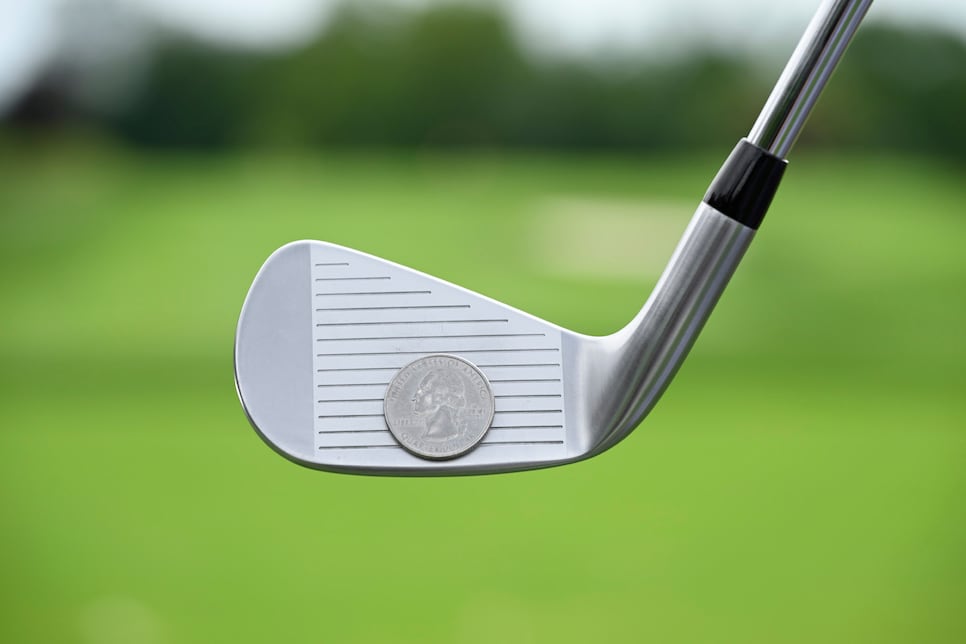
[Photo: J.D. Cuban]
Here are two great images for solid iron play – one to limit face rotation going back and one to get your low point forward coming down. First, imagine there’s a quarter on the clubface. Keep that quarter staring at the ball until the club gets to about hip high. Second, pretend you have a headlight pointing out from your chest. As you swing into impact, try to shine the light down your target line. With the face in check and your chest turning forward, you’ll flush your iron shots.