An enduring bond exists between the members of Royal Lytham & St Annes Golf Club, past and present, and the Georgian golfer Robert Tyre Jones, Jr., because it was at St Annes, that:
• He won his first Open Championship in 1926, thereby taking his place on the world stage of golf for the first time.
• He achieved his victory by playing one of the most famous single shots in history.
• He transformed his playing career on the international stage from one of failure to one of success.
• He identified the location from which he had played his ‘immortal shot’ and a plaque, the first to be placed on a golf course anywhere in the world to mark a single shot, was embedded.
When the legendary amateur won his first British Open title at Royal Lytham & St Annes, Jones started a run unique in championship golf. Including this win, he entered 14 championships and won 10, finishing second in two of the other four.
It was after he won in 1926 that the germ of the idea of winning all four majors in the one year first came to him. He confided his thoughts only with his great friend, American sportswriter Al Laney, swearing him to secrecy. Jones did not share his dream with his wife Mary or his fellow traveler and scribe O.B. Keeler. He knew that the only opportunity would arise in 1930.
If he had not won in 1926, the Grand Slam might well never have happened.
Jones sensed that predestination played a part in the outcome of championships, that the identity of the winner was somehow determined before the event started. He also sensed that there was a destiny waiting for him. It remained to be seen whether he would be able to fulfill it. While predestination might have decided in advance that he was going to win the Open in 1926, other developments and happenings cropped up in the weeks and days preceding the event, any one of which could have meant he did not.
The general strike 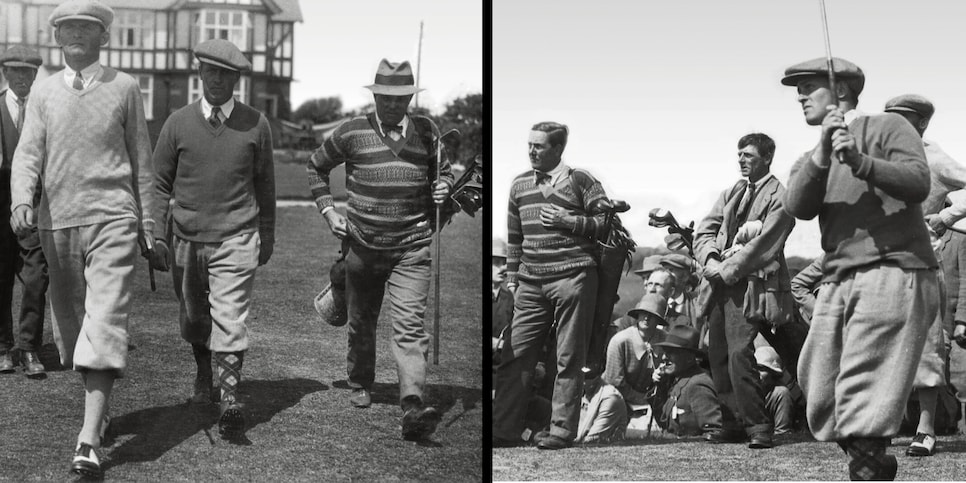
AMERICANS ON TOP Detroit’s Al Watrous (above left) started the final round two strokes ahead of Atlanta’s Bobby Jones, who had withdrawn in his only other Open appearance in 1921.
As he crossed the Atlantic with other members of the U.S. Walker Cup team on board the S.S. Aquitania, frantic telegraph messages flew in both directions trying to establish what lay ahead. Great Britain was faced with a general strike, and there were serious doubts about the feasibility of holding the Amateur Championship at Muirfield, the Walker Cup at St Andrews and the Open at Royal Lytham & St Annes.
The trigger to the general strike was coal-mine owners demanding reduced pay and increased hours for miners. Workers within and beyond the coal miners and the Trades Union Congress called for a general strike to support the miners. A nationwide stoppage started on May 3. The army and volunteers were called to respond, and for several days there was an impasse.
On board the ship, there was uncertainty. USGA President William C. Fownes Jr. sent a cable to the R&A, suggesting, in the verbose language of the times, that “the R&A were not to feel any embarrassment in the event it was deemed inexpedient to carry out any part of the golf program.” The reply from the R&A was that they “shall try to carry out all of the program.” By May 9, it was known that no boat or train would be available and instead motor cars or motor coaches would be arranged to take the team to London.
O.B. Keeler was intrigued to learn that “almost immediately after putting down a riot of rowdies with their batons, London police donned football apparel and played football with a team of strikers.” He commented, “A strike must be especially interesting in a nation where they do things like that.”
When the Aquitania paused at Cherbourg on May 11, the impression was that golfing events might still take place, although the charity match between Jones, Francis Ouimet, Abe Mitchell and George Duncan, scheduled for May 13, had already been postponed. By May 12, the strike had collapsed, and it was clear that both the Walker Cup and the Open would take place. After disembarking, the American players boarded cars, pushing their way over roads which recalled war-time conditions, with lorries of food trucks being accompanied by tin-hatted soldiers and motorcycle dispatch riders.
At this stage, the Amateur was in question, and if it were cancelled, thought was being given to moving the Walker Cup from June 2-3 to May 24-25 to not keep the American players longer than necessary. Both events took place.
During the crossing, Jones changed his plans. His first intention was to stay over to play in the Open with his Atlantan friend Watts Gunn. However, he was faced with a three-week gap between the Walker Cup and the Open, and he saw little realistic prospect of winning it. No amateur had done so since 1897. Jones had a wife and young child at home, so by the time he landed, he decided he was now going to return home with the bulk of the Walker Cup team.
In the sixth round of the Amateur at Muirfield, he was comprehensively beaten by a young Scot, Andrew Jamieson, who cycled to the course each day. When this was added to his abject performances during his earlier appearances in Great Britain in both the Amateur and the Open in 1921, he could see that the British public might have formed a poor view of his ability. He decided to stay over and play in the Open, still with no expectation of winning, but more to show the British public that he could “play a little.”
If he had not been knocked out by Jamieson but instead put in a strong performance at the Amateur, he would have been back home by the time the Open started. He would never had teed up in the championship, let alone won it.
Finding “Jeanie Deans” 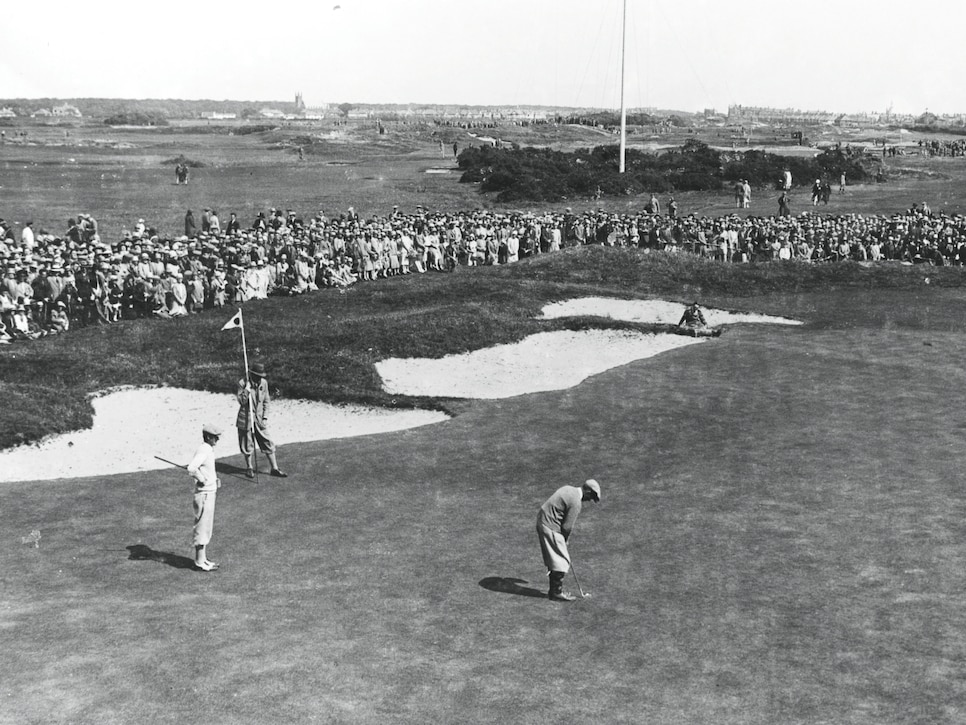
ALTERNATE UNIVERSE Had Jones skipped the 1926 Open to go home with the Walker Cup team, as planned, would he have won the Grand Slam in 1930?
Jones submitted his entry for the Open, and in the intervening weeks, his game improved. He was allocated Sunningdale as the location of his qualifying round, and there came two important developments. The first was that he found a driver made by Sunningdale professional Jack White. This club so suited his game that he used it to win all the 10 major championships that followed. He called this driver “Jeanie Deans.”
The second was that in the first qualifying round he played what many still consider the most nearly perfect round played by anyone anywhere ever, but this triggered apprehension for both him and Keeler. Both were concerned he had peaked too soon. When he started playing in the Open, his worries were found to be justified. After three rounds he was two strokes behind the young American professional Al Watrous. By coincidence, Jones and Watrous had been paired together for the last two rounds, played on the last day.
MORE: The last days of Bobby Jones
The immortal shot 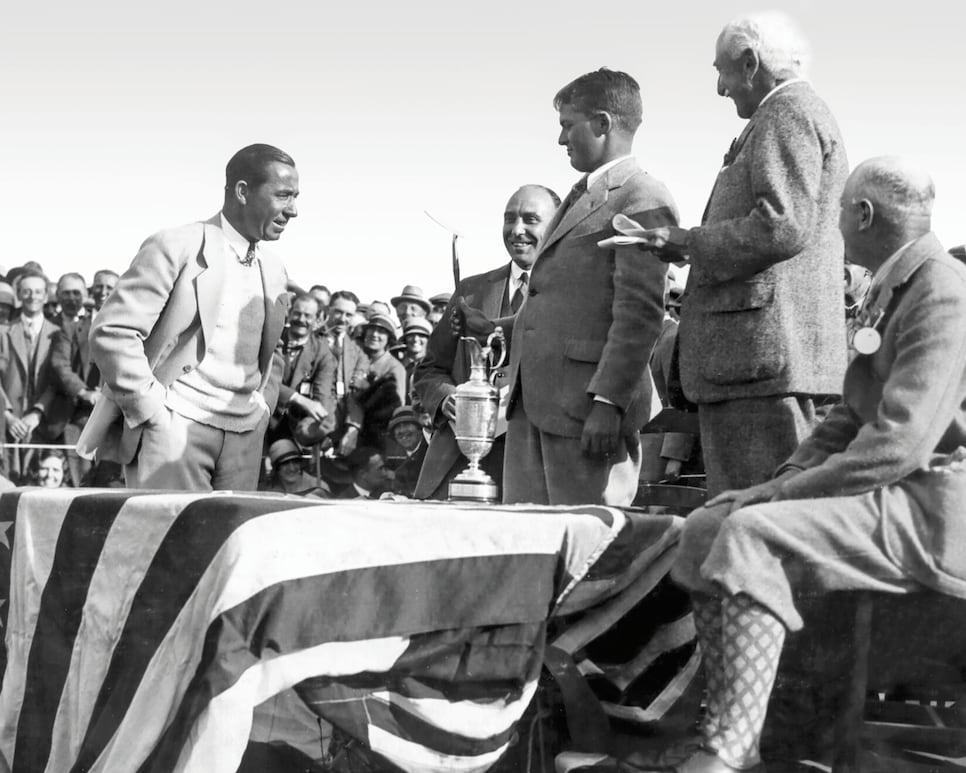
MASTERS OF CEREMONY Before Jones receives the claret jug, Walter Hagen tries to fetch a laugh by presenting him a comically oversized niblick.
The fourth round effectively became match play between Jones and Watrous. Still playing at a subdued level, Jones drew level with Watrous after five holes, but by the turn he was two behind once more. He pulled one back, but after 13 trailed again by two. Had he come all this way and stayed over for three more weeks just to finish second?
Watrous, who up to that point had seemed imperturbable, suddenly wobbled, three-putting 14 and 15. The two players, nearing exhaustion from the strain, were level once more. Before Jones played his second shot at the 17th hole, he knew Watrous had put his ball on the front part of the green.
Jones had pulled his tee shot into a sandy waste area. A perfect shot might leave him near or on the green, but the odds were stacked heavily against it. More likely outcomes were ending up in another bunker, heavy rough or even a lost ball. A 5 or worse loomed. A relieved Watrous would get his 4, and the entire trip would be another failure on the international stage. Writing in 1927, Jones summed up his prospects. “This, off dry sand, though the ball luckily lay clean, was a stiff assignment. You know, an eighth of an inch too deep, and the shot expires right in front of your eyes. And if your blade is a thought too high—I will dismiss this harrowing reflection.”
Of all the contemporaneous eyewitness accounts, the best is that by Laney in Follow the Leaders:
Jones walked straight across the fairway from left to right and stood there looking first at the green, then at the spot where he had put his tee shot. I wondered what he was thinking, looking first one way, then back, and I have wondered a thousand times since what it is that tournament players think about when they stand there putting off the moment for taking action. Not that Jones dawdled. Far from it. He always decided quickly, then went to work.
Now he looked, came back with his mind already made up, and what I remember more acutely than the shot itself was how drawn and almost ill Bob’s face appeared as he stepped into the sand and settled his feet. Then he struck the ball with a mashie-iron, about a No. 4 by later gradings. A big shout down the fairway told us that the ball had safely reached the green. When Watrous eventually took three putts, Jones moved a stroke ahead. What made it one of the finest shots ever brought off in championship play? With the target out of sight, the stroke also had to be judged exactly so that the ball would become airborne instantly, carry 175 yards or more, and stop quickly after reaching the green. It was only after I heard the shot discussed that I came to have some understanding of its difficulty and the boldness, technical mastery and even artistry involved in bringing it off.
This single stroke won him the championship against all odds. Had he not executed it as he did, he would have returned on the Aquitania empty handed once more. It was a case of predestination at its best. Eighteen year later, in 1944, Jones played his last shots in the British Isles at St Annes, as he played with members and with the U.S. military before returning home.
Perhaps the last word should be with the most successful golfer of all time, Jack Nicklaus, who wrote in his foreword:
That brilliant come-from-behind win for the gentleman from Georgia was celebrated with a ticker-tape parade in New York City. It also launched a remarkable run for Mr. Jones that ended with a record 13 major championship titles—a golf standard that became an important measuring stick in my career. I never had the fortunate pleasure to celebrate a victory over the subtle nuances and intellectual challenge of Royal Lytham, although I came frustratingly close in 1963 when I missed a playoff with Phil Rodgers and eventual champion Bob Charles by a shot. But that Open became a valuable learning experience that paid off a week later in Dallas, Texas, with my first PGA Championship title. But for so many reasons, Mr. Jones’ triumph at Royal Lytham, underlined with all its historical significance, was a truly important chapter in the life of arguably golf’s greatest amateur and one of the most influential figures in the history of this great game.
Adapted with permission from the new anthology Bobby Jones and the Royal Lytham & St Annes Golf Club compiled by Steven Reid ([email protected]).
This article was originally published on golfdigest.com