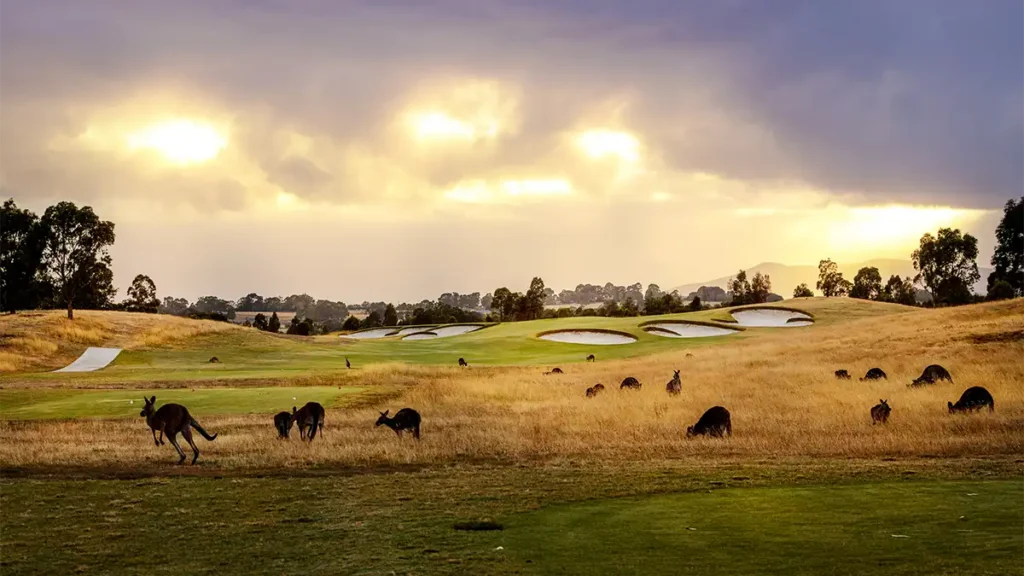
Having your own private backyard course is every golfer’s dream, but when you have spare hectares to play with, that dream moves up a notch.
Every golfer has dreamt about building a golf haven of their own. Perhaps the desire is as elementary as a backyard green complex to sharpen short games or even just a basic putting area. The greater the space to play with, the greater the possibilities. If you’re fortunate enough to have a rural property, the opportunity to build a full-length golf course turns from possibility into reality.
Such was the scenario for Sydneysider Steve Duchen. In 2020, he and his wife Polly bought “Oakgate”, a 42-hectare property near Freemans Waterhole in the Lake Macquarie region of New South Wales. Their house sits on a high corner of the property, overlooking an open, spacious expanse surrounded by state and national forests on three sides.
However, “I was uninspired looking at cattle,” Duchen laughs. So he built his own golf course.
Utilising two distinct sections of the property to create complementary yet quite different settings, Duchen’s largely self-designed nine holes amble across mildly undulating land in a layout that’s ripe for flexibility. With a par of 36 and length surpassing 3,100 metres, it has evolved into a true and fun test of golf, even for the professionals who have played it.
Constructing the first five holes fell to veteran shaper Lindsay Richter, who was contracted to Atlas Constructions at the time. Meanwhile, the grow-in and initial maintenance was the full-time task of long-time course superintendent David Warwick, who is best known in the industry for the 24 years he spent as the ‘super’ at Sydney’s Avondale Golf Club. Warwick used his role at Oakgate as a pre-retirement project before handing over the maintenance duties earlier this year to Martyna Synak, who also worked on the construction and grow-in of the final four holes, which were built by respected shaper, Craig Brown.
The nine holes occupy two distinct sections of the property, separated by a creek and environmental zone. The main part contains the opening two and closing three holes with fairways flowing across open ground that is bordered by trees yet remains uncluttered. Holes three to six venture into a more enclosed pocket of Oakgate where the playing corridors are defined by healthy stands of gums.
One beauty of owning a golf course is the authority to determine the layout each day. The area of the course housing holes one and two plus the seventh to ninth is open enough to allow for ‘cross-country golf’ where play can be to a different green or even in reverse. Plus, there are holes with numerous tees, such as the downhill, par-3 second where the angled green can be approached from any one of three spread-out tees. At the par-5 eighth, an alternate teeing ground changes the angle by as much as 40 degrees and brings water into play.
AN IDEA GROWS
“I thought, This is beautiful land,” Duchen says of the genesis of his course. “So I started on my own, just mowing the natural kikuyu pastures. But it quickly became extremely overwhelming, just mowing it with a 72-inch, zero-turn mower. The grass would literally grow faster than I could mow it.”
Duchen’s plan evolved quickly when he was introduced to Warwick, as well as Sydney-based course architect Harley Kruse, who provided some initial layout ideas. In reality, the course is laid out in about the only logical way nine holes could flow, given the size and shape of the land. The real genius is in the green complexes and the built-in flexibility.
“When we decided to stage it and implement the first stage, I had in the back of my mind that we’d never get to ‘Stage 2’ because of the additional construction costs and maintenance required with limited staff,” says Duchen, who has a background in finance and property development. “I thought I would be happy just having five greens. At that stage, I started looking at different various routings where we actually had 18 different holes from those five greens. So effectively we came up with three different six-hole routings, basically. There was a little ‘joiner’ hole in there somewhere, but we could have 18 different holes using five greens and eight tees – and playing the course different ways.

“And that’s where it sat for almost two years after completion by Atlas. It was only a subsequent decision that Dave and I made that it would be a great thing to have a nine-hole course rather than a five-hole course. I always thought nine holes was much more acceptable if ever we were going to market it, rather than saying, ‘There’s five holes and you play them all over the place.’
“But the cross-routing concept was definitely part of it on the assumption that there was never going to be very many people there and you could play wherever you wanted to play. And we still do it today – even when we play the championship nine now, we play another different nine which involves going different ways to create a strong, par-72, 18-hole layout using the alternatives we have.”
Oakgate is richer for the expansion. While the initial holes are a clever and intriguing use of the open portion of the property, ‘Stage 2’ meanders into a series of secluded pockets that highlights the diversity within the 42 hectares. Yet with the growth came an increased cost. Duchen figures his total outlay was just shy of $4.5 million, although there are several years of maintenance costs and significant equipment purchases factored into that sum. He got his hands dirty throughout, laying and connecting irrigation with the construction team and now continues in a more-than-part-time maintenance role (as “apprentice”) alongside Synak.
There’s strong definition between the kikuyu fairways and Santa Ana couch surrounds to the greens, while Warwick was adamant TifEagle was the right strain for the putting surfaces themselves – based on climate and maintenance. Bentgrass greens, while ideal, would be impossible to maintain with a staff of one. Six bunkers dot the open portion of the layout, including a “Church Pews”-style bunker that’s in play from both the first and ninth tees.
All in all, it’s an efficient yet architecturally clever use of the land.
“The strict criteria of its evolution was that we weren’t changing any of the landform,” Duchen says. “We were going to play with exactly what was here and, apart from greens construction – which involved a lot of work – there was no earthmoving whatsoever on the rest of the course.”
YOURS TO PLAY
For those familiar with the busy M1 motorway that links Sydney and Newcastle, the course is just a couple of turns west of the exit towards Cessnock and the Lower Hunter Valley, about an hour’s drive from Sydney. It’s a wonderfully private sanctuary, yet the faint hum of the M1 is just audible if you listen carefully enough.
Oakgate is more than just a golf course, too. There’s on-site accommodation and even a communal clubhouse, all of which are separated from the Duchens’ house by several hundred metres. The idea is for groups to rent the course and accommodation either for weekends away, business retreats or family getaways. As many as 16 people can fill the cabins and glamping tents, while group bookings include access to the ‘clubhouse’, with its kitchen, function room, swimming pool, deck overlooking the course and pickleball court. Golf carts are available as well.
Email [email protected] for full details.
Photographs by brett robinson/Australian Sports Turf Managers Association