On a fall afternoon in Anaheim, Calif., students in one classroom quietly study samples with microscopes. In another space, kids chatter noisily and the floor is littered with cardboard as they assemble medical walking boots they meticulously engineered from their own feet.
In a darker and near-empty room at the TGR Learning Lab, where there is a small podcast studio in the corner and numerous stations for computer design work, 16-year-old high school senior Brandyn West smiles brightly while thinking about her past five years in the program. She had childhood dreams of becoming an ophthalmologist because she underwent eye surgery as a young child. But at the TGR Lab, West discovered a passion for sound engineering. She now produces podcasts at the Lab, volunteers to do sound for her church choir and aspires to attend film school at USC.
“I probably wouldn’t have found what I wanted to do for a career without [the Lab],” West says.
The foundation that helped West discover her calling began with a much more modest mission.
On a Wednesday in January 1997—three months before Tiger Woods truly announced himself to the world with a historic victory in the Masters—a 59-word blurb was buried in the sports section of the Los Angeles Times:
Tiger Woods, golf’s youngest million-dollar man, and his father, Earl, have started the Tiger Woods Foundation to promote minority participation in golf and related activities. The announcement was made at a junior golf clinic in Scottsdale, Ariz., site of this week’s Phoenix Open. The foundation’s activities will include other junior golf clinics, with six tentatively scheduled for this season.
The word got out slowly. The foundation officially was formed the previous November, Earl Woods serving as president and chairman and his son, coming off the first two PGA Tour victories of his career that fall, being the flashpoint for anything they hoped to accomplish. They laughed at the time about having formed a traveling circus, with Earl making the arrangements for clinics and Tiger showing up at his appointed time to draw ooohs and ahhhs as he lashed at golf balls in a way nobody had seen.
“The time spent with my dad on the road during those early years of my career was so special,” Woods told Golf Digest recently, answering questions through email. “It was then that I began to understand what it meant to lead the foundation and the responsibility that came with it.
“One of the most important lessons my dad taught me was that you get out what you put in.”

Earl and Tiger Woods, along with students, turn over the first section of dirt at groundbreaking for the Tiger Woods Learning Lab.
J.D. Cuban
Hitting balls and speaking to kids about pursuing their dreams was a worthwhile endeavor. Seen through another lens: What other 20-year-old athlete in America had the renown or interest to form his own foundation?
Yet that beginning seems quaint now, considering what the TGR Foundation has grown into over three decades. Nobody can quite believe it, but the man with his name on the foundation will soon be 51 years old, and Earl Woods has been gone for 20 years. Tiger’s “Pops” lived just long enough to attend the 2006 opening of the foundation’s 35,000-square-foot TGR Learning Lab in Anaheim. He could not possibly have fathomed what it would become—a bustling and thriving STEAM-focused educational resource for underserved kids and teachers that features a robust after-school curriculum including robotics, forensic science, drone certification and comparative invertebrate zoology.
“The growth,” Woods said, “has been something to watch.”
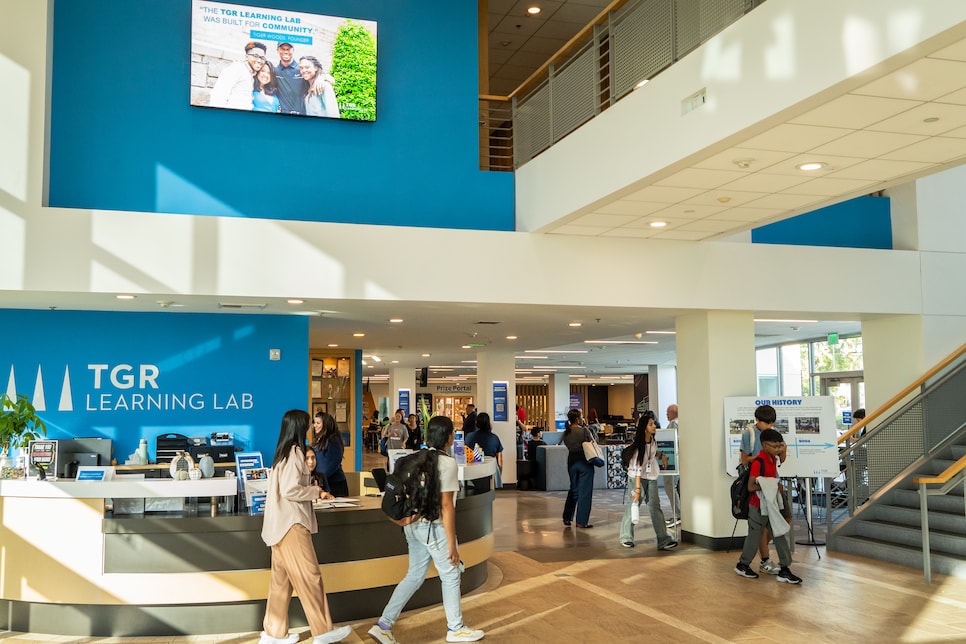
Students arrive at the TGR Learning Lab in Anaheim.
Justin L. Stewart
Oh, and there is golf at the Lab, with weekly clinics and even a class called “Golfology.” The facility features a full driving range that also can be played as a par-3 course, and there are PGA of America instructors on hand most days to help those who want to hone their skills.
But the game is more of a pastime for most who come to the Lab, and, truth be told, some students may touch a club once and never do so again. Woods has always insisted that creating competitive golfers in his light was never the point. He has said his vision came more into focus on the somber drive home from the cancelled PGA Tour event in St. Louis in the aftermath of the 9/11 attacks in 2001.
“I realized that the foundation could have a larger impact on the world and decided that our work should be modeled after the way I was raised,” Woods said. “We needed to create a safe place, centered on education, where kids were given the space to learn, grow and dream. A place they could call their own.”
In Anaheim, the need for such a place is close at hand.
At its street address of 1 Tiger Woods Way, the TGR Learning Lab is four miles from the gates of Disneyland and five miles from where Woods grew up in Cypress. The millions of tourists who flock annually to Orange County rarely venture outside of a few commercialized blocks around the Disney parks, and visitors likely never give a thought to Anaheim as a mostly average city of 346,000 that is like any other suburb in a massive metropolitan area; it deals with homelessness, poverty, crime and the fractured family dynamics that can make vulnerable children feel left out or lost.
Gyla Bell, the Anaheim Lab’s senior executive director who has been with the organization for 21 years, grew up in the area and attended school during a somewhat simpler time. Today, she noted, the Lab’s neighborhood sits right in the middle of two rival gangs—six square miles on each side. Seventy-eight percent of the population is Latino, Bell said, followed by Vietnamese and Koreans. An astounding 12 languages are spoken in the Anaheim Union School District. Eighty-two percent of households are eligible for free or reduced-priced meals at school. Many families live in overcrowded housing, sometimes three to an apartment, and caregivers work multiple jobs. The Lab sometimes loses young people who work to support their families.
In that world, the Learning Lab offers the Woods family mantra Tiger heard from the time he was little: “Caring and sharing.” The kids have a place of structure, safety, snacks, supportive adults and a concentrated array of learning opportunities they simply wouldn’t find anywhere else.
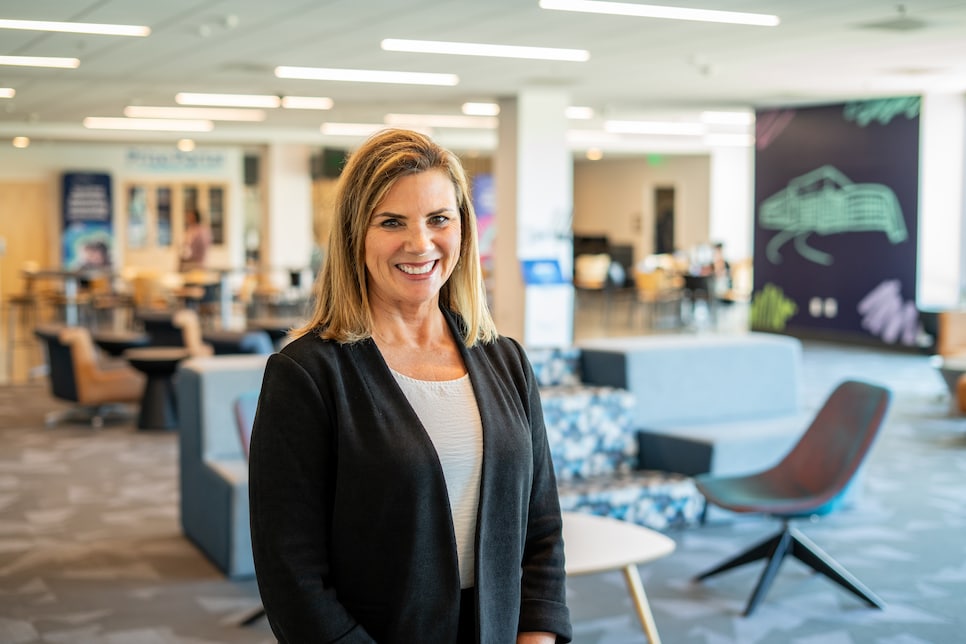
Gyla Bell, the senior executive director, grew up in Anaheim and taught in the school district before joining the TGR Learning Lab more than 20 years ago.
Justin L. Stewart
The exposure to the Lab begins with fifth-grade field trips that account for up to 8,000 student visits a year. The kids get a full tour of the seven classrooms, work areas and study spaces, then usually hit the driving range, with most visitors picking up a golf club for the very first time. The hope is that from this experience they see something that sparks an interest, and from there they can sign up for classes—all of them free. For anyone enrolled, the transportation after school is provided by district busing funded by the Lab.
Once the Lab has kids hooked, there are several dozen courses to choose from in each six-week session, most of them focused on the sciences, math or art, though there are also areas such as carpentry to learn about in the trade fields. With the Lab’s belief that experiential learning can unlock interest in ways traditional teaching can’t, a large portion of the instruction is achieved through hands-on experience and some lecturing and, much to the kids’ delight, no homework.
For West, discovering an interest in sound engineering was only the beginning.
Like other high school students, she has access to a bevy of resources for college, including individual consulting from Lab specialists and workshops on financial aid, SAT prep, admissions and pathways to a career.

Brandyn West is a high school senior who has found a passion for sound engineering.
Justin L. Stewart
Beyond her own life, West has watched as other students have gone from being unsure of themselves and what they wanted to blossoming when they find an area they enjoy. “After one course, their grades are better. They’re talking to people. They’ve made friends with the staff. It’s like they’re a different person,” West said.
Daniel Biviano Rayo knows exactly what West is talking about. He grew up in Buena Park, in the shadow of Knott’s Berry Farm, and was a high school freshman when he and his older brother rode their bikes to the Lab for a robotics class. They were disheartened when they built a “tortoise” robot they deemed too slow but shocked themselves by winning a race. “So it was ‘just have faith, have that belief,’” Rayo said. “Trust that your work is going to pay off.”
It did for Rayo, who earned his bachelor’s and master’s degrees and in a heartening full-circle story, returned to the Anaheim Lab as an instructor, teaching biology, psychology and robotics while leading a burgeoning running club. (There’s a wink in that, since Tiger Woods ran on his school cross country teams.)
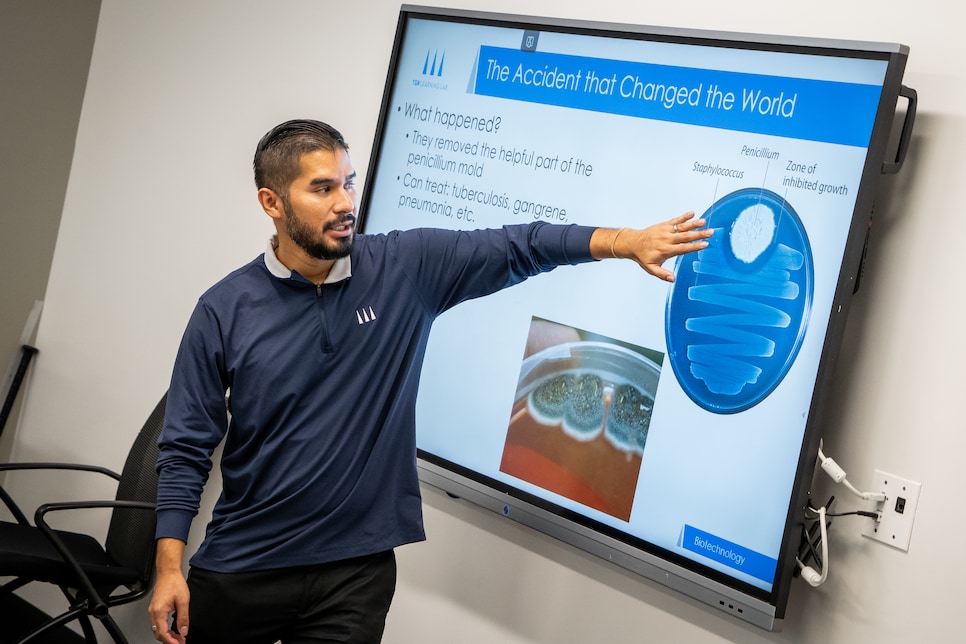
Daniel Biviano Rayo, an alum of TGR Anaheim, returned to the Lab as a teacher.
Justin L. Stewart
One of Rayo’s favorite sayings that he emphasizes to his students is simple but profound: “A candle loses nothing lighting another candle.” To encourage his runners to face their fears, he tells them a parable about a buffalo charging into a storm instead of running away. Much to Rayo’s delight, a natural leader on his running squad, Emmanuel Bernal, is now motivating his teammates before races with, “We’re buffaloes! We run through the storm!”
The TGR Foundation is now trying to mirror Rayo’s career realization for students far beyond Anaheim.
At its 30-year mark, the organization finds itself in its most aggressive and ambitious growth period. The Anaheim facility reports to have served more than 220,000 students. A second, 30-square-foot facility in West Philadelphia at Cobbs Creek Golf Course, which opened 19 months ago, has already gotten 12,000 students involved. Still in the development and building stages are Labs in Los Angeles, Atlanta and Augusta. The L.A. Lab, adjacent to the runways at LAX, is part of a 34-acre non-profit project, set to open in 2027, called Lulu’s Place. It’ll be a youth campus that offers educational, athletic and wellness programs. Tennis will be a key draw there, with the USTA Foundation building its own facility and courts.
The foundation has built a sizable financial reserve to fund its projects, with a reported $155 million in net assets on its most recent 501c3 tax return—much of that held in investment accounts. The year-to-year funding comes from a variety of sources; Woods is among the largest benefactors, with money raised through his hosting of the PGA Tour’s Genesis Invitational and Hero World Challenge, TGR Live-managed charity tournaments, and the Tiger Jam concert weekends in Las Vegas that began in 1998. The latter two have combined to raise more than $48 million, according to the foundation.
Other sources come with the specific projects. The Los Angeles Chargers gave $2.4 million to TGR to help pay for its new L.A. home, while Atlanta Falcons owner Arthur Blank’s foundation contributed $20 million to fund the new Atlanta TGR facility. Nick Gross, the founder of the Find Your Grind, a platform that focuses on future-readiness for kids, contributed $4 million to support multimedia space development at TGR.
“They see the North Star of what we’re aiming at in terms of really trying to make a dent in this world of education,” said Hrag Hamalian, the foundation’s CEO since March. “We already have impact. We already have stats on how we’ve served and how we’re positioning ourselves as we move forward.”
Hamalian has an inspiring backstory of his own. Born in Beirut, Lebanon, and raised in New Jersey, he doggedly pursued education and eventually earned an MBA at UCLA. At only 23, he founded a charter school in L.A. that he would grow into Bright Star Schools, a tuition-free system of nine campuses that have served more than 4,000 students.

CEO Hrag Hamalian seeks to convert educational opporunities into real-world jobs for the TGR Learning Center students.
SHANE_LOPES
Hamalian joined TGR in October 2023 as president of the Labs and national programs. Among his biggest tasks was to further mold the curriculum in Anaheim in a way that could be used in the other Labs, while also leaving open various needs that worked within certain markets. It demanded a unique skillset, and Hamalian possessed an educator’s sagacity and an entrepreneur’s tenacity.
That work has continued through renewed scrutiny of Woods’ life away from the foundation.
The same month that Hamalian became the CEO, Woods made headlines for the wrong reasons when he was in a rollover car accident near his home in Jupiter, Fla. Woods was arrested for driving under the influence and refused to submit to a urine test. Two hydrocodone pills were in his possession. Woods ultimately pleaded no contest to reduced reckless driving charges and had his driver’s license suspended for five years.
Amid that negative publicity, Hamalian said none of the previous financial supporters pulled their backing, adding, “The supporters, the partners that we have, have been steadfast with us, through and through.”
As a way of possibly explaining a deeper reason for why people believe in Woods’ causes without taking his personal life into account, Hamalian said, “Tiger exists outside of golf. I think he exists out of sports. What he has done and what he stood for transcends all of those environments. He stands symbolically for access.
West has found a field she wants to pursue; Rayo has already built a career. Helping more students make that passage is the next challenge.
Hamalian, the CEO, takes pride in enthusiasm from the teachers and students, but the more alumni he speaks to, the more he is nagged by the paradox of every educator’s effort: How do students take what they learn in the classroom and convert that into productive and fulfilling jobs and careers?
“How do you build social capital for kids?” he asked. “We’re only solving one part of this formula. We need to solve the other part.”
As quickly as the job market is changing because of technology and AI, Hamalian contends that formal education is having a hard time keeping up, and at the Lab’s level, it must evolve in developing corporate relationships in which the students can find mentors and future job opportunities.
One strong example of that is its connection to Providence Health. Students participate in career panels for both the patient-facing roles, such as doctors and nurses, and operational jobs like finance, engineering and administration. They make contact with people in those roles and then are asked to examine the health needs in their own communities. The students develop recommendations, present their ideas to a panel of Providence professionals and get feedback on their work.
Of opportunities such as the Providence project, Hamalian said, “We are uniquely positioned as an organization in this country, and it’s super exciting. Even in my time here, we’re seeing the evidence of taking a student, showing them a pathway, they get passionate about it, and then they drive into the workforce.”
Back in Anaheim, much of that work remains unfamiliar even to people who live nearby.
Through her two decades of leading the TGR Learning Lab, Bell still sometimes has to explain to people in the community exactly what she does. They have no idea what goes on in that building next to a driving range. “They say, ‘Oh, I thought it was a golf school,” she said.
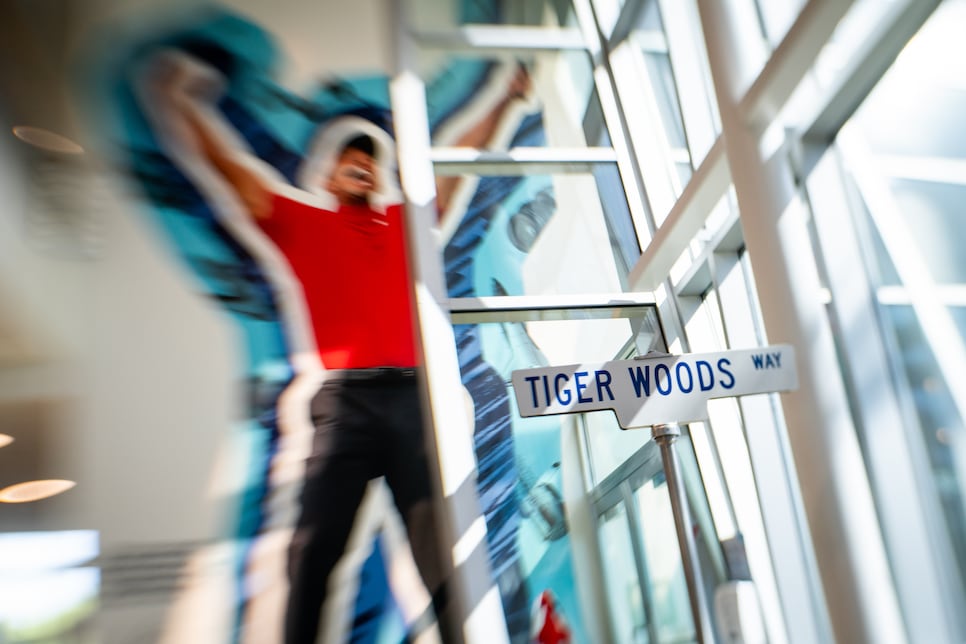
A large mural of Tiger Woods greets students in the TGR Learning Lab lobby.
Justin L. Stewart
That would be a reasonable assumption even if you only stood in the lobby. A massive mural of Woods throwing up his arms in celebration covers one wall. Just inside the doors is a life-sized statue of Tiger and Earl, the golfer’s arm draped around his dad’s shoulder. Further into the foyer is a large glass case celebrating the accomplishments in Woods’ 82-win PGA Tour career.
Beyond that, Woods’ presence is non-existent, and that’s perfectly fitting for the elementary students of today. “Some of them walk in and ask, ‘Who is that?” Bell said with a smile. “I say, ‘Well, that’s Tiger.’” The fifth-graders now are the Class of 2033 and they were only 3 when Woods won his last major in the 2019 Masters. For many, golf has zero presence in their lives.
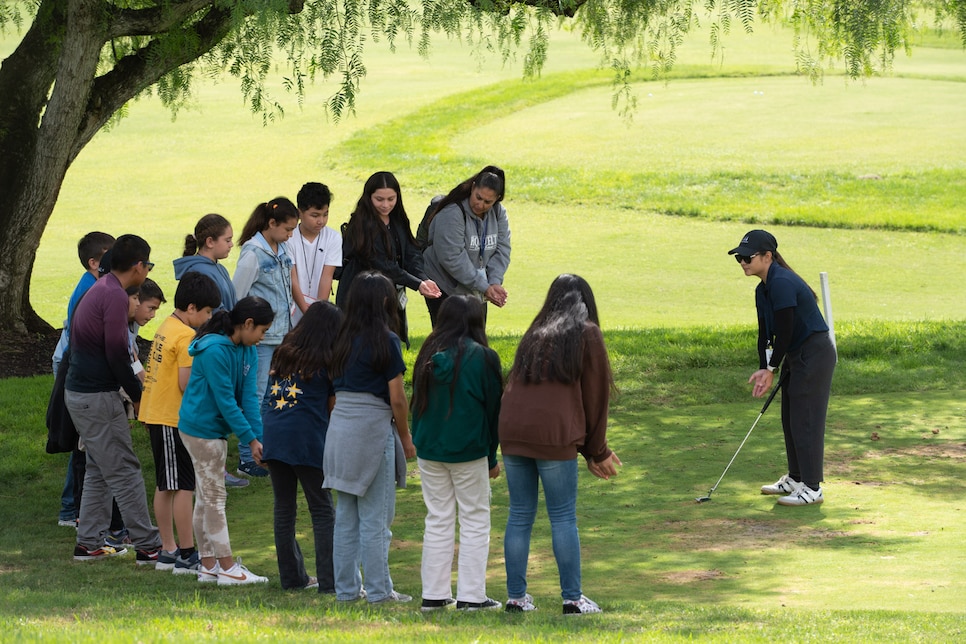
The Anaheim Lab has classes in “Golfology” and hosts clinics on weekends. TGR Learning Lab photo
That is not the case for the older students or Lab staff, and there’s a giddy excitement when Woods, who attends most board meetings via video, pays an occasional visit to the site. A few lucky kids get some golf tips from the 15-time major winner, but everybody knows what Woods would rather do: observe what the students are doing in the classroom and soak up the lessons just as they do.
“Seeing them light up as they experience something new, often something they wouldn’t have otherwise had the opportunity to do, is incredibly rewarding,” Woods, the father of two, said in his email response.
“He’s in his environment,” Hamalian said. “He’s at his best with kids, and he just loves being around them, seeing what they’re interested in. And he’s effusive about it. I don’t know how many people fully understand this, but his family’s values of sharing, caring, giving back—those were embedded very early.”
Last, but hardly least is ensuring that Tiger gets time to compete against the kids in video games.
“Bottom line, he’s a kid,” Bell said, laughing.
Woods leaves all of the day-to-day operations to the professionals he’s had a hand in hiring over the years. He has been immeasurably supported by the work and commitment of so many in recreating exactly the love and support he got in that modest house in Cypress he grew up in. He was on-site for last year’s opening ceremonies of the Philadelphia Learning Lab. A student named Fahtima shared the results gathered from her peers about the top words used to describe the Lab.
“Of all the great adjectives used,” Woods wrote by email, “the most common word was ‘home.’ That really is what it’s all about.”
This article was originally published on golfdigest.com